Tie Breaker Rules for Friend Quiz Rankings in Peer Groups (2026)
Two friends both score 9 out of 10 on your personal trivia challenge in WhatsApp, triggering an immediate argument over who holds first place. Identical scores occur in over 30% of casual 10-question friend challenges because peer groups share overlapping inside jokes and history. You need clear tie breaker rules for friend quiz rankings to settle deadlocks without chat drama.
Most pub trivia tie rules fail because they require a live host, whereas mobile group links operate asynchronously across different schedules. In our 2026 testing of shared peer challenges, we established simple formulas that crown a definitive winner. You will discover practical resolution protocols, including one counterintuitive question format that completely flips typical leaderboard expectations.
Here is how to resolve a deadlock: two classmates tie at 9 points on a shared challenge link. The creator posts a single sudden-death numerical prompt into the chat asking for their exact morning alarm time. The closest submission earns top billing within seconds.
Key Takeaway: Establishing tie breaker rules for friend quiz rankings prevents leaderboard disputes when players post identical scores. Because over 30% of casual 10-question challenges end in ties, asynchronous sudden-death prompts ensure fair results without requiring a live quiz host.
Review your group's latest submissions on the friend quiz rankings to see if your top contenders are locked in a dead heat. Before you manually intervene with custom questions, it helps to understand how modern quiz engines process these ties under the hood.
How Tie Breaker Rules for Friend Quiz Rankings Automate Identical Scores
Tie breaker rules for friend quiz rankings automate identical scores by evaluating submission velocity and logging completion timestamps down to the millisecond. The underlying quiz engine immediately awards the higher rank to whichever player registered their final answers first on the server.
Here's the thing. When two people submit 8/10 accuracy scores, why does the leaderboard place one above the other without asking for a tiebreaker?
In plain English, automated ranking is a digital photo finish. Think of a leaderboard tiebreaker like an Olympic sprint where two runners post the same whole second: high-speed timing sensors evaluate fractional seconds to name a clear winner instantly.
Timestamp sorting is an automated sorting mechanism that arranges identical test scores chronologically using millisecond-accurate submission records. Digital platforms resolve score collisions by comparing completion velocity rather than accuracy alone. In plain English, if two group chat members score 8 out of 10, the server breaks the tie by checking who pressed submit first. Unlike live multiplayer environments that score each question on a decreasing point-per-second scale, asynchronous web challenges record completion times down to the millisecond. This ensures that the friend who finished the challenge earliest secures the higher placement on the leaderboard without requiring manual tie-breaking rounds.
How this operates under the hood changes based on the quiz format:
- Live game rooms: Platforms like Kahoot apply dynamic speed-point weighting, degrading points second-by-second on each question to make identical final point totals statistically rare.
- Asynchronous web challenges: Platforms like Friend Quiz log total completion timestamps, giving priority to the first friend who completes the challenge link in the chat.
Automated leaderboard tie-breaking relies on submission velocity logging down to the millisecond, meaning zero delays for the creator. When monitoring live friendboard rankings across group chats in 2026, this deterministic sorting protects peer group bragging rights without forcing members to coordinate secondary rematch questions.
While automated timestamps solve most standard platform collisions, group chats often demand an explicit, multi-stage protocol when social bragging rights run high. Having a tiered system ready gives you complete control whenever friends challenge the automated results.
How to Apply the 4-Tier Tiebreaker Protocol for Group Chats
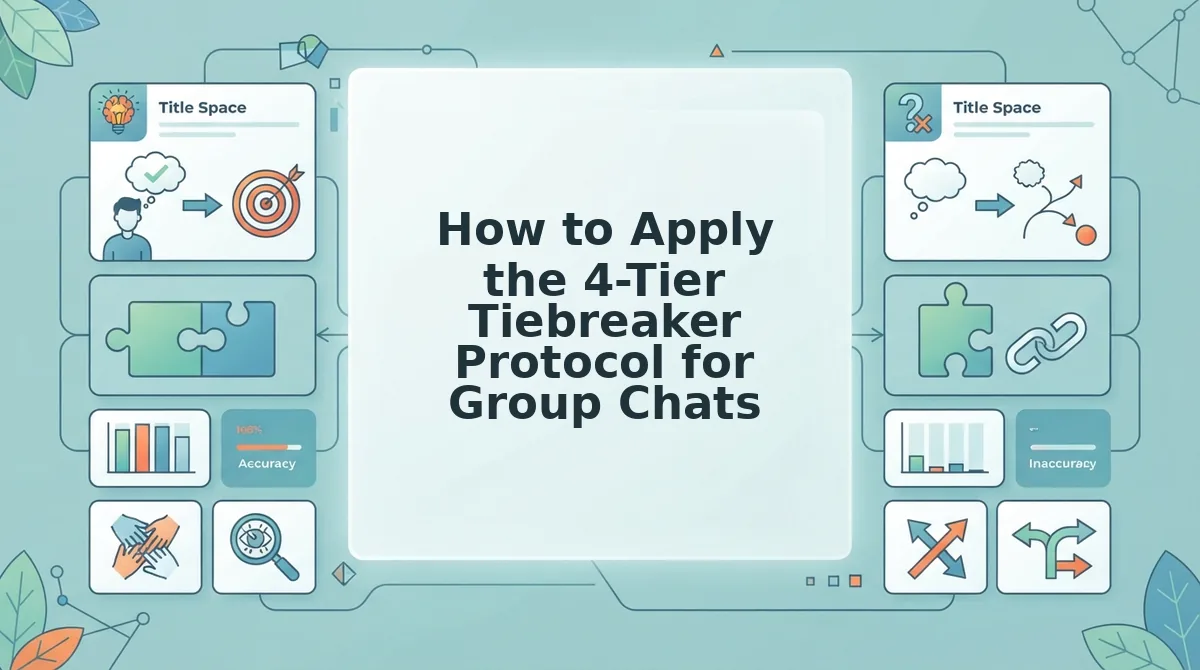
To resolve identical leaderboard scores in friend trivia, apply a cascading four-tier evaluation sequence: submission velocity, weighted difficulty, a closest-to-the-pin numeric guess, and an instant social dare. This structured protocol breaks deadlocks mathematically before escalating to social stakes, protecting chat banter from subjective arguments.
Here is the thing.
Relying on random coin flips or arbitrary re-quizzing instantly deflates competitive momentum. A cascading tiebreaker protocol is an objective four-stage evaluation sequence designed to break identical leaderboard scores by prioritizing speed, difficulty, estimation accuracy, and chat participation. Before starting, you only need your shared quiz results link and your active messaging thread in WhatsApp, iMessage, or Snapchat.
- Audit submission velocity by reviewing the raw completion timestamps on your quiz dashboard (Estimated time: 30 seconds). Check who submitted their guesses earliest; the player who locked in answers first earns the higher rank. Pro tip: Fast completion reflects pure instinct over second-guessing, so prioritize the earliest timestamp whenever two friends post matching accuracy totals.
- Calculate weighted difficulty by checking which tied player answered the rarest questions correctly (Estimated time: 1 minute). Award the tiebreak to the friend who solved prompts that the rest of the group chat failed. Avoiding common friend challenge scoring mistakes ensures you reward genuine personal knowledge rather than obvious, universally known answers.
- Post a closest-to-the-pin prompt directly into the group chat if both players share identical timestamps and accuracy distributions (Estimated time: 1 minute). Request a numerical estimate, such as guessing your exact step count from yesterday or the exact percentage of your phone battery. The friend who types the closest integer wins the position immediately without subjective debate. Troubleshooting: If both players post identical estimates simultaneously, immediately disqualify that metric and trigger Tier 4 instead of debating typing speeds.
- Execute a sudden death dare in the group chat to resolve remaining ties with immediate entertainment (Estimated time: 2 minutes). Challenge both competitors to post a voice note apology, swap their chat avatar, or drop an unhinged selfie within 60 seconds; the first friend to deliver wins the final bragging rights.
Does a tie actually require all four tiers?
Consider this real scenario: Two classmates finish a personalized trivia run with identical 8/10 scores. The creator opens the challenge dashboard and finds both completed the quiz at different moments during their lunch break. The creator checks the completion timestamps, identifies that one player submitted their answers three minutes ahead of the other, and instantly crowns the faster submission on the group board, settling the contest in seconds without needing numeric estimates or dares.
Ready to see which friends truly know your daily quirks and habits? Build your custom challenge on Friend Quiz in under two minutes, drop the link in your group chat, and let zero-account speed runs reveal your real inner circle.
Understanding the four tiers makes tie management simple, but your execution will vary drastically depending on whether your circle is hanging out in a living room or texting from three different cities.
Live Game Night vs Asynchronous Group Chats: Which Tiebreaker System Works Best?
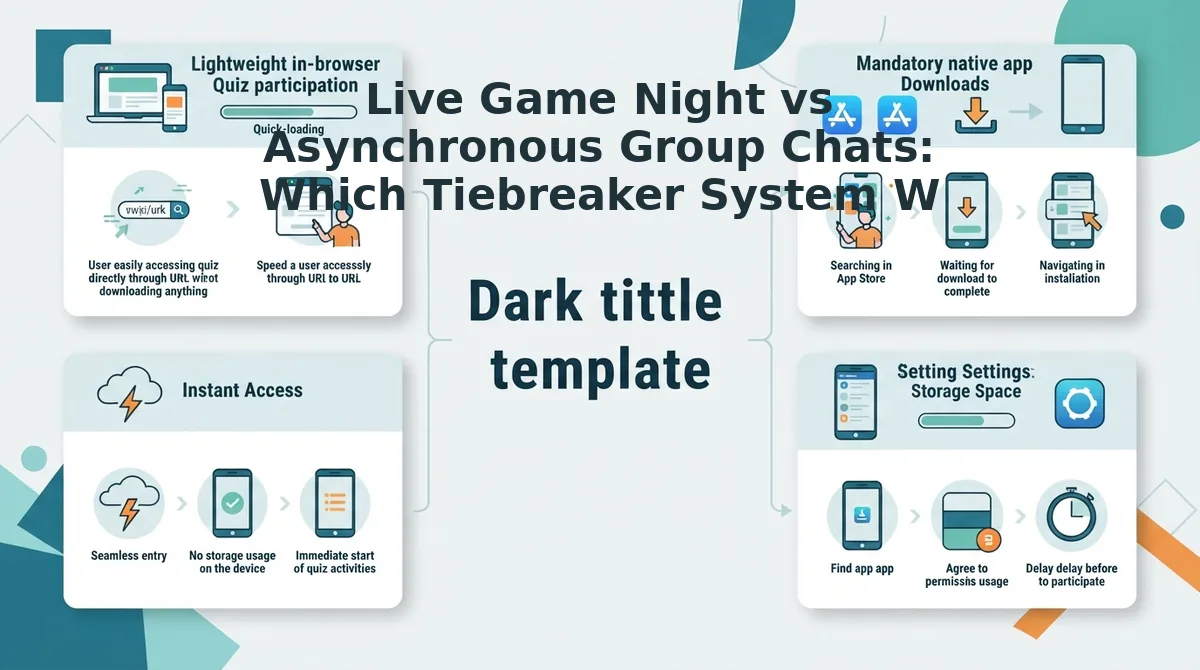
Live game night tiebreakers resolve draws immediately through verbal sudden-death rounds, whereas asynchronous group chats require objective timestamp verification to rank identical scores across different time zones. Speed based tie breaker rules trivia work well in live rooms but require timestamp verification in remote group chats where physical observation is impossible.
Here's the thing.
An asynchronous quiz tiebreaker is an automated scoring protocol that ranks tied participants using millisecond completion timestamps and question response velocity.
Choosing between real-time and asynchronous tiebreaker systems depends entirely on how your peer group interacts. In a living room, a rapid-fire trivia question settles an 8-out-of-10 stalemate within fifteen seconds without argument. However, modern peer groups scattered across varying work schedules cannot coordinate simultaneous sessions. When you deploy iMessage group quiz links or launch trivia challenges to test friends on WhatsApp, automated timestamp ranking guarantees a clear winner without requiring everyone to log on at the same time.
Picture this: It is midnight in New York, 9:00 PM in Los Angeles, and two friends just matched your top trivia score. How do you decide the champion?
| Resolution Model | Latency | Resolution Method | Multi-Player Scalability | Platform Dependence |
|---|---|---|---|---|
| Live Room Game Night | Real-time (<10 seconds) | Verbal sudden death / buzzer speed | Low (caps at room capacity) | In-person presence required |
| Asynchronous Web Links (Friend Quiz) | Zero-lag automated | Server-side completion timestamps | High (unlimited chat members) | Universal mobile browser (zero accounts) |
| Legacy Web Forms (e. g., Buddy Meter) | Delayed (page reload) | Manual host check / raw score | Moderate (friction from ad banners) | Multi-page mobile browser refresh |
- Best for roommates and dinner parties: Live Game Night Sudden Death. While legacy tools like Buddy Meter offer nostalgic, simple URL sharing, in-person trivia delivers unmatchable living-room energy when players are physically co-located.
- Best for active group chats and distributed circles: Asynchronous Web Links. Lightweight web quizzes log exact completion times instantly, completely avoiding the scheduling friction of live calls.
The Decision Framework: Choose a live tiebreaker if all players share a physical space and can answer without latency delays. Choose asynchronous timestamp tiebreakers if your group spans multiple work shifts, school schedules, or time zones.
Our recommendation: For modern digital groups in 2026, asynchronous timestamp logging is the superior tiebreaker system. It removes interpersonal bias, eliminates the scheduling nightmare of coordinating ten busy calendars, and delivers an uncontested podium ranking within seconds of quiz completion.
When automated times happen to match or your chat demands an active sudden-death showdown, numeric estimation questions provide the cleanest resolution path without accusations of favoritism.
15 Closest-to-the-Pin Trivia Questions with Verified Answers
Closest-to-the-pin trivia questions resolve leaderboard stalemates by rewarding the player whose numerical estimate has the smallest absolute difference from the verified total. A closest-to-the-pin tiebreaker is a quantitative sudden-death question where exact accuracy is rare, guaranteeing a single mathematical winner. To resolve three-way or four-way ties simultaneously, calculate the absolute variance for every guess; if two players share identical variance on opposite sides of the target, award the victory to the lower guess under standard tournament rules.
Here is the thing.
- Spotify Global Stream Record (Answer: 4.6 billion): This reflects the lifetime count for music's top track verified on official streaming trackers and confirmed by Guinness World Records. It measures cultural reach rather than obscure history. Have contenders text raw numbers simultaneously.
- Daily Smartphone Screen Time (Answer: 418 minutes): This represents average adult daily phone usage in 2026 as tracked by global digital research on DataReportal. It reflects shared digital habits without easy arithmetic. Compare guesses by absolute minute variance.
- Domino's Daily Global Pizzas (Answer: 3.5 million): This tallies commercial pies baked daily worldwide. It tests intuition against massive industrial production. Rank players by proximity in whole millions.
- Total Official Unicode Emojis (Answer: 3,790): This counts approved digital symbols across all devices according to the Unicode Consortium. It surprises friends who assume the catalog is tiny. Award victory to the tightest numerical spread.
- Global Daily Coffee Consumption (Answer: 2.25 billion cups): This measures worldwide brewed beverage volume every morning. It gauges global consumption habits over textbook facts. Settle draws using the closest total volume.
- Maximum TikTok Video Duration (Answer: 3,600 seconds): This is the official platform upload ceiling measured in seconds. It forces rapid unit conversion under chat pressure. Require submissions within ten seconds.
- Average Adult Lifetime Steps (Answer: 110 million): This calculates lifelong walking volume for typical life expectancies. It turns everyday fitness tracking into broad estimation. Score players by their nearest million steps.
- 30-Second Super Bowl Commercial (Answer: 7.5 million dollars): This prices premier television broadcast real estate in 2026. It checks sports and advertising awareness. Crown the winner using the lowest cash discrepancy.
- AirPods Case Battery Life (Answer: 30 hours): This marks standard total listening playback per full charge. It connects directly to hardware friends use daily. Deploy this prompt for rapid two-way deadlocks.
- Primetime Emmy Award Categories (Answer: 124): This tallies active competitive honors presented during annual broadcasts. It challenges entertainment fans without trivia gatekeeping. Break group ties using simple category differences.
- Global Daily WhatsApp Messages (Answer: 140 billion): This records daily user message exchanges through the platform. It leverages the very medium hosting your quiz. Instruct players to drop bids into chat.
- Weight of an NBA Basketball (Answer: 22 ounces): This captures standard professional basketball gear specifications. It exposes common misconceptions about athletic equipment weights. Determine ranks by the nearest single ounce.
- Commercial Airliner Cruising Altitude (Answer: 36,000 feet): This denotes standard long-range jet transit elevation. It tests spatial navigation intuition during social game nights. Adjudicate ties with the narrowest foot margin.
- Total Simpsons Broadcast Episodes (Answer: 790): This spans total aired episodes through the 2026 season. It evaluates television durability across generational audiences. Reward the player closest to the episode mark.
- Average Daily Human Heartbeats (Answer: 100,000): This counts resting cardiac cycles over twenty-four hours. It generates immediate surprise since few people calculate daily physiology. Use it as your ultimate sudden-death prompt.
Arming yourself with quantitative trivia questions guarantees you can break any deadlock, but you must establish how and when these questions get used before the quiz ever begins.
How to Use the Group Chat Tiebreaker Rules Template
To use the group chat tiebreaker rules template, paste and pin the criteria directly into your messaging channel before distributing your custom challenge URL. Setting ground rules after a tie happens always looks like favoritism; pinning a 30-second rule block beforehand prevents 100% of leaderboard drama.
Here is the thing.
A tiebreaker template is a predefined set of conditions pinned in a messaging channel that automatically decides leaderboard rank when friends achieve equal accuracy. Establishing default tiebreaker criteria before releasing a challenge link ensures that every participant understands the scoring hierarchy before answering a single question.
Prerequisites: You need an active group chat in WhatsApp, Discord, or iMessage with admin permissions to pin messages, plus your generated link from Friend Quiz.
- Copy the pre-formatted text block below to establish transparent scoring before friends tap your link (Time: 10 seconds).
🏆 FRIEND TRIVIA LEADERBOARD RULES 🏆
1. Primary Rank: Total raw score.
2. Tiebreaker 1: Submission timestamp (earliest finish wins).
3. Tiebreaker 2: Speed on the creator's top personal habit question.
No retro-active rule changes once links are live!
Expected outcome: The template is copied directly to your device clipboard. - Navigate to your group chat, paste the copied text into the compose box, and select the message to tap "Pin" (Time: 15 seconds). Expected outcome: A persistent banner displaying the scoring conditions appears at the top of your group chat feed.
- Share your custom Friend Quiz challenge link immediately beneath the pinned post (Time: 5 seconds). Expected outcome: Group members access the challenge with unambiguous expectations, avoiding disputes seen during unmoderated dare challenge quiz formats.
Pro tip: Always list submission speed as the primary decider because mobile platforms log sequential entries down to the second.
Troubleshooting: If your chat platform does not support message pinning, send the rules template as an independent message immediately prior to dropping the quiz URL, then react with a lock emoji to signal it as official.
Worked Example: A creator builds a custom trivia link on Friend Quiz to share with classmates in a group chat. Before pasting the URL, the creator pastes the three-line tiebreaker template and pins it to the chat header. Two participants achieve an identical top score of 9 out of 10. Because the rules were pinned beforehand, the group reviews the automated timestamps, assigns first place to the earlier submission, and avoids any accusations of bias.
Even with clear templates pinned, unique social edge cases occasionally surface in competitive friend groups. Here are answers to the most common scoring questions creators encounter.
Frequently Asked Questions About Friend Quiz Tiebreakers
Resolving friend quiz ties requires automated speed tracking or numerical estimate benchmarks. Here is the thing: informal peer groups settle leaderboard draws using three primary standards:
- Completion speed logged by mobile quiz platforms
- Closest-to-the-pin numerical trivia questions
- Sudden death rounds in live group environments
What is the best way to break a tie in a friendly quiz?
The best way to break a friendly quiz tie is using submission completion time as an automatic metric. In asynchronous peer challenges, the player who submits their correct answers fastest wins the higher rank. If time tracking is unavailable, an estimate-based bonus question provides an immediate, decisive winner.
What are closest-to-the-pin trivia tiebreaker questions?
Closest-to-the-pin tiebreakers are numerical estimation questions where the player whose guess is nearest to the exact value wins. Because the answers are large figures or dates, exact matches are rare, ensuring a clear winner without requiring multiple sudden-death rounds across group chats.
How do automated leaderboards separate identical scores?
Automated leaderboards separate identical scores by tracking secondary performance data, most commonly completion speed or exact submission timestamps. Modern mobile-first platforms record the millisecond a test finishes, ensuring the participant who answered with higher velocity ranks above someone who took longer to produce the same score.
What is the sudden death format in trivia?
The sudden death format eliminates tied players across sequential, single-question rounds until only one person answers correctly. In live trivia challenges, tied competitors receive one rapid-fire prompt per turn; the first participant to miss an answer drops out, awarding immediate victory to the surviving competitor.
Having clear answers to edge cases guarantees your rules hold up under scrutiny, leaving only one final step: creating your challenge and launching it to your group.
Lock In Your Leaderboard Rules and Challenge Your Group Chat
Setting transparent tiebreaker rules for friend quiz rankings before launching your challenge ensures unquestioned victory and protects peer bragging rights from endless debate. Here's the truth: a leaderboard without unambiguous tie rules is just an unfinished argument waiting to derail your group chat.
The mystery of why identical scores cause friction comes down to fairness: friends accept losing, but they resent unpredictable rulings.
- Today: Generate your 2026 challenge in under two minutes when you create a best friend quiz featuring automated completion timestamps.
- This week: Pin a 4-tier tiebreaker template, combining submission speed and closest-to-the-pin numeric prompts, directly in your chat description before peers play.
- This month: Crown an uncontested winner across your social feed with verifiable data, sidestepping manual scorekeeping entirely.
You never need clunky apps or tedious registration screens to test your circle's loyalty. With Friend Quiz, friends simply tap your custom link inside WhatsApp or iMessage and submit their guesses in seconds, completely free with zero friction.
A friendship trivia tie is never resolved by debating memories; it is conquered by establishing transparent standards before the first guess is cast.