Friendboard vs Global Leaderboard for Group Chat Engagement

A friendboard beats a global leaderboard for group chat engagement â with one condition you can't skip. That verdict has nothing to do with features. It's about board size: how many people can see your score, and how many of them care. Most leaderboard tools are vendor demos that sell you a ranking without ever asking how big the board should be, so the actual question â does a smaller board engage more? â goes unanswered on nearly every feature page.
You already have the group chat. You already have a quiz. What you don't have is a reason for anyone to play twice.
This comparison breaks the friendboard vs global leaderboard engagement question down by board size instead of board features. You'll get the five criteria that actually change behavior, a plain definition of a friendboard, and the four-beat replay loop that keeps a chat alive. One finding you probably won't expect: the weakest point in the cycle isn't the scoring â it's the share step, and a global list breaks right there.
No benchmark exists for this comparison, so nothing here quotes one. The argument is structural, and you can check it against your own group chat in about a minute.
Friend Quiz builds the smaller kind of board by default: you type your name, answer personal prompts, and get a shareable link that drops straight into WhatsApp or iMessage with no download and no login.
What Should You Compare Before You Pick a Board?
Compare five things: who is ranked, how close the next rank sits, what sharing a score accomplishes, how long the board lives, and what a guest gives up to enter. For a group chat quiz, yes, a friend-only board wins â with one condition: the group has to be small enough that last place still means something.
Only two of those five criteria differ between products. Rank distance, share value, and lifespan are decided by board size, not by the tool â which means board size is the lever you actually control.
| Criterion | Friendboard | Global leaderboard |
|---|---|---|
| Who is ranked | People who were invited and know you | Strangers, sorted by raw score |
| Rank distance | Short â often one or two points | Long â top scores pull away fast |
| Share value | High â the result means something to the reader | Low â nobody recognizes the name |
| Lifespan | As long as the chat stays active | Permanent and continuously buried |
| Entry friction | A link tap, no account | Often a signup before you appear |
Who is ranked is the deciding row. A global list is genuinely good at scale: it gives a product-wide sense of prestige, it rewards the top handful honestly, and it never needs moderating. If your goal is a public high-score table for thousands of players, a global board is the correct choice.
Best for group chat instigators: a friendboard, because the score is aimed at people who know you. Best for public challenges and open competitions: a global leaderboard, because reach is the point.
A friend-only leaderboard is a ranking limited to the people you invited, so every score carries social weight: someone you know is above you, and you can name them. That single constraint â an audience of acquaintances rather than strangers â is what turns a score into a conversation, because the result is only interesting to people who can place the name.
Pick the board whose audience can name you. Friend Quiz generates that link in one pass, so the invite list and the rankings are the same list.
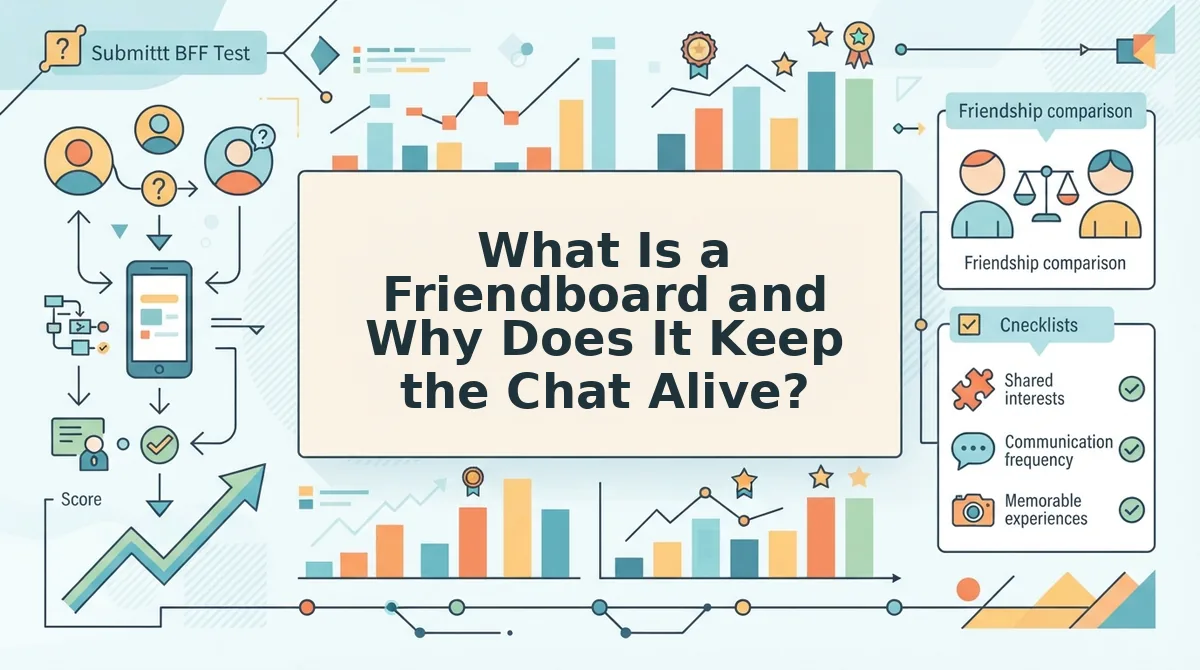
What Is a Friendboard and Why Does It Keep the Chat Alive?
A friendboard is a leaderboard limited to the people who were invited, so every rank sits next to a name the reader recognizes.
That definition matters because a ranking is only as motivating as the audience it points at. Think of it like a pickup basketball game versus a stadium tryout: in the pickup game you know exactly who beat you and you want the rematch tomorrow; in the tryout you are one anonymous number in a crowd, and you go home.
The mechanic competitors rarely spell out is social cost. Because every entrant was invited, last place is expensive and first place is worth screenshotting. A global list has neither pressure â finishing 8,412th costs nothing, and finishing first earns applause from people who can't place your name.
That asymmetry is why friends retake a quiz and strangers don't. The second attempt is aimed at someone specific â the friend who beat you by one point â not at the list. A friendship test or a friendship dare quiz both work on the same engine: the retake is a message to a person.
Walk the replay loop in four beats. First, the creator shares the link. Second, friends answer and a ranking appears. Third, someone screenshots a result and posts it back into the chat as banter. Fourth, a loser demands a rematch and reopens the quiz.
Beat three is where a global board dies. A good score means nothing to people who don't know you, so there is no screenshot, no banter, and no rematch â the loop stops one step short of the reason anyone played.
Where does a global leaderboard actually win?
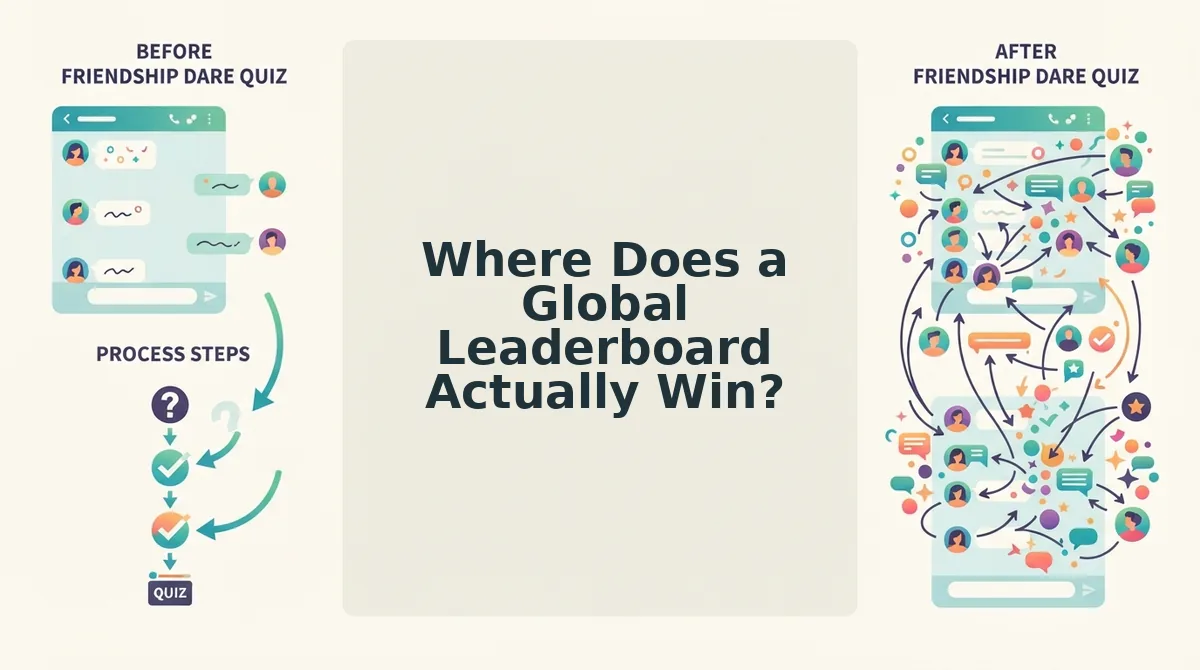
Where Does a Global Leaderboard Actually Win?
A global leaderboard wins whenever competition is the point rather than the conversation â open contests, seasonal challenges, and formats where being ranked against strangers is the entertainment itself. It is the weaker choice only when keeping a specific group chat alive is the goal.
Three things a global board does genuinely better: it persists across months instead of resetting with each new quiz, it scales past the edge of your contact list, and it creates long-tail competition against players you will never meet.
| Dimension | Friendboard | Global leaderboard |
|---|---|---|
| Field size | Roughly 5â15 people who actually know you | Anyone who opens the link, unbounded |
| What rank means | Standing among people with social context | Standing among strangers, often far below the top ten |
| What drives a retake | Banter and rematch pressure in the chat | Climbing toward a visible next rank |
| Persistence | Resets with each new quiz | Accumulates across seasons |
| Share step | A score worth screenshotting to friends | A score competing with every other stranger's |
The unresolved question in almost every leaderboard demo is whether anyone outside the top ten is actually motivated. Structural reasoning says no, and the mechanism is rank distance: motivation tracks the gap to the next rank, not the size of the field. A player who is 4,000 places from the next slot has nothing actionable to chase.
There is also an identity breakpoint. A display name buried in a stranger's list carries no social cost, so there is no reason to try harder next round. Your group chat is the opposite â your name is attached to your score in front of people you will see tomorrow.
That produces three breakpoints where global boards fail a group chat: rank distance collapses, the share step dies because there is nothing to brag about to people who were not there, and identity stakes vanish.
Best for the solo grinder chasing a season-long ranking against an open field. Best for the group chat instigator who wants twelve people arguing about who actually knows them â that is the friendboard, and the live rankings sit at live friendboard rankings.
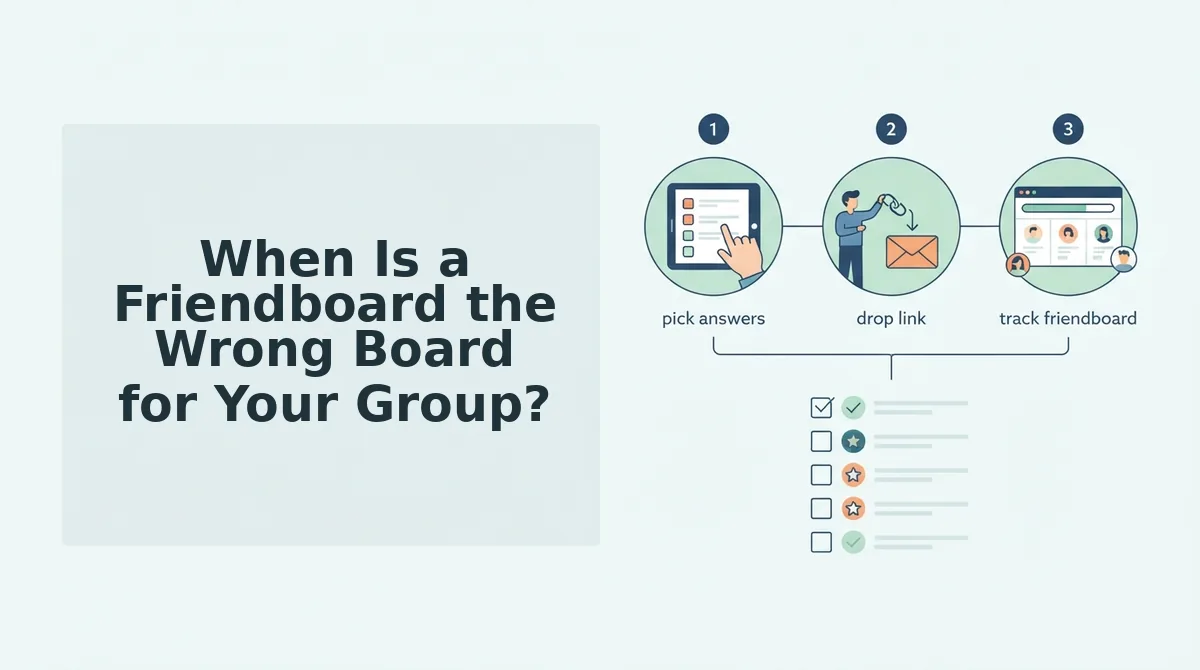
When Is a Friendboard the Wrong Board for Your Group?
A friendboard is the wrong board in three situations: the crowd has outgrown the people who actually know the quiz creator, the invite circle never shows up, and the questions are too thin to produce a score worth arguing about.
- The crowd is bigger than the people who know you. A friendboard assumes most players have real context on the quiz creator. Once the audience is mostly acquaintances, scores become guesses and the banter thins â move to a social ring or split into smaller boards.
- The invite circle still has to show up. No board format fixes an invitation nobody answers. Post the link once in the thread, tag two people by name, and let the first score pull the rest in rather than re-posting into silence.
- Scores only mean as much as the questions. Weak prompts produce clustered scores and no argument, which kills the rematch. Write questions with genuinely lopsided answers â habits, quirks, strong dislikes â so the spread is wide enough to be funny.
How Many People Should Be on the Board?
| Board tier | Rough size | What it rewards best |
|---|---|---|
| Peer board | 5â15 people who know you | Banter and rematches inside one chat |
| Social ring | Followers who half-know you | Reach and low-stakes public bragging |
| Global list | Strangers, unbounded | Long-running competition and contests |
Those ranges are reasoned, not benchmarked â treat them as a starting point to test against your own group.
Which Board Fits Your Group?
| Group size | Goal | Result should be | Board |
|---|---|---|---|
| Under ~15 | Keep one chat talking | Private | Peer friendboard |
| 15â50 | Reach and resharing | Semi-public | Social ring, or split into peer boards |
| Open-ended | Season-long competition | Public | Global list |
If you land in the top row, the workflow is short: create the quiz with your name, share the generated link in the group chat, and let friends answer in their mobile browsers while the board fills in.
What Else Do People Ask About Friendboards and Quiz Links?
Does a group chat quiz need a leaderboard at all?
No. A quiz works with no board if the fun is comparing answers in the thread itself. A board adds a reason to come back for a second round by turning separate scores into shared standings, which is what makes a rematch feel worth arranging.
What other group chat quiz ideas keep a chat going?
Rotate the format, not just the questions. A round of BFF test prompts, a guess-the-photo set, or a fresh best friend quiz hosted by a different person each week keeps the set surprising. Question-set variety is the usual reason chat quizzes fizzle after one round.
Does a who-knows-me-best board still work past twenty friends?
Weakly. Past roughly a dozen players a peer board starts behaving like a small global list, because the bottom half can no longer see a reachable next rank. Past twenty friends, split the group or switch to a wider board rather than watch participation slide.
Do friends see each other's answers or only the rank?
On a friendboard the visible artifact is the rank, not the answers. Friends see where they placed, not what anyone selected, which is why quieter members of a chat still play. Say so in the invite message â it removes the hesitation.
So which leaderboard should your group chat actually use? That depends on what you are optimising for.
So Which Leaderboard Should Your Group Chat Use?
Friends beat strangers wherever the conversation is the reward. That makes the friendboard the default and the global list the deliberate exception.
Match the board to the room, not to the feature list:
- Everyone in the chat knows you â friendboard. The scores start arguments, and the arguments restart the quiz.
- Half close friends, half acquaintances â friendboard for the core, global list for the outer ring.
- An open contest with people you may never meet â global leaderboard, which is the one job it does better.
That settles what the whole comparison kept circling: the question was never which board engages more, but which board fits the people who actually care.
If you are still torn, skim the matrix once more â then create a best friend quiz and drop the link into the chat that has gone quiet. One link, no downloads, no accounts.
A leaderboard is not a ranking â it is a short list of people who will care about the score, so keep it short enough that everyone on it would text you anyway.