How to spark a rivalry on a friendship test leaderboard
Your quiz link got answered. The Friendboard filled in. Then the group chat went quiet for three days straight.
That silence is common, and it doesn't mean your friends got bored of you. A friendship test leaderboard rivalry needs a loop, not a single ranking â one round produces a score, but nothing produces a second round unless somebody builds the habit. You already own the only asset it takes. A Friendboard is the live scoreboard on your quiz link showing who ranked where among everyone who answered, and it keeps updating as long as you feed it rounds.
This is how to start a friendship test rivalry that outlives the first ranking: the three touches that reopen a dead chat, the gap rules that stop the board from freezing, and the referee calls to settle before anyone plays. The whole loop needs three free things â a completed round, at least two people on the Friendboard, and one person willing to post a screenshot. That screenshot does more work than any score message, and the reason is the part most group chats never work out.
Start with a friendship test you can send as a plain link â no app, no login, and the Friendboard fills in as answers land.
How do you start a friendship test leaderboard rivalry in three touches?
Starting a friendship test leaderboard rivalry takes three touches: post a screenshot of the Friendboard, stake a one-line claim in the chat, then set a 48-hour window for the rematch link to be answered. Each touch takes under a minute and needs nothing beyond the quiz link you already have.
Before you start, confirm you have a completed round, at least two names on the Friendboard, and the link to the original quiz. The best friend quiz you already shared covers all three.
- Open the quiz link and screenshot the Friendboard (about 30 seconds). Capture the full ranking on your phone, then drop the image in the group chat with no caption beyond "round one." You should see replies within minutes, usually from whoever got placed lower than they expected.
- Type one sentence naming the placement you think is wrong (about 10 seconds). Say which rank you'd swap and why â a specific answer they got wrong, not a general complaint. You should get a defence back, which is the actual point: the reply is the rivalry.
- Generate a rematch link and post it with a 48-hour deadline (about one minute). Paste the new link under a line that says answers close Thursday night. You should see the Friendboard fill before the deadline passes, because a visible cutoff gives people a reason to answer today instead of eventually.
A rematch is a fresh quiz link generated after a completed round, answered by the same group on the same Friendboard. That distinction matters: the rematch is what keeps one running scoreboard alive, while a brand-new quiz resets the group and loses the history that makes a rivalry feel like a season rather than a one-off.
| What you send | What it triggers |
|---|---|
| A Friendboard screenshot | A placement dispute and the first reply |
| A one-line claim about one wrong answer | Someone defending their reasoning |
| A rematch link with a deadline | A second completed round inside 48 hours |
| Your own losing screenshot plus a one-question challenge | A direct head-to-head between two players |
The screenshot carries the loop because it's evidence and an invitation in the same message. A bare score typed into the chat reads as bragging and gets ignored; an image of the board reads as a challenge and gets answered.
Say two players land two questions apart. Rather than arguing the gap, the lower player posts their own screenshot, adds a challenge on one specific question, and the deficit becomes the reason for round two instead of the end of the conversation. More angles for that second round live in these rematch ideas.
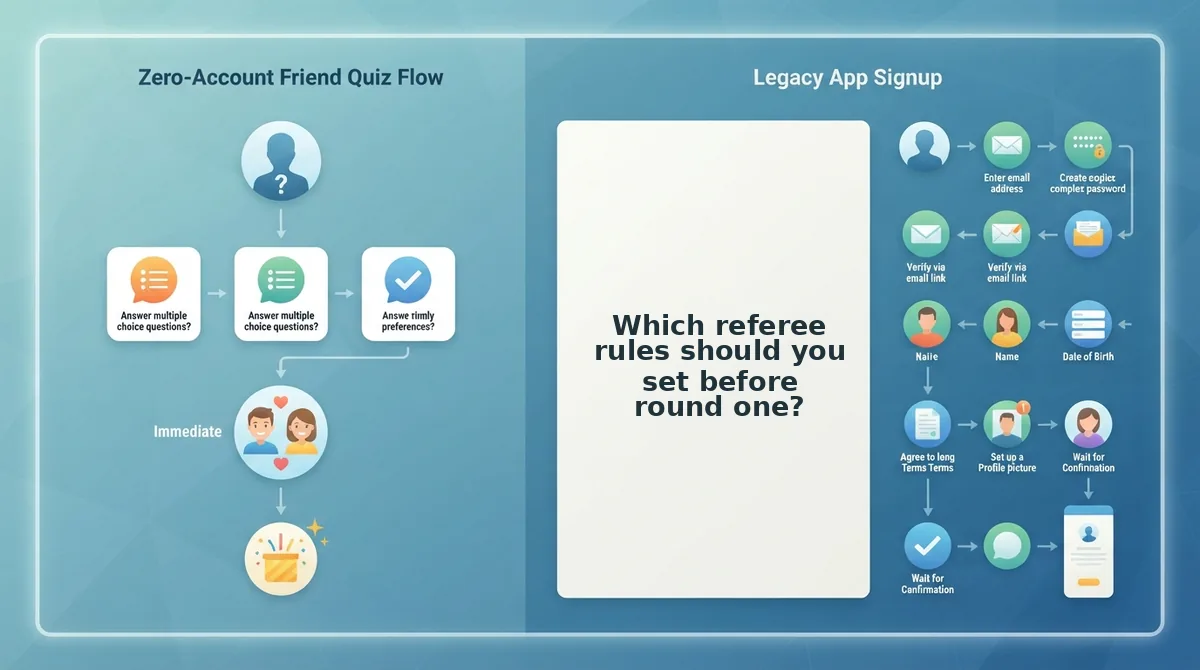
Create the quiz, share one link, and the Friendboard updates in real time as answers arrive â no downloads, no logins, nothing for your group to install before they can play.
Why do friendship test leaderboards go quiet after round one?
A friendship test leaderboard goes quiet because a completed round gives nobody a reason to return. A Friendboard is a ranked list of everyone who answered, ordered by how many of the creator's answers they guessed correctly â and once every answer is in, that list stops moving on its own.
Think of a pickup basketball game that ends at 21. Nobody scheduled the next one, so it doesn't happen, even though everyone had fun. Same mechanics here: the round closes, the chat moves on, and the board sits there like a scoreboard in an empty gym.
At the next level, the problem is the size of the gap. A rivalry stays fun only while two correct guesses could flip the outcome, so read a deficit in questions, not points. Two questions back is recoverable; eight is a verdict.
| Gap on the Friendboard | What it means | Move |
|---|---|---|
| Tied or one question apart | Still live | Post the screenshot, no handicap |
| Two or three questions apart | Needs a handicap | Creator answers last, or sits out a round |
| Four or more apart | Needs new prompts | Fresh quiz link with different questions |
Here's the contrarian part: everyone celebrates the leaderboard, but the leaderboard is exactly what stops moving once one friend runs away with it. For what an average-looking score actually signals, see what a good score looks like. Which referee rules should you set before round one?
Which referee rules should you set before round one?
Agree on four referee rules before anyone answers: how ties break, who answers when, how duplicate guesses count, and which topic is off-limits. The whole sheet takes under a minute to settle, and it decides whether the rivalry survives past round one.
- Agree the tiebreaker first. Post the rule beside the quiz link â sudden death on one extra prompt, or the earliest screenshot timestamp wins. A tie settled in seconds keeps momentum; a tie debated for an hour is the fastest way to kill the round, because the argument replaces the quiz as the event.
- Fix the answer order. The creator answers last, or their first-round score stands as the benchmark rather than a rival score. Either version cancels the edge that comes from writing prompts about your own habits.
- Agree on duplicate guesses. Decide up front whether two identical guesses both score or split the point. Duplicates are the most common scoring dispute in a group quiz, and a rule set in advance means nobody has to referee mid-round.
- Name one off-limits topic out loud. One stated boundary keeps trash talk playful instead of personal, and it is far cheaper than walking back a joke later. These banter mistakes are exactly what the rule protects the group from.
What is the fairest friendship quiz tiebreaker?
The fairest friendship quiz tiebreaker is the one agreed before round one, not invented after the scores land. A single sudden-death prompt works for most chats: both tied players answer one extra question, and whoever lands closer to the creator's real habit takes the round. If nobody wants a play-off, the timestamp on the first submitted screenshot decides it, rewarding the friend who showed up early rather than the one who argued hardest. Either rule exists to end the tie in seconds, so the group moves on to a rematch or a friendship dare quiz instead.
How do you know the rematch loop is actually working?
You know it is working when someone posts the screenshot before you ask, a new challenge gets answered inside the 48-hour window, and the score gap narrows in questions. Replies slowing after round two and a tiebreaker renegotiated mid-round are the signals pointing the other way.
| Signal | Healthy | Warning |
|---|---|---|
| Who brings it up | A friend posts the screenshot first | Only the leader talks about scores |
| Reply speed | Answers land inside 48 hours | Replies slow after round two |
| Score gap | Narrows to a question or two | Widens, and the trash talk stops |
Best for a chat that just finished round one: watch the 48-hour window. Best for a group two rounds deep: watch the gap â that is the closest thing to an honest progress bar. Neither check needs an install; the BFF test link and the Friendboard do the measuring.
Balance matters here, because the Friendboard measures attention to small habits â a coffee order, a Monday mood, a song on repeat â not friendship quality. Groups that treat it as a memory test keep the loop light; groups that treat it as a verdict stop playing. For how a closed group score differs from public rankings, see group chat against global rankings. Churn sits between round two and round three, so set the cadence there instead of letting it drift.
What should you send when the chat goes quiet again?
Send the next quiz link, not a recap of the last one. The playbook stays small: three touches to get a quiz into the group, plus the referee sheet â tiebreaker, answer order, duplicate rule, one off-limits topic â that keeps scoring from becoming the argument.
Two ways back in. Still testing the water? Run a fresh friendship test with a lighter question set, because low stakes keep the quieter friends answering. Already mid-rivalry? Send a best friend test link the same day, while last round's scoreboard is still sitting in the chat.
Lock the rematch date where energy dips, usually between round two and round three â that is where most rivalries quietly stop. A quiet chat is rarely a missing friendship; it is a missing screenshot, and sending one is all it takes to find out.