Buddy Meter vs Friend Quiz answer privacy for group chats
Your thumb hovers over an answer on a friend's quiz, and the question arrives before the tap: will they see this?
That half-second hesitation is the search. Buddy Meter vs Friend Quiz answer privacy is a pre-signup anxiety question â you want to know who sees what you picked before you have created a quiz or joined anyone else's.
Short answer: on Friend Quiz, the creator sees your accuracy score and your Friendboard spot, not the options you tapped. Before you play anywhere, run this test:
Answer-visibility test â (1) does the creator see per-question picks, or only a total score? (2) is your result public on a board, or visible only to the creator? (3) does the quiz page load the correct answers into your browser before you answer?
Question three is the one nobody asks out loud. A third-party browser extension for Buddy Meter is published openly on GitHub, and it points at a different kind of exposure than a creator reading your picks. We come back to it below.
First, though, we split creator-side visibility from participant-side exposure, quote what Buddy Meter's own pages commit to, and show what a Friendboard actually publishes.
Can the quiz creator see the answers I picked?
No â on Friend Quiz, the creator sees a final accuracy score and a Friendboard placement, not the options you tapped. Answer privacy is the gap between what a quiz records on its server and what a creator can actually read back after the fact.
The confusion comes from treating one permission as if it covers two different things. Score visibility is a number: how many questions you got right. Pick visibility is the list of picks â which option you chose on question three, question four, question five.
Think of a teacher who posts grades next to student ID numbers instead of handing back marked test papers. The result is public; the reasoning behind it is not.
| Creator sees | Creator does not see |
|---|---|
| Your accuracy score, as a percentage of correct answers | The option you picked on any individual question |
| Your Friendboard placement and the name you entered | A list of picks in the order you tapped them |
| The running order of players, updated as friends play | Your answers mapped back to specific question numbers |
Three terms carry the rest of this article:
- Accuracy score is the percentage of the creator's questions you answered correctly, reported as a single number rather than a transcript.
- Friendboard placement is your rank among everyone who has played that quiz, displayed on the creator's board.
- Client-side answer exposure is when a quiz sends the correct answers to your browser before you finish, leaving them in the page instead of on a server.
In plain terms: the quiz maker sees a scoreboard, not a transcript. When you finish a Friend Quiz, your percentage and your name land on the creator's Friendboard, which ranks everyone who has played. The creator can see that you scored eight out of ten and that you sit second on the board. They cannot open a view showing that you chose the second option on question two and the fourth on question five. That is the list of picks, and it never reaches them.
If you want the full sequence of what a quiz records and when, what happens after you submit your guesses on a BFF test walks through it step by step
What Buddy Meter's own pages say about your answers
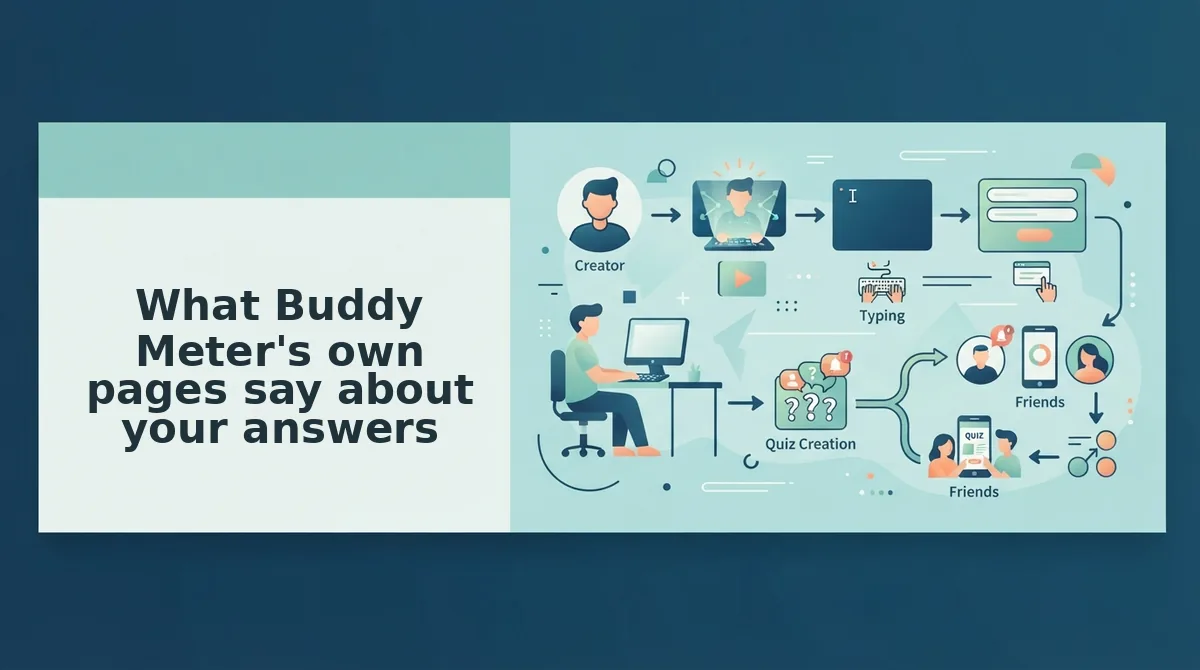
Buddy Meter's published pages explain how a quiz is created, played, and scored. They do not document a creator-facing log of which option each friend tapped â and that silence is the answer.
Buddy Meter is a browser-based friendship quiz platform where one person answers prompts about themselves and friends guess those answers.
What Buddy Meter's own pages say about answer visibility: they cover quiz creation, gameplay, and score display, and they stop there. No published statement confirms or denies that a creator can review individual question-by-question picks. The documented behavior is about the final result, not the raw answer sheet. That makes the honest position a narrow one â scoring and result sharing are described; per-question answer access is not. Treat any claim beyond that, in either direction, as unverified until you have read the wording yourself.
Think of a pub quiz scoreboard: it posts the final tally, not a photocopy of every answer sheet.
A scoreboard tells you the outcome. It never tells you what the quizmaster kept in the drawer â and those are two separate questions.
The artifact people usually cite here is buddymeter-cheater, a third-party browser extension published on GitHub by splitline, with 7,324 views on its associated video. Read it precisely:
- What it shows: quiz content reaches the participant's browser, where a client-side extension can read it.
- What it does not show: that a quiz creator ever sees which option you picked.
- What it is not: a documented policy from Buddy Meter.
That is participant-side exposure, not creator-side visibility â a mix-up worth correcting out loud, because an artifact and a privacy policy are different kinds of evidence. The underlying mechanism still needs verification before anyone states it as settled fact.
[REVIEWER: paste the confirmed wording from Buddy Meter's results or FAQ page here â quote it directly rather than paraphrasing from memory.]
Friend Quiz takes a different route on the creator's side, and the gap becomes obvious once you see what appears after a friend finishes.
What Friend Quiz shows the creator after a friend plays
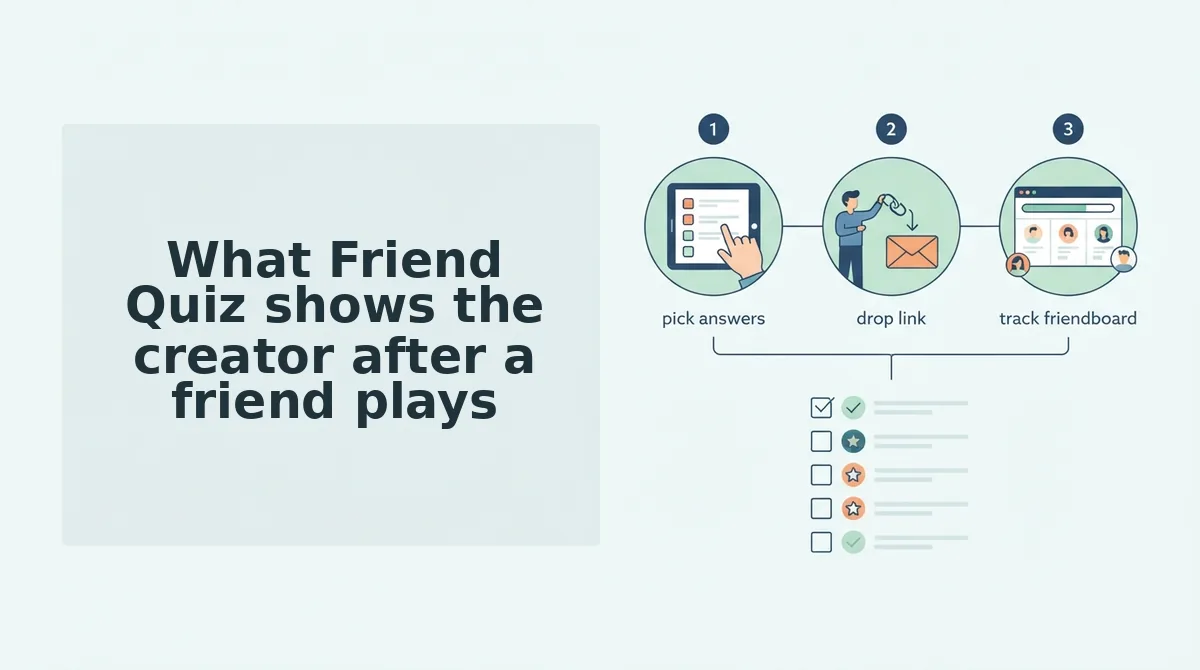
The creator receives an accuracy score and a Friendboard placement â two outputs, not a transcript of which options the friend tapped. It is the mirror image of the Buddy Meter question covered above, pointed at a different dashboard.
What comes back to a Friend Quiz creator after a friend plays: a score showing how many of the creator's answers the friend matched, plus a position on the creator's Friendboard, which ranks every attempt. No per-question breakdown is returned, so the creator learns that a friend scored seven out of ten, not which three they missed. And because play requires no account, no email and no app download, that score attaches to whatever display name the player typed â not to a verified identity. You can see the shape of the output on the friendship test flow.
Buddy Meter's honest advantage is familiarity: it is the format most group chats have already met, so a link needs no explaining. Friend Quiz's advantage is access â the friend taps a link and is playing, with nothing installed. Judge both on the same question: can the creator reconstruct your picks afterwards?
| Reader | Better fit | Why |
|---|---|---|
| Group chat that wants zero installs and no signup | Friend Quiz | Runs in the mobile browser with no account, email or app |
| Group already running the Buddy Meter format | Buddy Meter | Recognisable to players; check its own pages for current answer handling |
| Anyone chasing visible bragging rights | Friend Quiz | The live leaderboard ranks every attempt |
Best for a large WhatsApp thread: Friend Quiz, because nobody has to create anything to play. Best for a group already mid-rivalry elsewhere: staying put, and asking that creator-view question first.
Why the Friendboard is the real privacy surface, not your answers
The Friendboard is the part of a friend quiz the whole group chat can see: a public ranking of display names and scores. Your individual answer choices are not on it. The exposure a player can actually feel is their name sitting beside a number, in a thread full of people who know them.
That reframes the search. Answer data stays behind the creator's view â the thing friends worry about is the smaller half of what gets disclosed.
What actually sits on the board:
- The display name the player typed
- Their score, or how many answers they matched
- Their rank against everyone else who played
- Not included: which option was chosen on any question
Then consider the delivery route. The quiz link gets pasted into WhatsApp, iMessage or Instagram, so the audience for a placement is every person in that thread â not the person who made the quiz. A name and a number travel further than an answer key ever would.
That hands you one practical lever, and it is not opting out of playing: decide what you type in the name field. First name, nickname, an inside joke â you choose what the group sees attached to your score.
Next step: build a quiz on Friend Quiz, pick a display name you are happy to defend, and drop the link in the chat. If you want the stakes higher than bragging rights, run a friendship dare and check the live leaderboard once the replies land.
The board only shows what you hand it â so choose the name, then let your score speak for itself.