How to fix a friend quiz race that went flat
Six answers on the board, one screenshot dropped into the group chat, then two days of silence. That is the exact moment hosts start searching for how to fix a flat friend quiz race â and the answer is almost never "better friends." It is a return loop.
A flat friend quiz race is a shared quiz whose standings stop changing before the people playing it stop caring. The link worked; the loop did not. A race needs three things a one-off quiz never had â a clock, a friendboard (the live standings page that ranks everyone who has played), and a rival worth catching. The round-two cliff is the drop-off point where a group quietly stops returning, and a spectator is anyone who opened the link, watched the scores land, and never submitted one. You already did the hard part: you built a quiz and real people opened it.
What follows is the diagnostic, the return loop, and the length ceiling, in that order. The leak that sinks most races is not the one hosts blame on their friends â it sits around question nine, and it is self-inflicted.
Point at your own break point in this table before you change anything:
| Leak | What it looks like in the chat | Fix |
|---|---|---|
| Sent | Link dropped mid-conversation with no name attached | Re-send with one line of trash talk and your name in it |
| Opened | Opens spike, then flatline inside an hour | Ask for a score, not a click: "reply with your number" |
| Finished | People start and stall around question nine | Cut to 8â10 prompts and delete anything you cannot argue about |
| Posted | Scores exist but nobody shares them | Post the board screenshot yourself and tag the top score |
| Returned | Board freezes after round one | Open round two with a deadline and someone to catch |
To locate your stall, count four numbers from your own chat: how many people received the link, how many opened it, how many finished, and how many posted a score. A drop between sent and opened is a share problem â the link read like homework. A drop between opened and finished is a length problem. A drop between finished and posted is a status problem, meaning nobody knew a board existed to be topped. A drop after posting is a return problem, and it is the most common one. Fix the stage that lost the most people, not the stage that feels most urgent.
Nobody Gave the Group Chat a Reason to Reopen the Friendboard
A friend quiz race goes flat because the quiz is designed for a single visit and nobody built the second one. Your friends did not lose interest in you; they ran out of reasons to open the same link twice.
A return loop is the short sequence of prompts and updates that gives a group a reason to come back to the same standings page. Think of a pub quiz night: nobody stays for the questions â the questions take twenty minutes and the night takes three hours. They stay because a board is updating and someone at the next table is beating them. Your link delivered questions and skipped the night.
That is the whole mechanism. A quiz is one-and-done, while a race needs a clock (a reason it closes), a board (visible standings that move), and a rival (a name within reach). Miss any one and round one is the entire race. The second failure is quieter: spectators. Lurkers inflate how many people "saw" the link and deflate how many actually played, so the host reads a busy chat as a live race when the board has been frozen for a day.
Run the three-touch nudge cadence instead of one hopeful drop:
The Quiz Was Too Long and Everyone Stalled Around Question Ten
Most friend quiz races die between question 9 and question 12 â not because your friends got bored of you, but because the quiz ran past the point where the prompts were still funny. The practical ceiling is 8â10 prompts.
Answer fatigue is a lever the host controls, not a flaw in the group. Question eleven isn't a test of loyalty; it's a test of patience, and everyone fails it.
Here's why the dead zone sits right there. Your first eight prompts cover the personal material â the coffee order, the irrational fear, the thing you always say. By prompt nine, you've stopped writing about yourself and started writing filler to reach a round number. Adding questions feels thorough. It reads as generous. It is the single most common way creators kill their own race.
Before you start editing, you need two things: your live quiz link open in one browser tab so you can preview the flow, and about five minutes. No tools beyond that.
Run the eight-minute edit pass
- Open your quiz in preview mode and answer it yourself, start to finish, without pausing to admire your own jokes. Time it. You should see a completion time under 90 seconds. Anything longer is a red flag for the group chat.
- Read each prompt and ask one question: could two friends genuinely argue about this answer? You should see a clear yes or no within three seconds. Hesitation means no.
- Cut every prompt that fails that test â the filler, the vague ones, the one where the answer is obviously your name. You should see your list shrink to 8â10 items.
- Reorder so your single funniest prompt sits at position three, not position fourteen. You should see a hook that lands before attention drifts.
- Test the trimmed version against a shorter format like a shorter friendship test to calibrate the ceiling. You should see how much faster a tight quiz moves.
- Resend the link to two friends first, not the whole group. You should see a completed result before you broadcast.
How many questions should a friend quiz have?
A friend quiz should have 8â10 questions. That range finishes in under 90 seconds on a phone, keeps every prompt in the funny-personal zone, and leaves the group wanting a second round rather than relieved it's over. Past ten, you're not testing friendship â you're testing stamina.
Length is the leak you can fix without asking anyone for anything. The next leak lives on their side of the screen.
The Link Went Cold and Round Two Had No Hook
Round two dies for two mechanical reasons: the original link has scrolled out of reach in the chat, and nothing about re-sending it signals that anything is different this time. Fix the mechanics and the same group often reopens the board within an hour.
- Re-send the board screenshot with the link, not the bare link. A cold paste of the same URL reads as a chore â your friends already ignored it once, so they will ignore it again. Attach a screenshot of the current standings above the link and the message stops being a request and becomes an invitation to defend a position. Same URL, same group, completely different response rate.
- Apply the rematch rule before you send anything. If the question set still holds, keep the same board so scores carry over and nobody loses progress. If you are changing enough prompts that past answers no longer apply, generate a fresh link instead. Mixing the two is what produces the "wait, do I start over?" silence.
- Frame round two as settling a score, not asking a favor. One line does it: "Two points separate first and last â running it back." That sentence names a gap, which is a reason to click, where "can you try my quiz again" names an obligation.
- Switch the format for the friends who never answered. A friendship dare quiz gives the quiet members a lower-effort entry point than a scored trivia round, and pulling two new players in can restart momentum on its own.
- Steal a structure from a short rematch list. Half the battle is knowing what round two even looks like; a set of friendboard rematch ideas gives you a format to announce rather than an open-ended "again?"
Every one of these runs through the same workflow: a new or refreshed quiz link in under two minutes, no account, no download. Build it, screenshot the board, and paste both into the chat in one message.
The 60-Second Audit That Restarts a Flat Quiz Race
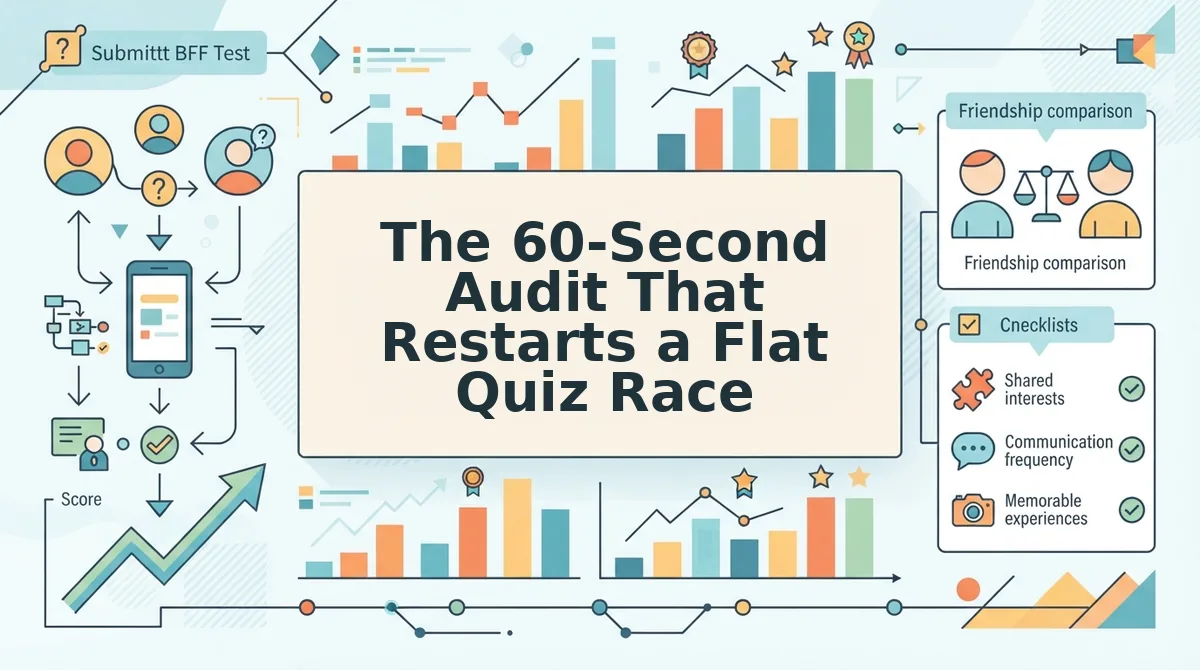
Walk the five leaks in order â sent, opened, finished, posted, returned â and you will usually find one that is dramatically louder than the rest. Fix that one. Fixing all five at once spreads your effort thin and tells you nothing about which change actually worked.
Start with the leak the audit names loudest: if it is opened-but-not-finished, cut the question count and re-post with the board attached. If it is finished-but-not-returned, the rematch message is your fix. Then be honest about the limit â some chats have simply gone quiet, and no rematch revives them. In that case shrink the group to the three or four people who actually reply instead of overselling round two to a dead thread.
The next step is the one you control: start a friend quiz, share it, and let the board do the arguing. A flat race is a fixable race, and you now know which leak to plug first.