Friendboard Banter Mistakes That Turn Rivalry Into Drama
The score lands in the group chat. Someone screenshots it. Then the thread goes quiet for twenty minutes.
That silence is where most friendboard banter mistakes begin. It is rarely a kindness problem â it is an aim problem: the joke hit a person instead of a guess.
You already made the quiz and shared the link; the Friendboard is live and the rankings are public. What follows is a targeting rule to apply before you hit send, not a personality overhaul. One finding may surprise you: the riskiest moment on a Friendboard usually isn't the low score itself.
Do this in the moment: a quiz goes out to a four-person chat, the results update, and you line up a jab at whoever scored lowest. Before sending, name the target â the guess or the guesser.
- If it's the guess, send it.
- If it's the guesser, rewrite it.
The score is identical. The message isn't.
One limit: this works in chats you're al ready part of. Public rankings can travel past the group that made them, so a line written for four friends can land in front of a colleague, a sibling, or a group chat you forgot you were still in. The test is simple: would you say it with your name attached to a screenshot? If not, rewrite it. That check is the whole method. Target the guess, not the guesser, before you press send â quicker than apologizing, and it keeps the quiz funny instead of mean. Run it once per jab and the habit carries.
What do you need before you fix a Friendboard rivalry?
You need two things to fix a Friendboard rivalry: a shared rule for what banter may target, and a read on the three inputs behind every score.
Friendboard is the live scoreboard where a group's quiz results sit side by side. Banter is teasing aimed at something a person did; trash talk points the same energy at the game instead of the player. Culture Shift's "Banter vs. Bullying in the Workplace" separates the two by what the joke targets, and that test holds on a quiz board.
Before step one, you need three things: the quiz link you created, the group chat it went out in, and about two minutes. Nothing to install.
- Open your quiz link and read your own question set back. Any prompt with two plausible answers was a coin flip, not a loyalty test. You should find at least a couple â those are the questions doing the damage.
- Count the people in the chat before you post a score. Under five, a joke lands as a nudge; at thirty, it reads as a verdict. You should know which one you are sending.
- Type the call-out one-to-one first if it stings, then repeat it group-wide only after. You should hear whether it landed before an audience does.
The rule fits in two sentences: attack the guess, never the person, and make the call-out one-to-one before it goes group-wide. Teasing a friend for picking B when B was genuinely reasonable stays playful, because the target is a guess. Teasing them for "not knowing you" targets the person, and that is the version that curdles. The Three Dials make this concrete: a score is a joint product of the creator's question set, the guesser's luck, and group size, so one number never certifies how close two people are.
Those two checks cover most flare-ups. The rest cluster into seven repeatable mistakes.
Which seven Friendboard banter mistakes turn a quiz board sour?
The seven Friendboard banter mistakes that sour a quiz board are: screenshotting a low score publicly, naming last place in a big group, replay-grinding then claiming skill, treating the score as proof of closeness, link-spamming people who never opted in, writing rigged inside-joke questions, and gloating in an undefeated bio. Each one shares a single flaw â the joke targets a person's loyalty instead of the game's luck.
Banter targeting is any teasing aimed at the mechanics of the quiz â a lucky guess, a bad question, an unlucky question order. Banter targeting loyalty hits the human instead. Only one of those two is safe to post.
- Publicly screenshotting a low score. A 1:1 roast lands as play; the same image in a 30-person group reads as humiliation, because the audience gained witnesses while the joke stayed the same size. Before posting, count the readers, not the joke's sharpness. Instead of "look how bad you did," say "the question order did you dirty, run it again."
- Naming last place out loud in a large chat. Rank is visible on the Friendboard already, so announcing the bottom slot adds no information â only a spotlight. It matters most in the biggest chats, where the person can't respond without escalating. Instead of "congrats on dead last," say "bottom three, rematch tonight."
- Replay-grinding, then claiming skill. Running the quiz five times until the answers stick converts a luck test into a memory test, and the group can see the attempt count. It stings because it makes honest first-timers look worse by comparison. Instead of "undefeated," say "second attempt, first attempt was rough."
- Treating the score as proof of closeness. A Friendboard score measures how well someone guessed your answers to your questions â nothing about how much they care. Reading a low number as low affection turns a game into a referendum. Instead of "guess we're not that close," say "my questions were unfair, honestly."
- Link-spamming people who never opted in. Dropping the quiz link into a chat where nobody asked invites the awkward silence nobody wants to be the first to break. It matters because a non-player can't lose, and a non-player who's pestered stops clicking. Instead of reposting four times, say "one try each, then I'll drop it."
- Writing rigged inside-joke questions. Creators sometimes write prompts only they could answer, then read the resulting low scores as comedy. That's the most counterintuitive one: the funnier the inside joke, the less the score measures anything. Instead of "nobody knows me," say "that one was a trap, my bad." A fairer set of prompts is the whole point of this best friend quiz question set â questions a real friend has a genuine shot at.
- Gloating in an undefeated bio. Pinning "still undefeated" on a board where everyone can see the attempt counts invites an audit rather than a laugh. It stings because it's the one flex that invites evidence. Instead of "undefeated," say "lucky streak, someone end it." Or escalate deliberately with a friendship dare quiz where losing is the joke.
Notice that six of the seven are fixable with a reworded sentence, not a deleted post. Chat size, however, changes which sentence is safe.
Does chat size change what's funny?
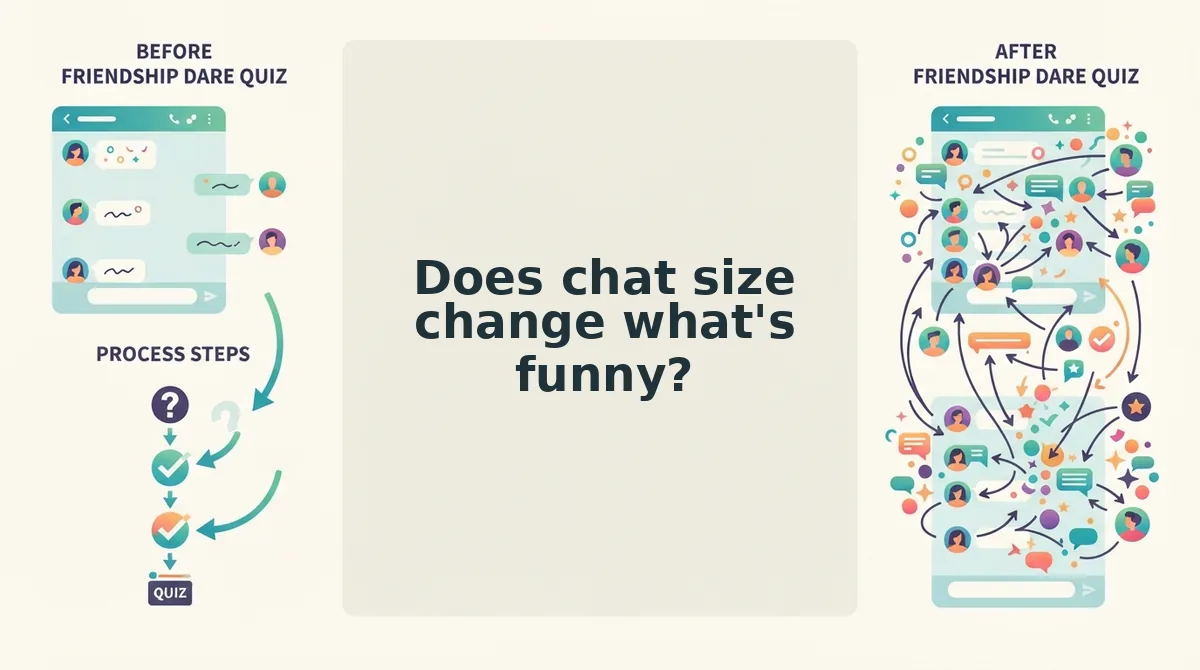
Yes. The identical call-out gets riskier with every person added to the thread, because audience size changes who is watching the joke land, not just who hears it.
John-Paul Davies' Joking or Bullying? Banter in Workplace Culture and Relationships makes a receiver-perception point that carries straight over to a scored quiz: banter is defined by how the person on the receiving end takes it, not by how the sender meant it. Workplace banter resources like Culture Shift and Social Skill Up handle that intent-versus-impact gap well, but none of them apply it to a game where a rank is sitting next to your name.
| Audience | What lands | What misfires | Recommended move |
|---|---|---|---|
| One-to-one DM | Specific guesses, mock outrage over a single answer | Rarely anything â no spectators | Best for the two-person rivalry: keep the score war in the DM |
| Four-to-six person chat | Jokes about the question set itself | Piling on one person's low score | Best for the close group chat: one call-out per person, then stop |
| Thirty-person group | Jokes about the quiz, never the players | Publishing someone's last-place rank | Best for big servers: banter the score, never the person |
Why a line that killed in a DM bombs in the group: the DM had one reader who already knew you were kidding. Add twenty-nine spectators and the same sentence stops being a joke and becomes a public ranking of how much someone pays attention to you. When the rivalry is genuinely between two people, route it to a BFF test and keep the big board for group-wide fun.
How do you check the banter got lighter?
Watch behavior for 24 hours after the next result posts. You need the live quiz link, the group chat, and nothing else â the signals are all visible in who replies, how fast, and whether anyone shares again.
- Open the Friendboard and screenshot the current order (30 seconds). This is your before picture so you can tell whether the mood actually moved.
- Note who replies first after the next score lands. Fast, joking replies suggest the board is still play; silence from the person who usually leads is the warning sign. You should see at least two people riffing within an hour.
- Count voluntary re-shares over the following day. Someone posting the next link unprompted is the clearest green light â nobody reshares a thing that embarrassed them.
- Check the bottom of the board. If last place plays the next round, the score isn't being read as a verdict on the friendship. If they go quiet, it is.
- Reset on a cadence â weekly or per quiz â and keep separate boards per quiz instead of one permanent ranking, since the standing order is often the friction rather than the trash talk. The Friendboard vs global leaderboard comparison covers the mechanics.
Keep score and closeness separate while you read those signals: a low result measures one round of guessing, not how well someone knows you, and the friendship test framing helps say that out loud before anyone internalizes a rank. Social Skill Up's What is banter? When does banter become bullying? is a useful one-line reference for the intent-versus-impact distinction when a thread needs settling. Building a fresh round with clean questions is a two-minute job, and a new board resets the mood faster than any apology.
Fix the joke first, then reset the board
The loop closes here: the call-outs that soured a board almost always targeted a person's loyalty rather than the question or the luck behind a guess. Same joke aimed at the quiz stays funny; aimed at the friend, it doesn't.
Then attach the rule to the link itself. Paste your quiz URL with one line â "we mock the questions, not the scores" â so everyone who joins inherits the standard without a lecture. And if your group genuinely enjoys harsh banter, that's fine too; the board is the thing to change, not the people on it.
Start by creating a friend quiz with prompts that reward attention instead of inside knowledge, and share it with the rule attached.
The next round can be the one everyone screenshots for the right reason.