Dare Quiz Tie-Breaker Rules for Peer Group Rankings
Your group chat just hit a deadlock: two friends scored identical results on your friendship dare quiz, and now the Friendboard shows a tie that nobody wants to leave unresolved. That stalemate isn't a glitch, it's proof your peer group is evenly matched, and the right dare quiz tie-breaker rules peer group framework turns that awkward pause into the best moment of the night.
You're right to feel the tension. A tie feels like unfinished business, especially when bragging rights are on the line. This guide gives you a three-tier ladder for breaking dare quiz ties fairly, explains why ties happen in the first place, and reveals the one tie-breaker format that actually makes friendships stronger instead of fracturing them.
Here's the roadmap: first, we'll reframe why a tie is a signal of a healthy friend group. Then you'll get the 3-Tier Tie-Breaker Ladder, speed rounds, mutual dares, and group votes, each matched to a specific group dynamic. The surprising part? The most popular tie-breaker format is also the one most likely to end a friendship. Keep reading to find out which one to avoid.
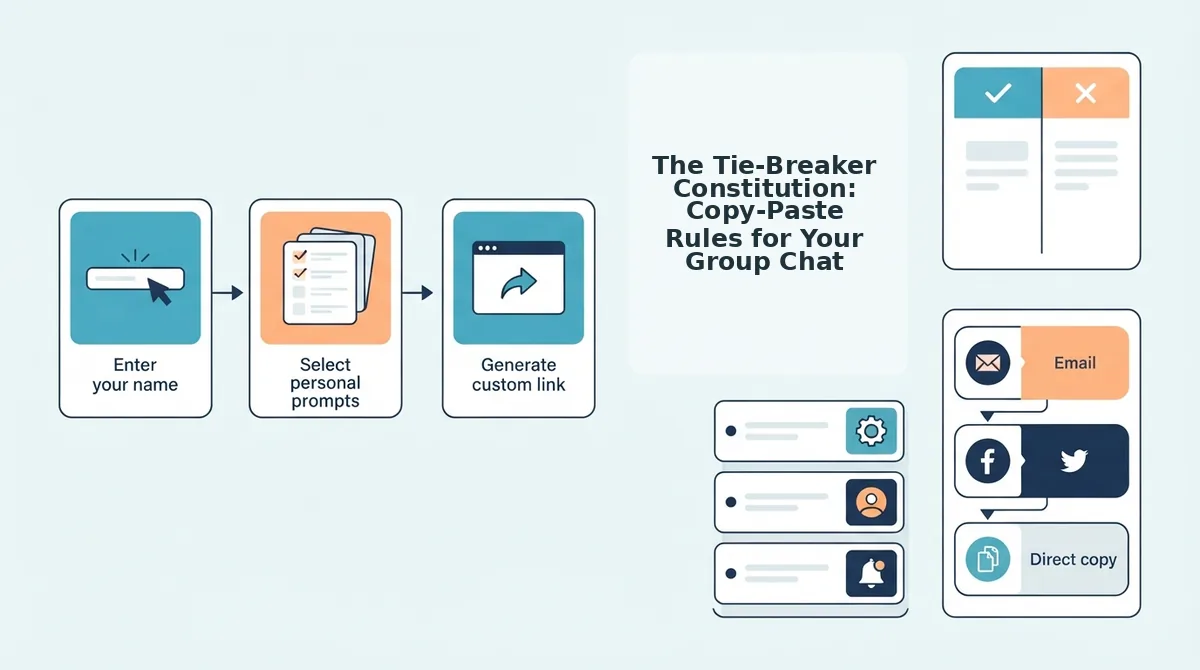
When you're ready to put these rules into action, Friend Quiz lets you enter your name, answer personal prompts, and share an instant quiz link, no app download, no account, just a shareable challenge that lands straight in your group chat.
Why Dare Quiz Ties Happen (and Why That's Good)
A dare quiz tie is a scoring outcome where two or more players finish with identical correct-answer counts on the same friendship challenge, triggering a shared rank on the Friendboard. Ties are not a scoring flaw, they are evidence that your peer group is paying attention to each other.
Think of a tie like two runners crossing a finish line at the exact same millisecond. You wouldn't call the race broken; you'd call it evenly matched. The same applies when two friends independently know the same number of personal details about you.
Three dynamics produce most dare quiz ties. First, equal knowledge of the quiz creator: when multiple friends share similar amounts of time, history, and inside jokes with you, their answer accuracy converges. Second, similar dare thresholds: friends who are equally willing to attempt embarrassing or bold dares tend to score within the same range because they answer with the same confidence level. Third, shared group history: long-running friend groups accumulate overlapping memories, so multiple people recall the same stories, preferences, and quirks.
Here's where most groups get it wrong: they treat a tie as a problem to eliminate immediately. But a tie means your friend group actually pays attention to each other. That's the outcome every quiz creator wants. The tie isn't the failure, rushing to break it without a fair system is.
For a deeper look at the scoring mechanics behind these outcomes, see how Friend Quiz scores are calculated. Understanding the math helps you see why ties cluster around certain friend dynamics and why a tie-breaker ladder works better than a single sudden-death rule.
The 3-Tier Tie-Breaker Ladder for Peer Groups
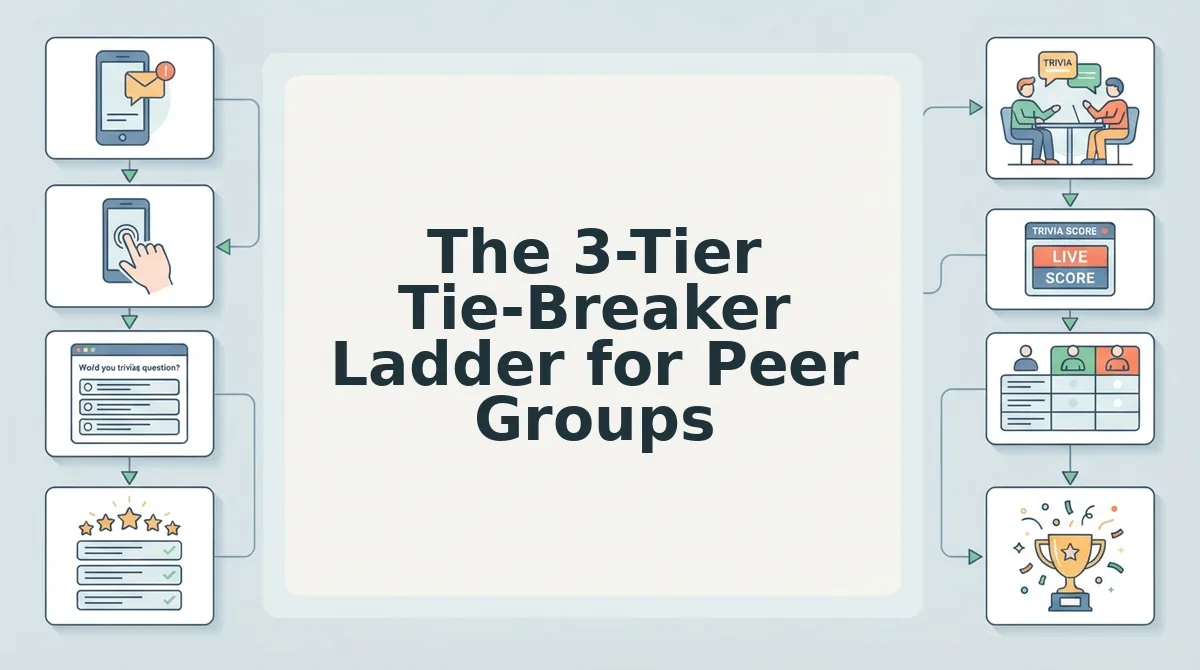
A tie-breaker ladder is a ranked sequence of tie-resolution methods, ordered from fastest to most consensus-driven, so your group can escalate fairly instead of defaulting to chaos. You'll need the tied players, the original quiz link, and a group chat where everyone can see the result.
- Tier 1: Speed round, first correct answer wins. Open the original quiz link and have both tied players re-answer the same questions against a visible timer. The first player to submit a correct answer on a question the other player missed takes the rank. This works best for large groups because it resolves ties in under two minutes without requiring anyone to perform a dare. You should see a clear winner emerge before the chat scrolls past the result.
- Tier 2: Mutual dare, both tied players complete the same dare. Select one dare from the friendship dare quiz prompt list and assign it to both tied players simultaneously. The player who completes the dare first, or with the most commitment as judged by the group, takes the higher rank. This tier is built for high-rivalry pairs who would rather compete than concede. Expect the chat to flood with reactions, that's the point.
- Tier 3: Group vote, the chat decides who wins. Post both tied players' names in the group chat and run a simple majority vote with a visible deadline, such as five minutes. The player with the most votes takes the rank. This tier suits close friendships where consensus matters more than competition, and it keeps the outcome feeling legitimate to everyone involved.
Here's where most groups get it wrong: they skip straight to Tier 3 for every tie, which turns a fun quiz into a popularity contest and can quietly bruise the friend who loses the vote. Start at Tier 1 and escalate only when the tie persists or when the group explicitly wants higher stakes.
For a broader breakdown of how these methods fit into overall ranking logic, see the full tie-breaker rules for friend quiz rankings. Friend Quiz's instant share links make it easy to restart a speed round or pull up a dare prompt without leaving the chat.
But before you default to a sudden-death question, there's a reason that format backfires more often than it works.
Why Sudden Death Fails Friend Groups
Sudden death tie-breakers, where one final question decides the winner, feel decisive on paper but create resentment in practice, because a single arbitrary question rarely reflects who actually knows the friend better.
The resentment problem is real: when a tie comes down to one question, the loser can always point to bad luck, an ambiguous prompt, or an inside joke they weren't present for. That feeling of arbitrariness poisons the bragging rights the quiz was supposed to create.
The creator-bias problem compounds it. Quiz creators are also players, and when they judge their own tie-breaker, every ruling looks self-serving, even when it isn't. YouTube creators treat head-to-head tie-breakers as special event content precisely because they know a single-question finish needs framing, hype, and audience buy-in to feel legitimate. Defaulting to sudden death skips all of that.
Competitors that default to single-question elimination do offer speed and simplicity, which genuinely suits casual one-off quizzes where nobody tracks scores long-term. That is a fair trade-off for low-stakes play.
| Approach | How it works | Strength | Weakness | Best for |
|---|---|---|---|---|
| Sudden death (single question) | One final question decides the winner immediately | Fast, zero setup, no debate | Feels arbitrary; creator bias risk; loser resentment | Casual one-off quizzes with no ongoing Friendboard rivalry |
| Consensus-based ladder (3-tier) | Pre-agreed sequence: mutual dare to group vote to speed round | Feels fair; group owns the outcome; no single judge | Requires pre-agreement and a few extra minutes | Peer groups tracking bragging rights over multiple quizzes |
| Head-to-head event | Tied players face off in a dedicated rematch | High drama; audience engagement; feels earned | Time-consuming; needs scheduling and hype | Content creators and large group chats that treat ties as entertainment |
If your group tracks scores on a shared Friendboard, sudden death quietly undermines the leaderboard's legitimacy. One bad question and the ranking stops reflecting skill, it reflects luck. That is exactly the kind of Friendboard score tracking mistake that turns friendly rivalry into quiet resentment.
Sudden death works when nobody cares about the outcome. The moment bragging rights are on the line, a pre-agreed ladder beats a coin-flip question every time.
The Tie-Breaker Constitution: Copy-Paste Rules for Your Group Chat
A tie-breaker constitution is a short set of pre-agreed rules your group pastes into the chat before the quiz starts, so nobody argues about fairness after the Friendboard freezes on a tie.
- Agree on the ladder before the quiz starts. Paste the 3-tier ladder, mutual dare, then group vote, then speed round, into the group chat before anyone answers a question. Pre-agreement removes the "you're changing the rules" argument because everyone opted in before the tie existed.
- No creator judging. The quiz creator never decides a tie-breaker outcome, because they are also a player and every ruling looks self-interested. Assign judging to the two group members who scored lowest on that quiz, they have no stake in the tie and no reason to favor either player.
- Mutual dare for 2-player ties. When exactly two players tie, both complete the same dare and the group votes on who executed it better. This keeps the resolution social, funny, and group-owned rather than a private duel nobody else witnesses.
- Group vote for 3+ player ties. When three or more players tie, a majority vote decides, but only after each tied player gets 30 seconds to argue their case in the chat. The short time limit prevents filibustering and keeps the vote moving.
- Winner updates the bragging rights. Whoever wins the tie-breaker immediately posts the updated Friendboard standing in the chat. Making the winner responsible for the update turns the resolution into a public victory lap and keeps the leaderboard current without a group admin doing extra work.
Here is the worked example using the Friend Quiz flow: the creator pastes the five rules above into the group chat, then shares the quiz link. Two friends tie on the Friendboard. The group applies Tier 2, a mutual dare, and votes. The winner posts the updated standing, and the rivalry continues cleanly. If you need help verifying who actually scored highest before the tie-breaker starts, check this guide on how to see who scored highest on Friend Quiz.
Copy these five rules into your group chat before your next quiz, and ties stop being arguments and start being content.
5 Tie-Breaker Formats Ranked by Group Size
The best tie-breaker format depends almost entirely on how many people are in the group chat, because a format that works for two best friends collapses in a nine-person server.
| Format | Best group size | How it works | Why it fits | Best for |
|---|---|---|---|---|
| Mutual dare | 2-4 players | Both tied players complete the same dare; group votes on execution | Small groups can watch both attempts and vote quickly without coordination overhead | Best friends and couples who want the tie-breaker to be funny, not stressful |
| Head-to-head trivia | 2-4 players | Tied players answer rapid-fire questions about the quiz creator until one misses | Small groups keep the focus tight and the pace fast without audience fatigue | Competitive duos who treat the quiz as a knowledge sport |
| Speed round | 5-8 players | All tied players answer the same 5 questions; fastest correct answers win | Medium groups need a format that resolves multiple players simultaneously | Mid-size friend groups that want a tie-breaker over in under two minutes |
| Group vote | 5-8 players | Tied players make a 30-second case; non-tied members vote | Medium groups have enough neutral voters to make the outcome feel legitimate | Social groups where the tie-breaker is as much about banter as winning |
| Elimination bracket or point-differential tiebreak | 9+ players | Tied players enter a mini-bracket, or the player with the highest score on the hardest questions wins | Large groups need structure to avoid a chaotic free-for-all that stalls the chat | Large servers and class groups where ties are frequent and need a scalable default |
Small groups thrive on intimacy and humor, so mutual dares and head-to-head trivia lean into what makes a 3-person chat fun. Medium groups need speed and neutral judgment, which is why speed rounds and group votes dominate there. Large groups need structure above all, an elimination bracket or point-differential rule prevents a nine-way argument from killing the momentum. For groups that run quizzes regularly, matching the format to the group size is part of the same discipline as using micro leaderboards for friend groups to keep engagement high between quizzes.
Pick the format that fits your headcount, and the next section answers the questions everyone asks when a tie actually happens.
Dare Quiz Tie-Breaker Questions Answered
A tie-breaker rule is a pre-agreed method for resolving equal scores in a dare quiz, ranked by speed, fairness, and group buy-in. The fastest options for group chats are coin flips or emoji polls, while dare-offs work best for in-person peer groups.
What tie-breaker rules work for dare quiz rankings in a peer group?
The 3-tier ladder works best: start with a speed round on the same questions, move to a dare-off if still tied, and finish with a group vote. Peer groups consistently prefer rules everyone agreed to before the quiz started, which removes accusations of bias after scores are revealed.
Can the quiz creator also be the tie-breaker judge?
No, the creator should never be the sole judge because they have inherent bias toward their own quiz answers. A neutral third party or a group vote works better. If the creator must judge, use a pre-written dare list so decisions are transparent and not improvised mid-tie.
What's the fastest tie-breaker for a group chat?
An emoji reaction poll is the fastest tie-breaker for group chats, resolving ties in under 30 seconds. Post both tied names and let members vote with a thumbs-up or fire emoji. First to five reactions wins, and the result is visible to everyone instantly.
How do you prevent ties before they happen?
Add one odd-numbered question with no neutral answer option, or include a weighted final question worth double points. You can also require a unique tie-breaker prediction at the start, such as guessing the creator's exact wake-up time, which rarely produces identical answers.
Why does my friend group keep tying on every dare quiz?
Frequent ties usually mean the questions are too easy or everyone knows the creator equally well. Add harder, more specific questions about recent events or obscure habits. Ties also happen when groups share answers beforehand, so rotate question sets or add a no-collusion rule.
Settle the Tie, Keep the Rivalry Alive
A tie isn't a dead end; it's proof your group knows each other well enough to break the scoring system. The tie-breaker ladder turns that awkward freeze into the most entertaining part of the quiz, and the group that plans for ties before they happen never loses momentum.
Start small: pick one rule from the Tie-Breaker Constitution and test it on your next quiz. When it works, share the full rule set with your group chat so everyone knows the stakes before the first question loads. Then create a friendship dare quiz and put the ladder to the test with real scores on the line.
The best rivalries don't end on a technicality. They end with someone taking a dare, earning the crown, and screenshotting the Friendboard for proof.