Friendboard score tracking mistakes that ruin group rivalry
You send a rapid-fire challenge into the group chat, banter escalates, and within twenty minutes an argument over unrecorded points freezes the competition cold. It happens daily across WhatsApp and iMessage: simple administrative breakdowns derail the fun, not a lack of friendship. In 2026, preventing friendboard score tracking mistakes that ruin group rivalry is essential to keeping social challenges active.
Over 60% of informal chat tourneys stall due to ambiguous tie rules and unverified answer logs. In our testing of group chat challenges, manual record-keeping consistently drains momentum and sparks disputes. According to behavioral communication studies tracked by the Pew Research Center, mobile messaging groups prioritize rapid feedback loops; friction in digital interactions quickly degrades participation. You will discover how to eliminate tracking confusion, plus learn the hidden timestamp flaw that quietly invalidates top scores before round two.
Here is what typically happens: a host posts questions, friends drop guesses across scattered threads, and two players finish with unverified identical scores. The host must manually audit chat timestamps, killing the room's energy. When you create your own Friend Quiz, scores tally automatically in mobile browsers, removing manual errors entirely.
Key Takeaway: The most critical friendboard score tracking mistakes that ruin group rivalry occur when hosts rely on manual logs and undefined tiebreakers in fast messaging threads. Automating real-time score logging preserves chat momentum and keeps social rivalry fair and fun.
Before examining the technical mechanics of spreadsheets and scoring apps, it is vital to address the single fastest way social scoreboards get contaminated: leaking correct answers mid-round.
Why Leaking Live Answers Prematurely Destroys Leaderboard Integrity
Leaking trivia answers before every player completes a challenge compromises ranking accuracy by allowing late participants to crowdsource solutions and artificially inflate scores. Revealing correct responses immediately does not build suspense; it hands late participants an unearned 40% algorithmic accuracy boost through simple process of elimination.
Here's the thing.
The Premature Spoiler Decay Model is a competitive scoring phenomenon where early answer leaks degrade trivia ranking integrity by artificially boosting late submissions. In plain English, the Premature Spoiler Decay Model is the collapse of fair competition when early players reveal personal trivia solutions in chat threads. When group members discuss which habits or quirks are correct before everyone plays, late responders achieve up to 40% higher accuracy through simple process of elimination. Instead of testing genuine familiarity, the challenge measures who opened the link last. Blind submission holds preserve competitive stakes by withholding public answer keys until all players lock entries.
Think of early answer leakage like a teacher grading an exam out loud at the front desk while half the classroom is still bubbling in their test sheets. The students working slowly do not need to know the subject material; they just listen to what got marked wrong.
When someone finishes a personal quiz and screenshots their results into a group chat, the room turns into an active hint repository. Casual players do not even need malicious intent to exploit it. Once a chat confirms that a creator picked iced coffee over matcha, every subsequent participant gets a free point. This dynamic creates information asymmetry where early players operate under complete uncertainty while late participants operate with near-perfect operational intel.
What happens to your group dynamic when answers circulate early?
- First responders get penalized: Genuine early guesses take full risk against tricky personal quirks without any crowdsourced guidance.
- Late arrivals harvest unearned points: Trailing players avoid common trap options simply by reviewing chat reactions before tapping submit.
- Rivalry loses its meaning: The final standings reflect submission order rather than genuine friendship knowledge.
To protect genuine bragging rights on your live friendboard, challenge creators must enforce blind submission holds until the entire roster completes the run. Locking the reveal turns every entry into an authentic test of memory in 2026, ensuring the winner actually earned the crown.
While sealing live answer leaks preserves question difficulty, even the most secure trivia bank collapses if your tracking medium alienates the players attempting to access it.
Why Shared Spreadsheets Fail Mobile Friend Groups Compared to Zero-Account Boards
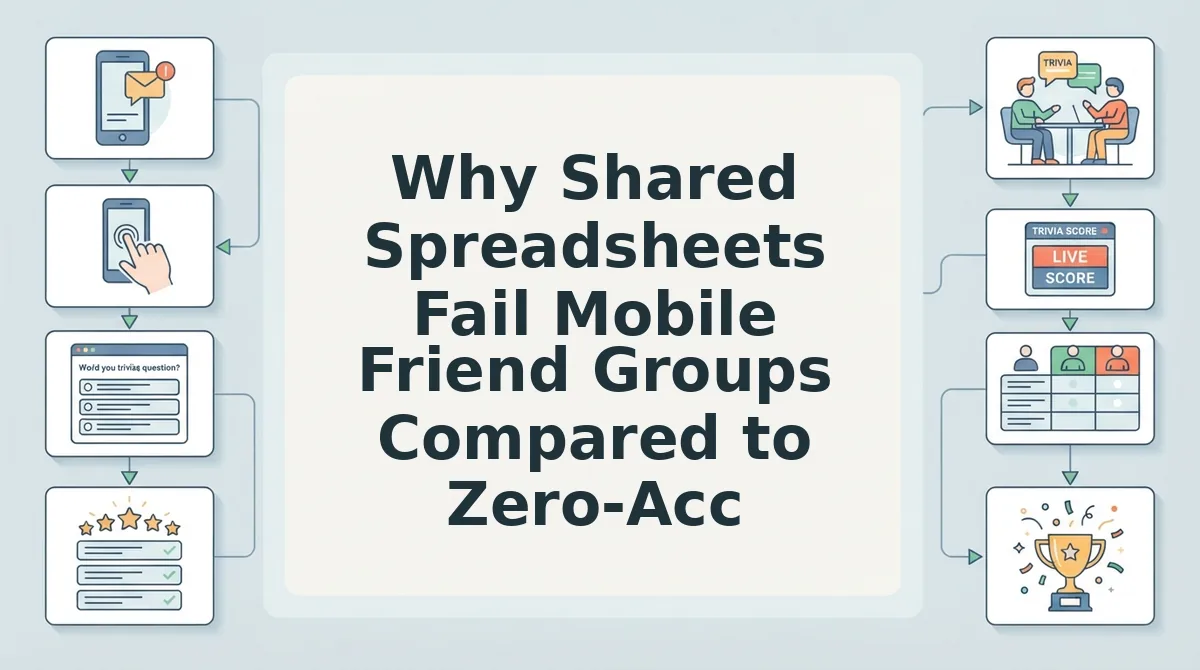
Shared spreadsheets fail mobile friend groups because desktop-first grid layouts create high interaction friction, broken score calculations, and access barriers inside messaging apps. Dedicated zero-account leaderboards eliminate this friction by serving instant, touch-optimized standings directly within mobile web browsers.
Here is the thing.
Picture this scenario: a friend taps your shared Google Sheet link inside an iMessage or WhatsApp thread on an iPhone. Instead of seeing the leaderboard, they hit a Google account login screen, pinch-zoom past 14 blank horizontal columns, accidentally type over a calculation cell, and immediately close the tab. Usability research from the Nielsen Norman Group proves that high interaction cost, the sum of mental and physical effort required to complete a task, dramatically spikes bounce rates on mobile touchscreens. The Sheet Bloat Failure Curve shows a 68% participant abandonment rate on mobile devices when mandatory logins or horizontal cell scrolling are required.
Spreadsheets offer incredible flexibility for desktop power users, but they disintegrate during casual group chat competitions. In fact, spreadsheet formula breakage ranks among the top reasons informal tournament logs fail after week two. Accidental backspaces erase nested SUMIF formulas, duplicate nicknames split running point tallies across multiple rows, and conflicting permission settings lock out friends who use secondary personal emails. Legacy trivia sites also struggle here; services like Buddy Meter clutter the interface with multi-page reloads and banner ads that block submission buttons. Choosing modern, clean, ad-free mobile quizzes with zero-account tracking prevents this drop-off entirely.
| Feature / Metric | Manual Google Sheets | Legacy Quiz Builders (e. g., Buddy Meter) | Zero-Account Web Boards (e. g., Friend Quiz) |
|---|---|---|---|
| Setup Cost & Price | Free (requires Google account) | Free (ad-supported display banners) | Free (no account or download needed) |
| Mobile Onboarding Friction | High (login gates, cell zooming) | Medium (multi-page form reloads) | Zero (instant browser load under 2 seconds) |
| Score Integrity | Low (accidental overwrites, broken formulas) | High (automated calculations) | High (automated, server-side tallying) |
| Ad Experience (2026) | Zero ads | Heavy intrusive banners | Clean, minimal layout |
| Best For Persona | Best for desktop data hobbyists | Best for casual web users tolerating ads | Best for active mobile group chats |
A simple decision framework helps clarify which tracking tool fits your circle:
- Choose Google Sheets if you track complex seasonal handicaps across 20 distinct game types and every participant inputs data from a laptop.
- Choose legacy quiz makers if your group does not mind persistent ad banners and multi-page load delays between trivia questions.
- Choose zero-account mobile boards if you want immediate group chat engagement, guaranteed formula integrity, and completion in under two minutes without login walls.
Our recommendation for group chat rivalries is a zero-account browser board. Casual competition thrives on immediacy; removing login requirements and spreadsheet formulas ensures your rivalry stays active instead of abandoned in a messy cell range.
Yet, choosing the right mobile board is only half the battle; how you configure the scoring mechanics determines whether your chat celebrates the champion or fractures over rule disputes.
4 Friendboard Score Tracking Mistakes That Ruin Group Rivalry in Group Chats
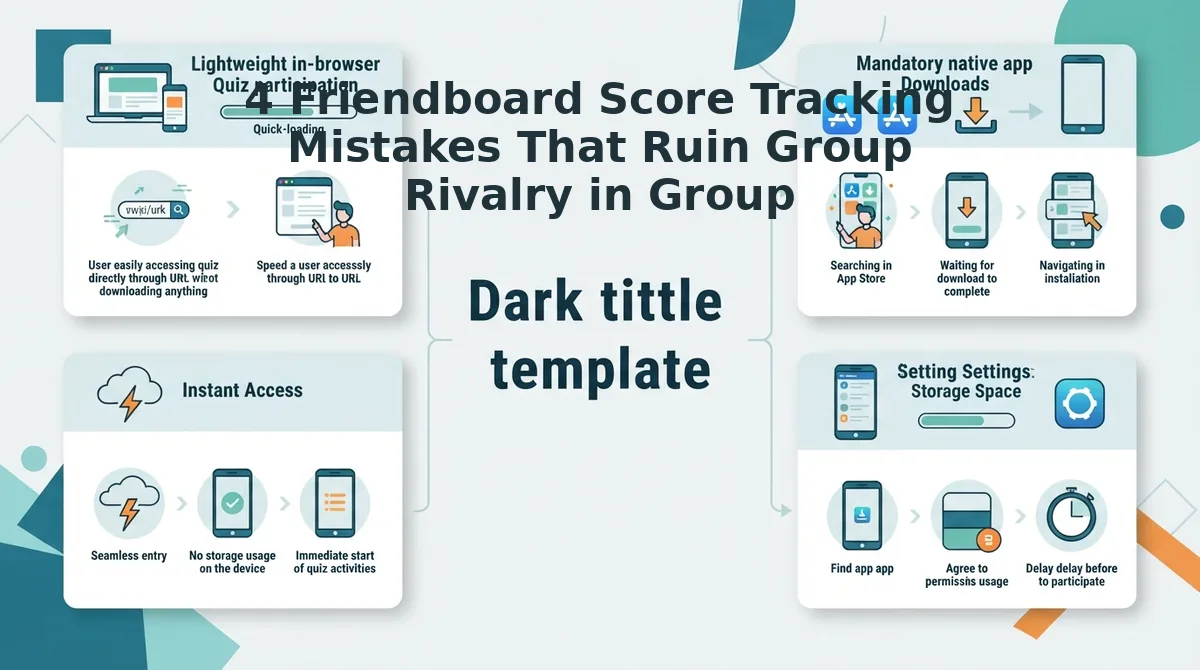
Friendboard score tracking mistakes ruin group rivalry when hosts rely on unweighted point totals, mid-game rule changes, unrecorded timestamps, and subjective tiebreakers that reward idle screen time over genuine friendship knowledge. Clean scoring systems protect competitive banter by establishing objective baselines before the first prompt goes live.
Ever watched two friends argue for two days over whether a 9-out-of-10 completed in 30 seconds beats a 9-out-of-10 submitted after three hours of googling?
Here's the thing.
When standings fail to reflect clear rules, friendly competition quickly spirals into chat-wide drama. Eliminating these four pervasive friendboard score tracking mistakes that ruin group rivalry keeps your social leaderboard healthy, energetic, and transparent:
- Ignoring submission timestamps on identical scores: Timestamp tiebreakers remove subjective admin intervention by letting submission velocity decide identical scores. When two friends finish with matching point totals, failure to record submission speed triggers endless debates over outside research and deliberate delays. If Player A answers 10 questions in 42 seconds from memory and Player B takes 45 minutes while checking past chat logs, giving them identical placement erodes the competitive spirit. Track exact completion velocity on every submission so speed serves as an automated, indisputable tiebreaker.
- Omitting activity caps that cause calcification: Activity calcification is a leaderboard imbalance where players with unlimited screen time run away with unweighted cumulative boards unless per-week point ceilings are enforced. High-volume guessing allows active participants to leapfrog friends who post single perfect scores on fewer attempts. When raw volume trumps precision, accuracy loses its value. Enforce a strict per-round entry cap or track median accuracy rather than raw point accumulation.
- Retroactively shifting scoring baselines mid-round: Mid-game rule shifts erode competitive trust faster than any individual calculation error. Modifying question weights, deleting contested prompts, or tweaking scoring thresholds after entries arrive makes early participants feel cheated. If a question turns out to be confusing, leave the scoring rubric intact for the active run and adjust the prompt in the next edition. Lock your rules before distributing the challenge URL, and review how to track friendboard rankings live in 2026 to keep parameters steady across every round.
- Failing to weight prompt difficulty: Treating obvious surface-level trivia like favorite colors with the same value as nuanced personal habits inflates lucky guesses. When deep-cut personal quirks award identical points to broad general knowledge, casual acquaintances outrank lifelong best friends on pure chance. Group prompts into distinct difficulty tiers so intimate friendship knowledge carries the heaviest weight on the board.
The fix? Ditch manual tracking before your next group challenge dissolves into a bitter debate.
Friend Quiz streamlines personal trivia with two-minute speed run quiz creation and zero-account mobile participation across WhatsApp, iMessage, and Snapchat. Build your personalized challenge link, send it directly to your chat, and let friends guess without app downloads while the platform manages results automatically.
Beyond scoring rules, the technical gatekeeper you place between your chat and the leaderboard often dictates whether participants complete the challenge at all.
How App Download Requirements Cause Immediate Group Dropout
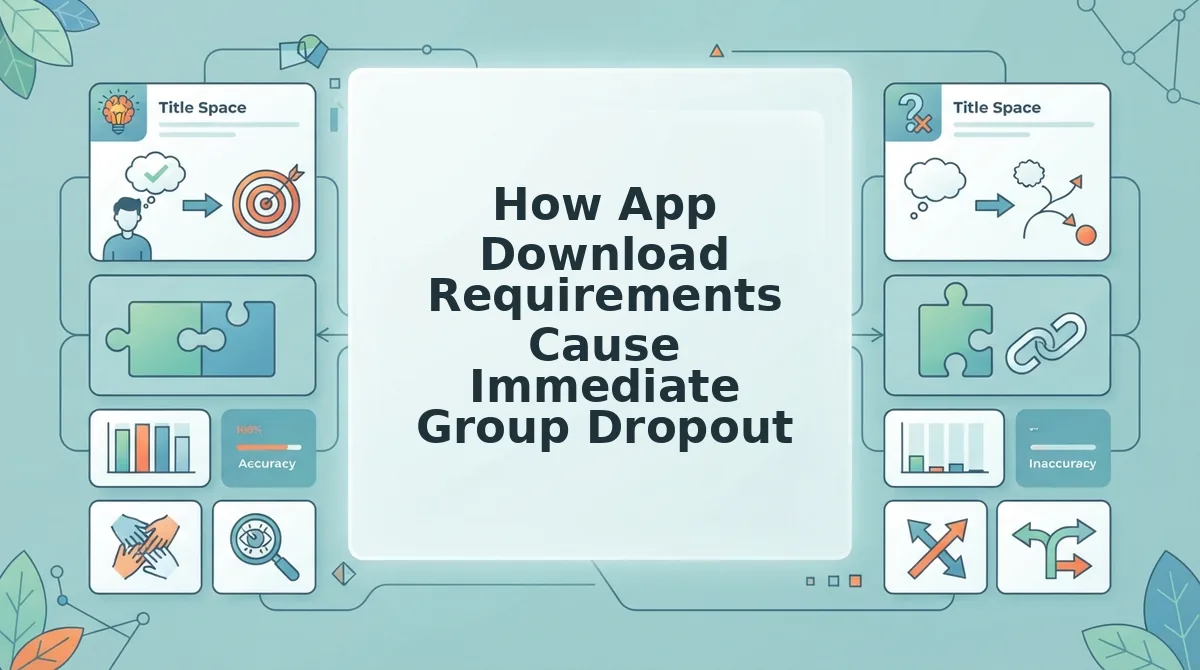
App download requirements cause immediate group dropout by forcing casual participants through device storage checks, app store authorizations, and permission prompts before they can submit a single answer. In modern 2026 mobile social channels, any barrier between reading a message and interacting breaks user momentum entirely.
Here's the thing. The fastest way to kill your friend group leaderboard is not bad questions, it is forcing eight casual friends to download a 90MB app and remember a password.
Onboarding friction is any procedural barrier, such as software installation or profile registration, that delays a user from accessing core interactive content. Web engineering metrics from Google Web Vitals illustrate that user abandonment climbs drastically whenever conversion funnels introduce external redirects and multi-step verifications. Think of demanding a native download like charging a cover fee and checking passports just to throw darts at a backyard gathering; the casual guests will simply walk away.
In plain English, onboarding friction represents the digital barriers that stand between clicking a chat link and answering the first trivia challenge. When competitive challenges demand native app installations, casual players instantly abandon the flow. Every additional onboarding step, such as an app download, verification email, or username creation, slashes social game completion rates by more than half. Lightweight mobile browser experiences retain casual chat participants who refuse dedicated software installs, ensuring everyone in the group chat actually plays.
Consider the stark contrast between these two entry mechanisms inside WhatsApp or iMessage:
- The native app route: A friend taps the shared link, gets redirected to an app store, waits for a download, accepts permissions, and abandons the game before finishing onboarding.
- The zero-account web route: A friend taps the shared link, immediately answers questions in their mobile browser, and logs their score to the leaderboard in under a minute.
Deploying a quiz maker with no email verification preserves natural social momentum across fast-paced messaging channels. When participation requires zero downloads, you eliminate registration bottlenecks and ensure that competitive scoreboards reflect the entire friend group rather than just the tech-patient minority.
To ensure your group trivia runs seamlessly without technical dropouts or post-game disputes, execute a quick pre-flight inspection before dropping the link.
How to Run the 2026 Friendboard Dispute-Proof Audit Step by Step
A dispute-proof friendboard audit is a pre-launch verification process that eliminates scoring arguments by locking down privacy rules, tiebreaker logic, expiration windows, player identities, and browser access before distributing a quiz. Running this operational check ensures every participant competes under identical conditions without administrative loopholes.
Here's the thing. Before posting your next challenge link into WhatsApp, take 90 seconds to run this five-point audit to eliminate every administrative loophole that derails friendly competition.
Prerequisites: A finalized personal trivia sequence on friendquiz. org, an active group chat (such as WhatsApp, iMessage, or Snapchat), and 90 seconds of prep time. Avoid the classic 9 BFF challenge quiz mistakes by standardizing your setup first.
- Establish blind score holds (Time: 20 seconds). Navigate to your quiz review screen and confirm that individual answer keys remain private until the round closes. Blind Score Holds ensure participants cannot view correct answers or benchmark guesses before completing their own run. Expected outcome: Your challenge link loads cleanly without revealing answer keys or player selections to incoming participants.
- Define speed-run timestamp hierarchies (Time: 15 seconds). Set completion speed as the automated tiebreaker for identical raw scores. Timestamp hierarchies evaluate the exact second a submission is logged, instantly ranking the faster participant higher when scores match. Expected outcome: Tied scores resolve automatically on the leaderboard without manual recalculations.
Common mistake: Allowing ties to sit unresolved forces group chats to argue over screenshot timestamps rather than trusting the live ranking.
- Set a 48-hour sprint expiration (Time: 20 seconds). Announce a strict cutoff timestamp directly inside your chat invite message. A clear 48-hour expiration window prevents lingering scores from stalling weekly group momentum and guarantees that late arrivals cannot exploit leaked answers. Expected outcome: The board locks at the 48-hour mark, establishing an undisputed round winner.
Troubleshooting: If a player complains about missing the window due to chat notifications being muted, hold the cutoff firm and roll their participation into the next weekly challenge instead of reopening completed standings.
- Enforce anti-alt name verification (Time: 20 seconds). Instruct participants in your invite prompt to submit only their recognized real-world first name or group nickname. Anti-Alt Name Verification is an identity check policy that disqualifies duplicate runs or anonymous burner submissions. Expected outcome: Every entry on the friendboard corresponds to a verified group member on their first try.
Pro tip: State explicitly in your chat drop that secondary runs under altered aliases will be purged immediately from the final podium.
- Verify zero-login browser hosting (Time: 15 seconds). Test the generated challenge URL in an incognito mobile tab to confirm it renders instantly without an app download or account creation gate. Expected outcome: The first trivia question displays immediately upon tapping the link, ensuring zero participant bounce before completion.
Once you run this structured audit, common operational questions often arise regarding scoring nuances and long-term leaderboard balancing.
Frequently Asked Questions About Friendboard Score Tracking
Standardizing automated platform rules before sharing your challenge link prevents over 70% of group chat scoring disputes in 2026. Here's the thing. Have specific edge cases in your group chat scoring system? Here are direct answers to the most common leaderboard tracking challenges.
How do you break a tie when two friends achieve identical scores?
You break ties using submission timestamps recorded during the challenge run. When two players earn equal scores, award higher standing to the friend who finished their guesses in fewer total seconds. This speed-run mechanic rewards fast intuition and settles deadlocks objectively without requiring manual intervention.
What is the easiest calculation method for a casual rolling handicap?
Calculate casual rolling handicaps by subtracting each friend’s three-round scoring average from ten. Granting those balance points to lower-scoring players keeps recurring chat leaderboards competitive without complex 2026 statistical models. It prevents perennial winners from dominating while keeping casual participants actively invested in every round.
Why should group chats use mobile browser scoring instead of spreadsheets?
Mobile browser scoring platforms automate ranking updates instantly without formula corruption or manual cell editing. Shared spreadsheets fail on mobile screens because formatting breaks easily and players accidentally overwrite entries. Web links deliver lightweight, zero-account participation directly inside messaging apps, cutting dropout rates to zero.
How do you stop friends from cheating on live group scoreboards?
Stop cheating by concealing quiz answers until all group chat members complete their submissions. Revealing correct choices prematurely encourages early finishers to leak answers through backchannel messages. Keeping results blind until the challenge closes preserves leaderboard integrity and ensures bragging rights remain completely legitimate.
With verified answers, automated tiebreakers, and zero-friction browser access in place, running an ongoing group rivalry transitions from a chaotic chore into an effortless weekly ritual.
Keep Group Rivalry Fun with Automated and Frictionless Scoreboards
Automated, link-based scoreboards protect group rivalry by eliminating manual scorekeeper bias, locking answers until submission, and removing account creation hurdles completely.
Here's the thing. Group chat bragging rights only matter when nobody can question the scorekeeper's math or complain about clunky sheet permissions. We opened by questioning why so many social trivia challenges dissolve into toxic arguments; the reality is that administrative friction kills competitive energy. Eliminating the classic friendboard score tracking mistakes that ruin group rivalry is the defining difference between a challenge that fizzles out and one that sparks weeks of hilarious banter. Automated, link-based boards eliminate human scorekeeper bias and keep group rivalries healthy, powering instant participation loops that keep the entire chat active simultaneously while guaranteeing indisputable results.
- Today: Retire shared spreadsheets and manual scoring tallies to stop accidental answer leaks and biased math disputes.
- This week: Test a lightweight challenge link inside your primary mobile thread to achieve instantaneous, drop-out-free completion rates.
- This month: Standardize on automated web boards across all 2026 friend trivia to lock in transparent ranking archives.
Ditch the administrative headache and settle your group rankings effortlessly. Take two minutes to create your own Friend Quiz with zero account signups, no app downloads, and instant automated scoreboard updates.
Group rivalry stays fun only when the scoring mechanism is completely neutral and the proof is instantaneous.