Why a leaderboard makes friends replay a best friend test
You drop the link in the group chat. Silence â then one friend posts a score and the thread detonates. Within a minute, half the group wants another shot. That is usually the moment someone asks how to replay a best friend test, and it is also the moment the real product shows its face: the second attempt, not the quiz.
If you have built a quiz with the friend quiz maker, you know the arc. Enter your name, answer the prompts, share the link, watch the Friendboard fill in â then watch it stall. The questions rarely fail. The chat just lacks a number worth beating.
This guide covers why the leaderboard, not the question writing, drives repeat attempts, how a replay differs from a retake or a rematch, and whether a second go on identical questions counts as cheating.
You will also see why most quiz formats cannot produce a replay loop at all â search this query and you mostly land on one-shot video tests with no score left behind â and why the fix is visibility rather than harder questions.
Replay, retake, or rematch? What each one actually does
Replay keeps the original link and the original questions and files a fresh attempt beside the first one. A retake rebuilds the quiz, and a rematch keeps the people but starts over with new questions â confusing the three is what makes half of these threads argumentative.
The short version: replay means same link, same questions, new attempt, best score stands. A retake means the creator resets or rebuilds, so the questions change. A rematch means the same group starts a fresh quiz, often in a different format, so nobody is defending last week's number.
| Mechanic | Replay | Retake | Rematch |
|---|---|---|---|
| What changes | Nothing except the number of attempts | The question set | The whole quiz |
| Same questions | Yes | No â rebuilt | No â new prompts |
| Score handling | New attempt files under the same name, best score stands | Earlier answers stop lining up with the prompts | A fresh Friendboard starts empty |
| Best for | The friend who saw the gap and wants another shot | The creator whose prompts were weak, vague, or already discussed | A group that has squeezed the original quiz dry |
Honest trade-offs: a rebuilt quiz tells you something new about a person, a replay mostly tests memory, and a one-shot video quiz has one real advantage â nobody can prepare for it. Pick by what you want out of the chat, not by which format sounds trendier.
| What you actually want | Do this | Best for |
|---|---|---|
| Bragging rights, settled fast | Replay the existing link | The competitive friend sitting one point behind |
| New information about a person | Start a fresh quiz with new prompts | The creator whose answers got screenshotted around the group |
| Chaos, on purpose | Run a friendship dare quiz | The group that has stopped taking the scoreboard seriously |
The workflow stays identical across all three: enter your name, answer the prompts, share the link, and each attempt lands on the Friendboard under the same name â which is exactly why the ranking, not the quiz, keeps the thread alive.
Try one attempt on the best friend test first, then decide which of the three your group actually needs.
Why friends replay a best friend test after seeing the leaderboard
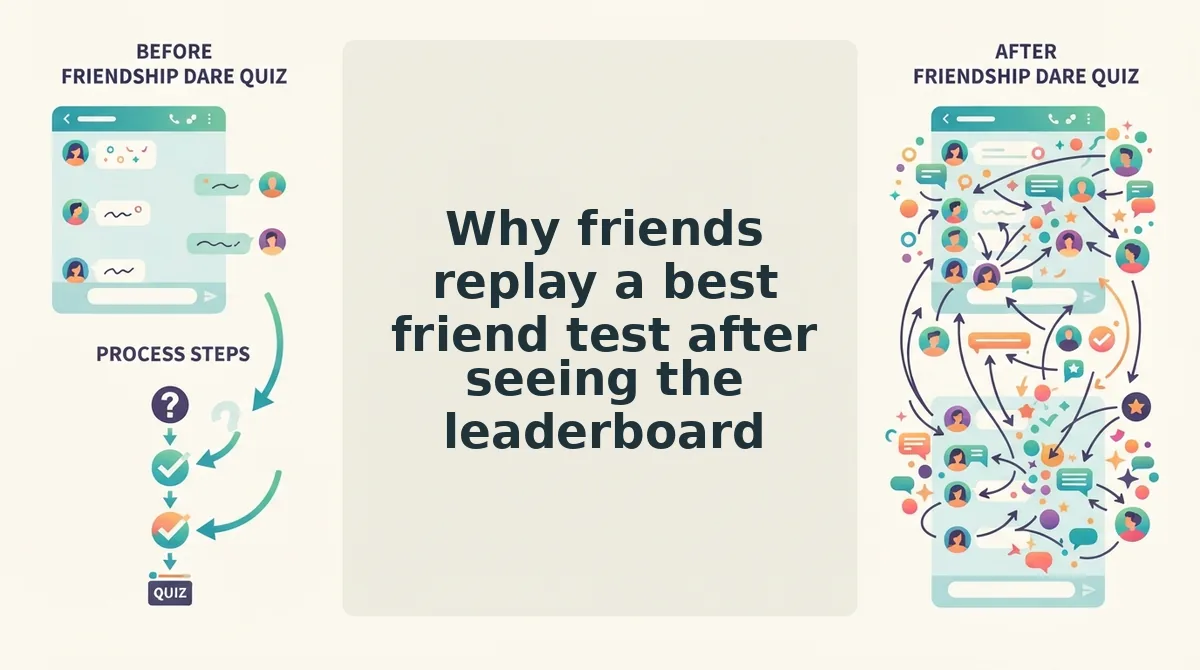
Friends replay a best friend test because the Friendboard turns an abstract result into a visible rank and a specific number to beat, and another attempt on the same link is cheaper than conceding in the chat. The quiz itself is not what pulls them back â the gap between their score and the top score is. Once a friend can see they were two answers behind the person they sit next to at lunch, the loss stops being private and starts looking fixable, and the ranking rather than the questions does the work.
The Visible Score Gap is the measurable distance between the top score on a Friendboard and the score a friend just posted, displayed as both a number and a position. The loop runs in four steps:
- A ranked score appears the moment the first friend finishes, giving everyone else a benchmark.
- The next friend opens the link and sees the delta â a number and a place, not a vague verdict.
- Replay costs one tap; conceding costs face in front of the group.
- The new attempt files under the same name, the best score stands, and the chat reacts again.
Think of the screen above a bowling lane. Nobody memorizes the frame-by-frame math, but everyone can see whose name sits on top, and a spare is always one more roll away.
Why the gap has to be visible at all
An accuracy score that is stored and an accuracy score that is shown to other people are two different products. Hidden, it produces polite congratulations. Ranked, it produces replays â which is the difference explored in Friendboard vs global leaderboard. A synchronous, one-shot video quiz cannot run this loop at all: it is over before anyone can compare, and it leaves no number behind to beat.
A second attempt on unchanged questions feels fair to most players because it stops being a knowledge test and becomes a memory test â they have already seen the answer key, so the replay measures recall and pattern-spotting rather than how well they know the creator. That distinction matters: it is why the same fixed question set rewards attention instead of luck, and why a fresh quiz is the better move whenever you genuinely want new information about a person rather than a rematch of the same rivalry.
Whether that memory advantage crosses into cheating is the next question worth answering.
Is replaying the same best friend test cheating?
No. Replaying the same best friend test is not cheating â a fixed question set turns attempt two into a memory test rather than a knowledge test, and that difference is the entire argument.
A fixed question set is the same list of prompts served to every friend on every attempt.
- Attempt two is a memory test, not a knowledge test. Once the questions stop changing, the only variable left is whether you remember what you saw. Someone who blanked on question four can clear that same prompt on a replay without learning a single new thing about their friend. Use the second run deliberately â treat it as a review, not as proof of closeness.
- The leaderboard already implies repeat attempts. A Friendboard is a running record of scores attached to names, not a sealed one-shot exam. Seeing a score gap sit there invites another run the same way a shared scoreline invites a rematch. Read the replay as the intended loop instead of a loophole.
- The terms are symmetrical, so nobody gains an edge. Every friend holding the same link can replay it too, and they face identical prompts. A retake is only unfair if one person is allowed a second try and another is not. Lean on that symmetry: if a friend grumbles about your second attempt, point out that their second attempt is one tap away.
- A better number is not new information. Replaying can lift your score without changing how well you know the person â the quiz itself learns nothing new about either of you. If what you actually want is fresh material to tease each other about, replaying is the wrong move and a brand-new quiz is the right one.
Verdict: replaying isn't cheating, but it is a different test â it measures recall of the prompt, not closeness of the friendship.
That loop only turns while the link is still alive in the chat, which is exactly where the next problem starts.
How to get friends to replay without nagging the group chat
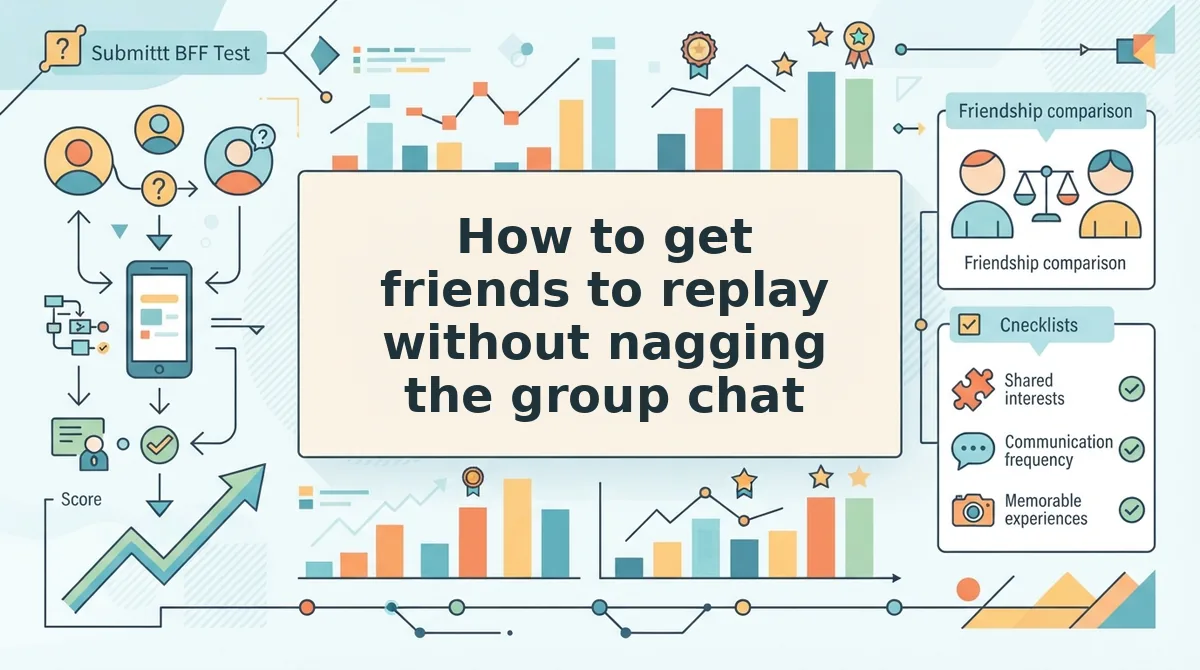
You get friends to replay by putting the ranking where the group can see it and tagging the friend who sits one point off the lead, so the score does the asking instead of you. It takes about two minutes and three things: your quiz link, the Friendboard it feeds, and the chat where you first shared it.
A Friendboard is the live ranking attached to your quiz that shows each friend's score as they finish. That visible gap is the reason a replay happens at all â a friend who can see they are one point behind has a motive that a polite request never creates.
- Open your Friendboard and read the ranking top to bottom â 20 seconds. Note who is first and who is second. If nothing has moved since you shared, check how fast the Friendboard updates before assuming your friends ignored you.
- Tag the friend one point off the lead. Use a close gap only; a wide spread gives nobody a reason to move. You should see their name highlighted in the chat thread.
- Post the ranking into the chat and type one line underneath it with the actual delta, not "play my quiz". Copy one of these:
- "8 out of 10 and you're calling yourself my best friend"
- "One point behind, one replay away, your call"
- "Second place is a real place and you're in it"
- Check the Friendboard again once the reply lands. A new score in the slot you tagged means the nudge worked.
Pro tip: Screenshot the Friendboard and drop the image into the chat rather than pasting the link again. A visible ranking travels further than a URL nobody taps.
If nobody bites, the ranking almost certainly never got seen â that's a visibility problem, not a boring quiz. Fix the surfacing before you rewrite the questions, and read how to keep a group chat from ignoring your quiz link.
What that looks like in practice
You shared a best friend quiz, two people played, and the chat went quiet. Instead of resending the link, you open the Friendboard, see first and second separated by a single point, screenshot the ranking, and post it with a tag on the second-place friend and the line about second place being a real place. They reply, replay, and the new score lands on the board â which gives the next friend down something to chase.
Ready to give your group a scoreboard worth arguing over? Create a friend quiz at friendquiz.org â no account, no app download, and a live Friendboard the moment your first friend finishes.
Most of what friends ask next comes down to scores, attempts, and links.
Questions about replaying a best friend test
Does replaying a best friend test reset my score?
No. A replay adds a second attempt and leaves the first one on record; the best score stands at the top of the Friendboard while the older attempt stays logged underneath. Test-takers keep their highest number, so a bad second run costs nothing.
Can you redo a BFF quiz without a new link?
Yes. The same BFF quiz reopens every time you tap the link, so nobody needs a fresh URL to try again. Creators only need a new link when they change the questions themselves â a replay just opens another attempt on the existing set.
What does the accuracy score on a best friend test actually count?
It counts correct answers divided by total questions, expressed as a percentage. There is no weighting, no bonus points, and no penalty for guessing, which is why two friends can land on the same number from completely different questions.
How do I get a friend who has never played to join?
Send the link straight to that person rather than dropping it in the group chat, where it scrolls away within minutes. A first-timer needs no account and no download â one tap opens the quiz in their phone browser.
- Tag them by name in the message so it reads as a dare, not a broadcast.
- Ask what they scored, which turns a shared link into a conversation.
A replay only means something if you know what the second run is actually measuring.
What a second attempt really measures
A replay measures appetite for the top of the board, not knowledge of the person â and that is still a real answer about the friendship, just not the one the quiz asked for.
Watch what happens when someone lands at 6/10 while the leader sits at 9/10. The gap is visible, public, and cheap to close. That friend isn't relearning you â they're buying another roll of the dice on a scoreboard the whole group can see.
Which leaves a sharper question than "should I let them replay?" â what do you actually want the board to record?
- Replay for yourself. Reopen the same link and take one more pass at your own accuracy score. Your best attempt stands; nothing already posted gets erased.
- Build a board for the group. Create your own quiz and share one link, so the ranking fills itself without a single nudge message from you.
Two moves, one board: replay for yourself, then build one for the group. If you want a second surface to share, the friendship test runs on the same one-link, no-download setup. A leaderboard doesn't measure who knows you best â it measures who refuses to stay third.