Friendship Test Rankings for Roommates Who Love to Compete
Four roommates, four separate quizzes, and four different "best friend" verdicts â which means nobody can prove anything. The fix is structural, not emotional: friendship test rankings for roommates only work when one person builds the test and everyone else answers the same link. One creator, one shared quiz, one ordered list of who actually pays attention.
This is the household playbook. You'll get the setup that survives a flat where nobody is on the same device, the question style that produces a real spread instead of a five-way tie, the fair-play rules almost nobody writes down, and a fixed tiebreaker sequence for the deadlock that always arrives. Later, you'll see which single habit question splits a group faster than any "deep secret" prompt â it's the one most quiz makers skip entirely.
Friend Quiz runs the whole thing in a mobile browser: type your name, answer the prompts, share one link, and watch the friendship test results stack up on a live Friendboard â no account, no email, no download for anyone in the flat.
What Do Friendship Test Rankings for Roommates Actually Measure?
A friendship test ranking measures match count, not personality. A friendship test ranking is an ordered placement of every household member by how many of the quiz creator's answers they matched â four roommates, four scores, one table, highest to lowest. Percentages, grades, and personality labels play no part.
Two terms carry the rest of this page. The Friendboard is the live standings page attached to a single quiz link, so nobody has to screenshot replies into the group chat. A tiebreaker is the fixed rule agreed before answering starts, so a 7â7 deadlock doesn't turn into an argument about the argument.
Think of it like a household fantasy league: one scoring sheet, one table, and standings that only mean something because every player drafted from the same pool.
What a flat needs before the standings mean anything is agreement, not equipment. One roommate writes the quiz and becomes the answer key. The test runs 10â12 prompts, long enough to separate people, short enough that everyone actually finishes. One link goes out, everyone answers exactly once, and the group accepts the result before the first answer lands. Because no account or app install is involved, people answer from whatever phone, tablet, or laptop is already open on the sofa.
Get those four conditions right and the placement is clean. Skip any one of them â two links, two rounds, no agreed tiebreaker â and you get four opinions instead of a ranking. The friendship test flow handles the sorting; the household handles the agreeing.
How Do You Set Up and Share the Roommate Friendship Test?
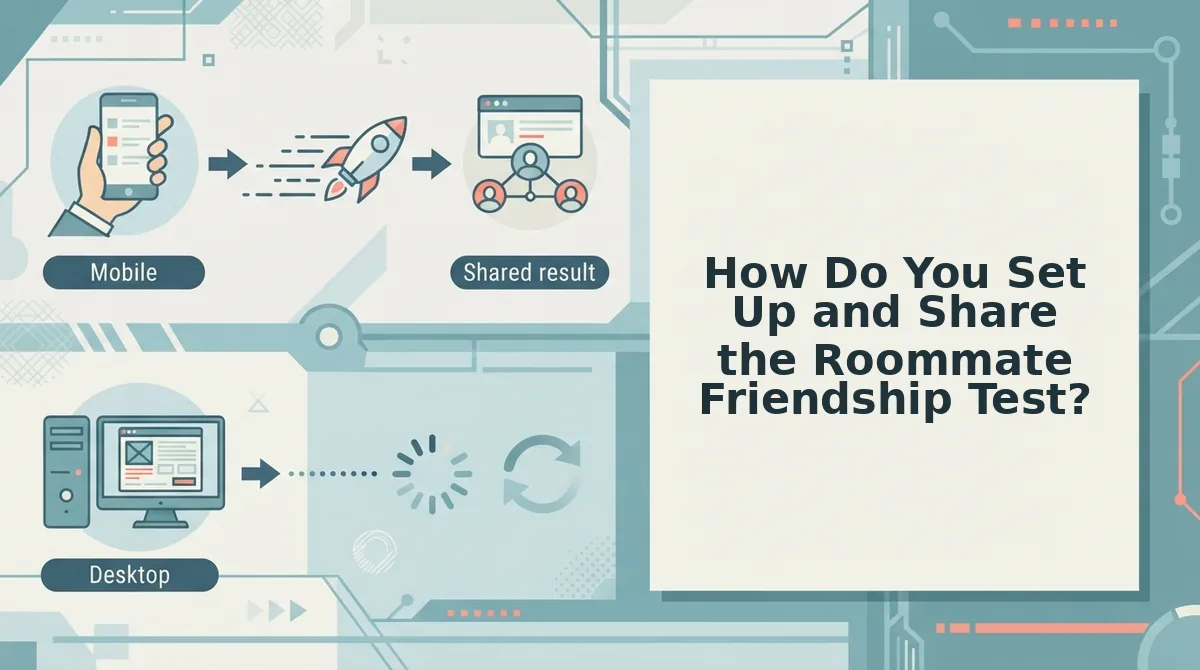
Set up takes about two minutes and needs one browser, one phone or laptop per roommate, and a promise to answer at the same time. There is nothing to install and no account to create at any stage.
- Open friendquiz.org and type your name. Your name becomes the quiz title, so the link is instantly identifiable in a chat with three other threads running. You should see the first prompt load in the same screen.
- Write 10â12 prompts that separate people. Apply the Shared-Flat Test: ask about observable behaviour rather than confided secrets, because roommates know habits, not inner life. Ten to twelve discriminating prompts produce a spread; twenty-five easy ones produce a five-way tie.
- Answer your own prompts as the creator. This builds the answer key every roommate is scored against. You should end with a complete set of your own answers saved.
- Drop the one link in the group chat with a deadline. "Answers in by 9pm, no asking me" is the whole instruction. Everyone answers once, on their own device, without seeing anyone else's screen.
- Let the scores sort themselves. Each completed round adds a name to the standings in matched-answer order, so the household gets a table rather than a tally sheet.
| Roommate prompt | What it reveals |
|---|---|
| What temperature is the thermostat set to right now? | Who runs hot versus who runs the bill |
| How long do dishes sit in the sink before someone cracks? | Who cleans on a trigger versus on a schedule |
| Which mug is off-limits, and whose is it? | Who notices territory claims |
| What's the default takeaway order on a bad night? | Who actually shares the food decisions |
| What time does the flat really go quiet? | Who tracks other people's rhythms |
| Which chore gets done silently and never mentioned? | Who sees the invisible labour |
Run the same structure as a tighter best friend test for the two people who think they're the closest pair in the flat â same link, same rules, different bragging rights. Either way, the household gets one scored round instead of four competing narratives.
The scores land in order automatically once everyone has answered â here's how the table fills in live.

How Does the Friendboard Turn Answers Into Live Standings?
A Friendboard is a live standings page for one quiz that ranks every roommate who answered by how many of their answers matched the creator's, and it updates as each person finishes rather than only at the end.
On the creator's side the mechanic is three steps. One person builds the quiz from their own real answers, one link goes into the group chat, and each roommate opens it on their own device, answers once and submits without a profile, login or install. The board then counts matched answers per person and displays the flat in descending order, ready to screenshot the moment the last submission lands.
Think of it as a pub quiz scorecard pinned to the fridge: everyone plays identical rounds and the card fills in as sheets come back, except the marking is automatic and nobody can round their own score up.
Who Sees What, and When
The board is a scoreboard, not a transcript. It publishes placement by match count, so the group chat gets an order rather than a running commentary on which prompt each person missed. It also ranks only the people on that one shared link â this is not a site-wide leaderboard against strangers. If the flat wants tighter rules, agree before the round that only the top three placements get screenshotted.

How Do You Check That the Rankings Actually Worked?
Read the spread before you read the names: a wide gap between first and last means the prompts separated the flat, while a near-flat line means you asked questions anyone could guess.
- A wide spread between first and last. This is the success signal â every point of separation is a prompt somebody genuinely didn't know. Three or more answers of daylight between top and bottom means the quiz did its job.
- Everyone scoring identically. A flat line means the prompts were too easy, usually favourites every roommate has already heard. Rebuild around shared living â thermostat settings, dish defaults, who hoards the good mug â and rerun.
- Late joiners. Send the same link, never a fresh quiz, so their score lands on the existing board instead of splitting the flat across two leaderboards.
- One person refusing to play. Agree the rule out loud â they rank last or they sit out â and let the standings continue. Waiting on a refuser stalls the board halfway and kills the momentum.
- A disputed "wrong" answer. The creator's original answer stands, full stop. Relitigating every prompt turns a two-minute game into a committee meeting.
- A tie at the top. Run the ladder in order: repeat head-to-head on the most discriminating prompts, then one sudden-death prompt, then earliest submission time as the final call.
Then lock the fair-play protocol: everyone answers simultaneously, nobody asks the creator for hints, and the creator stays out of the answer chat until the board is full. Households that want a second round with higher stakes can escalate to the friendship dare quiz, and pairs craving a head-to-head can run a BFF quiz.
What to Do With Your Standings Once Everyone Has Played
The board settles the argument the group chat was having with a number instead of a vibe. That's the payoff: one flatmate is provably the best-informed, and everyone else has a rerun to demand.
Run the sequence start to finish tonight â build a quiz with 10-12 prompts drawn from shared-flat life, drop the single link in the group chat, let the Friendboard order the household as submissions land, and apply the tiebreaker ladder if two people finish level. Keep the fair-play rules posted so nobody plays the last hand twice.
If your flat finishes in under ten minutes and immediately wants more, escalate to the friendship dare quiz â same mechanic, higher stakes, a fresh board to fight over. Then type your name on Friend Quiz and send the link before anyone changes the subject.