What to do when one friend runs away with the friendboard
Three friends have played, and one name already sits clear of the pack â everyone else bunched within a point or two, close enough to touch and nowhere near the top.
If that's your group chat, you're watching one friend dominating the friendboard, and the maddening part is that you built the quiz. You typed your name, cycled the habit prompts, dropped the link, watched the answers arrive in order â then the same person won by the same margin.
The cause is mechanical, not mystical. Three things drive that gap, and one of them is the cause your group never says out loud.
Watch where the advantage enters. A creator runs the speed-run prompts, keeps the ones with an obvious right answer, and shares the link; friends answer sequentially, with the board already visible. Winning stops being about knowing you and becomes about position.
One limit worth naming: none of this proves anyone cheated, and no format makes a board perfectly even â a friend who genuinely knows you should win sometimes. What you can change is the shape of the contest, and re-running the friendship test prompts takes under two minutes, with no account and no download.
Before you reset anything, it helps to know what a fair friendboard actually requires.
What a Fair Friendboard Needs Before You Reset Anything
Reset the board, not the quiz. Keep your question path, start a fresh friendboard, and confirm the link opens before you blame the questions.
The friendboard is the live ranking of everyone who answered your link; your question path is the ordered set of prompts each player moves through; format rotation swaps the quiz type, not the wording.
- A saved question path you can edit. If you can reorder prompts without redoing your Speed Run, a reset costs seconds instead of a rebuild. Test that it loads before you share anything.
- A shareable link that opens cold on a phone. The link is the whole game â no download, no login, no wall between a friend and their first answer. Paste it into the group chat once, then tap it from a second device.
- Two submitted answers, minimum. One score isn't a ranking; two is. The same link must load the same path for every player, or a reset proves nothing and the gap looks like skill instead of setup.
To see that flow before asking anyone else, take the best friend test yourself â same link, same no-login path.
Which leaves the question of why the same name keeps landing on top.
Why Does the Same Friend Keep Winning Your Quiz?
Because they're playing a different game than everyone else in the chat. Three causes explain almost every runaway Friendboard â a narrow question pool, proximity bias, and the modal-answer strategy â and only one of them is actually unfair.
Diagnose before you reset. Think of a rec league where one team keeps winning: sometimes they're genuinely better, sometimes the schedule keeps handing them home games. Your quiz has a schedule problem, and it's fixable.
Proximity bias is the tendency for prompts to favour whoever physically shared the memory the prompt was built from. Write a question about a road trip two friends were on and those two start with a lead nobody else can close.
Modal-answer strategy is answering each prompt with the most statistically likely option rather than the true one. It's a legitimate style of play, not cheating â and it wins every time your prompts are predictable enough to guess.
| Cause | What it looks like on the board | Fix in section 4 |
|---|---|---|
| Narrow question pool | Same two or three names rotate through the top spots | Widen the prompt mix beyond habits and favourites |
| Proximity bias | One friend scores high on memory questions, low on nothing | Rotate in prompts about things nobody witnessed |
| Modal-answer strategy | A solid, unspectacular score with almost no wrong guesses | Write prompts with no obvious default answer |
Before you call any score dominant, check what a normal spread looks like â what a good score on a best friend quiz friendboard actually is.
Why does my friend always win my quiz? Usually because they're answering strategically, not psychically. A player who picks the most statistically likely option on each question â fruit, pet, weekend habit â outscores a player answering honestly about details they never witnessed. Layer on proximity bias, where prompts drawn from shared memories favour whoever was in the room, plus a narrow question pool repeating the same themes, and one friend can sit at the top of the leaderboard without doing anything unusual. The board isn't broken. The question design is doing the work.
The fastest fix doesn't require rebuilding your quiz at all.
How Do You Start a Fresh Friendboard Without Rebuilding the Quiz?
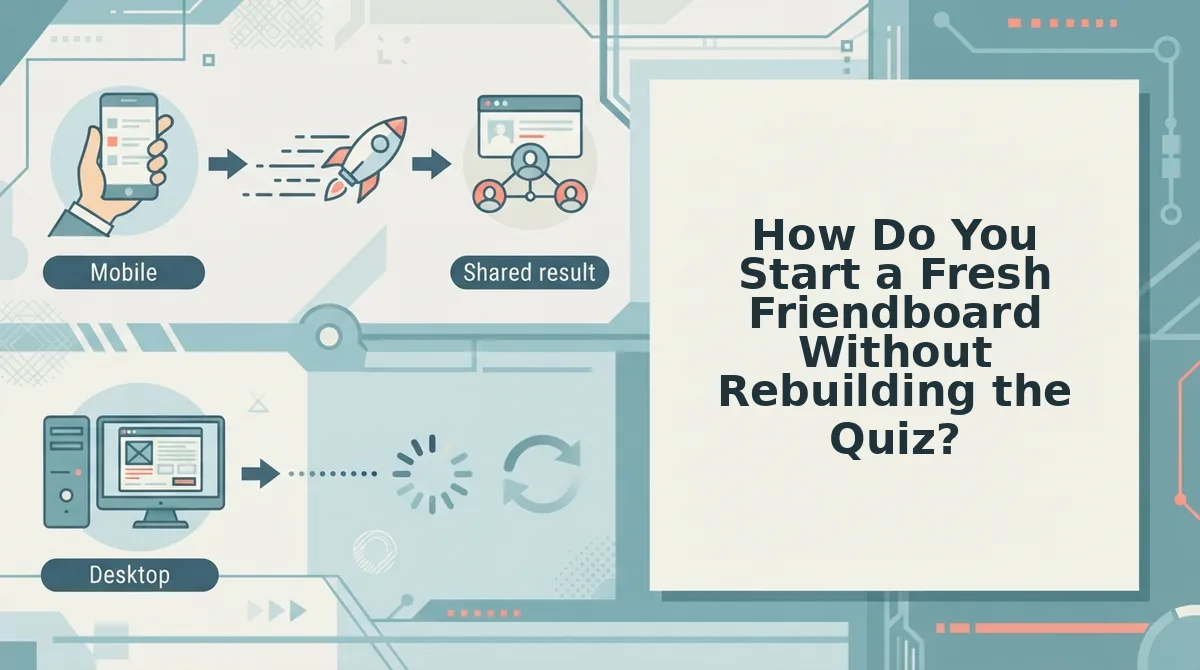
You can reset a friendboard in about three minutes by keeping your existing quiz as the base and rewriting the prompts instead of starting over. All you need is your quiz link, the edit screen, and the group chat where the original was shared.
Friend Quiz runs on one simple creator workflow: name, then prompts, then link, then sequential answers, then results. The reset happens at the prompts stage, which is why you never have to retype your name or rebuild from scratch.
- Open your quiz's edit screen and keep the question set. Leave the number of questions and the answer format exactly as they are. You should see the same quiz structure you built the first time, ready to edit rather than recreate â this saves the bulk of the rebuild time.
- Rewrite each prompt across a wider pool of topics. Swap habits your closest friends already know for ones only a sibling, coworker, or old classmate would catch. Aim for a spread that touches daily routines, dislikes, small preferences, and one or two odd quirks. You should see a set where no single person has heard every answer.
- Generate the new link. Save the rewritten prompts and copy the fresh share URL. You should see a new link that loads the updated quiz in a mobile browser with no login required.
- Reshare with a one-line reason. Post the link with a short note like "rewrote the questions, everyone replay." You should see replies and new submissions within the hour instead of silence â if not, see how to keep a group chat from ignoring your new quiz link.
- Check the board after the third and fifth submission. Compare both the leader and the spread between first and last place. A new name at the top, or a visibly tighter spread, means the fix landed.
Be honest about the limit: a fresh link resets scores but cannot guarantee parity. If the same friend still tops the board, that's data about how well they know you, not a failed reset â and a best friend quiz with a genuinely close result is more fun to replay than a manufactured tie.
Ready to try the rewrite? Create your best friend quiz, edit the prompts, and drop the new link in the chat.
Which Format Swap Actually Changes Who Wins?
Swap formats when rewriting questions doesn't move the leader â each change redefines what winning means, so a different skill decides first place. Work down this ladder from the smallest change to the largest.
- Rewrite the prompt pool first. This is the cheapest swap and the one most groups skip. Expanding from a handful of obvious habits to a mixed pool of routines, dislikes, and quirks is the difference between testing memory and testing closeness. Use it before anything else, because it fixes the actual cause rather than the symptom.
- Move to a friendship dare quiz. A friendship dare quiz replaces recall with willingness, so the friend who remembers everything no longer has an automatic edge. Winning here means being game, not being attentive â pick it when your group is bored rather than genuinely mismatched.
- Build a fresh question path. Start a new quiz with entirely new prompts rather than edited ones. This resets the guessing advantage a dominant player has built up across repeat rounds, because they no longer have a modal answer to fall back on.
- Change the game type entirely. A different quiz format changes the scoring surface, not just the questions. Use it as the last rung, when two boards in a row have produced the same winner.
On pool size: a quiz likely needs roughly 10â15 prompts before single-guess variance stops deciding first place [est.]. That's reasoning from how often a lucky guess can swing a short board, not a measured study â treat it as a target, not a rule.
How to make a friendship quiz fairer
Fairness in a friendship quiz comes from question spread, not from handicapping the best player. Widen the prompt pool so no single friend has heard every answer, keep the count high enough that one lucky guess can't decide first place, and rewrite prompts between rounds instead of replaying the same set. Avoid tilting questions toward the weakest player â a board where the person who knows you best still wins is the point. If the same name tops two boards in a row, swap the format rather than the scoring, because the real risk is that the chat stops clicking the link at all.
One mechanic worth naming: when the same name wins twice running, the group chat goes quiet. A format swap is re-engagement first and fairness second â and it takes about two minutes to start a friendship dare quiz for the chat.
Parity isn't the goal. A board people want to come back to is â and sometimes that means letting the friend who genuinely knows you keep the top spot.
Reset the Board and Hand the Link Back to the Chat
The diagnosis compresses to one line: your prompts are too narrow and one friend has learned your answer pattern. The fix is equally short â widen the pool, generate a new link, and reshare it with a stated reason so nobody assumes they missed something.
Do it in two moves. Reshare the rewritten link now and read the board after the third and fifth submission. If the same name still tops it, open a clean board with brand-new prompts and let the group start from zero â a new BFF quiz takes about two minutes and needs no account.
Then leave it alone. The winner seeing their name at the top is part of the fun, which is why the fix is better questions rather than a handicap on the leader. A board worth returning to beats a tie nobody earned.