What Makes a Friend Quiz Go Viral in Discovery
Topper Guild's "Best Friend Quiz" video has racked up 38,926,124 views, and yet the quiz you spent 20 minutes building for your group chat got two replies and a "seen." That gap isn't about effort. It's about understanding what makes a friend quiz go viral in the first place: identity stakes, instant payoff, and a re-challenge loop that refuses to die.
You've felt it. You send a quiz link into WhatsApp or iMessage, and it either detonates into a 40-message thread or evaporates without a trace. The difference is rarely the questions, it's the psychological triggers baked into the quiz before anyone taps it.
This article breaks down the viral mechanics behind friend quizzes: why they spread in group chats, the four-step loop that turns one tap into a rematch, and the speed threshold that separates a quiz that goes viral from one that gets ignored. Along the way, you'll see how a zero-account, under-two-minute creation workflow, like the one at Friend Quiz, removes the friction that kills most quizzes before they launch. One finding in particular will change how you write your next quiz's first question.
Why Do Friend Quizzes Spread in Group Chats?
A friend quiz spreads because it gives people a low-risk way to signal identity, earn visible social proof, and satisfy curiosity about how others perceive them, all inside a conversation they're already having.
Start with the simplest layer: identity signaling. People share quizzes that make them look good or reveal something flattering about themselves. When someone posts a "Who knows me best?" link, they're not just sharing a game, they're saying, "I'm interesting enough to be studied." The quiz becomes a mirror, and the sharer wants that mirror held up in public.
The intermediate layer is social proof framing. Think of a friendboard like a scoreboard at a bowling alley: nobody bowls a strike and quietly sits down. They look up, check the screen, and let the ranking do the bragging for them. Friendboards and rankings create the same effect, visible, shareable bragging rights that turn a private score into a public claim. A 9/10 on a best friend quiz isn't just a number; it's a badge you screenshot and post.
The advanced layer is the curiosity gap. A quiz titled "Which of my 3 a.m. thoughts are you?" creates an itch that only tapping the link can scratch. The gap between what you know about your friend and what the quiz promises to reveal is the engine that drives the tap. Micro-leaderboards amplify this by making every score a new piece of evidence in an ongoing rivalry, not a one-time result, but a standing argument.
Here's the self-contained answer: A friend quiz goes viral in group chats when it combines three psychological triggers: identity signaling (the sharer looks good by sharing), social proof (rankings and friendboards make scores publicly comparable), and a curiosity gap (the promise of revelation is stronger than the effort to tap). When all three triggers fire in a chat where trust and banter already exist, the quiz stops being a link and becomes a conversation event, something people respond to, screenshot, and re-share.
The 4-Step Viral Loop Framework for Friend Quizzes
The viral loop has four stages: Trigger (identity curiosity), Tension (personal stakes), Reveal (shareable proof), and Re-challenge (rematch pressure). Each stage maps to a specific feature you can build into any friend quiz.
Prerequisites: A quiz creation tool that requires no account and no app download, like Friend Quiz's browser-based builder, plus a group chat where at least three people know each other well enough to care about the results. Total setup time: under two minutes.
- Trigger. Frame the quiz as an identity test, not a trivia game. Open your quiz builder and title it with a "who knows me best" or "how well do you actually know me" framing. This phrasing creates identity curiosity: the person reading it immediately wonders whether they'd score higher than everyone else in the chat. You should see the question prompts shift from generic ("What's my favorite color?") to identity-loaded ("What's the habit I hide from everyone?"). Expected outcome: the first tap happens within seconds of posting, because the title makes not tapping feel like admitting you don't know your friend. For question ideas that maximize this trigger, use best friend quiz questions that trigger identity curiosity.
- Tension. Fill the quiz with personal habits and inside jokes, not generic trivia. Select prompts about your daily routines, quirks, likes, and dislikes, the details only someone who actually pays attention would know. Generic questions ("What's my birthday?") create no tension because anyone can guess them. Inside jokes and hidden habits create stakes: every wrong answer is a small public embarrassment, every right answer is proof of closeness. You should feel a slight discomfort writing at least one question, that discomfort is the tension working. Expected outcome: players slow down, second-guess answers, and start debating in the chat before they even finish.
- Reveal. Let the friendboard do the bragging for you. After players submit, the quiz should display a ranked friendboard showing who scored highest. This is the shareable moment: the winner screenshots the ranking, posts it back into the chat, and the social proof loop starts. You should see the chat shift from gameplay to commentary, "Of course Sarah won, she's obsessed with you." Expected outcome: at least one screenshot of the friendboard gets shared outside the original chat, pulling in new players who want to beat the current leader.
- Re-challenge. End with a dare, not a goodbye. Attach a rematch prompt or a dare link to the results screen. The message should challenge the winner to prove it wasn't luck or challenge the losers to redeem themselves. You can use friendship dare quiz links to turn the rematch into a higher-stakes round. Expected outcome: the quiz gets replayed within 24 hours, often with new players joining to dethrone the current champion.
Here's the self-contained answer: The 4-step viral loop for friend quizzes works like this: (1) Trigger identity curiosity with a "who knows me best" title, (2) build tension using personal habits and inside jokes instead of generic trivia, (3) reveal a ranked friendboard that gives winners a shareable screenshot, and (4) re-challenge players with a dare or rematch prompt that restarts the loop. Each step feeds the next: the trigger gets the tap, the tension keeps players engaged, the reveal creates social proof, and the re-challenge turns one quiz into an ongoing rivalry.
But none of this matters if your quiz takes too long to load or too many taps to start. That's where speed becomes the silent killer, or the secret weapon.
How Fast Does a Friend Quiz Need to Be to Go Viral?
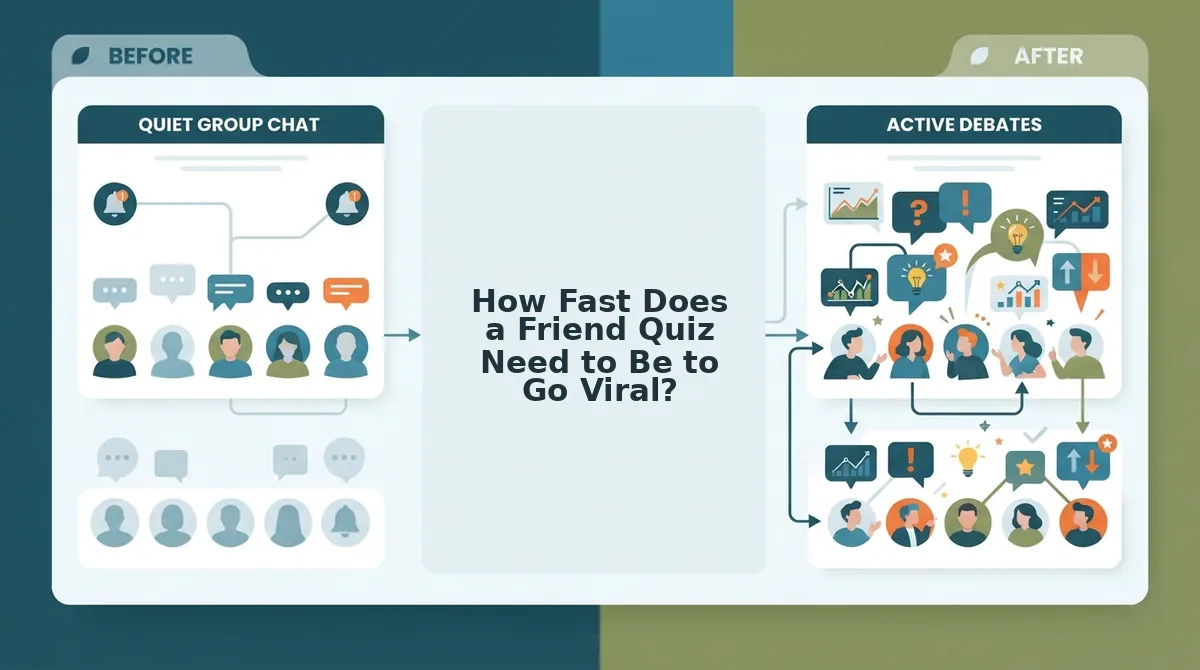
Viral speed is the total elapsed time between a friend tapping your quiz link and that friend sharing their own result, and it has a hard ceiling of about three minutes. Friend Quiz's workflow hits this by letting you create a friend quiz in under two minutes and letting players finish in under 30 seconds.
Think of quiz speed like a checkout line: every extra step is another shopper who abandons the cart. Mobile users abandon pages that take longer than three seconds to load, and attention spans inside group chats are even shorter, a quiz that takes five minutes to finish gets screenshotted, mocked, and forgotten.
The speed requirement breaks into three tiers. At the simple level, a quiz must load instantly and show the first question without a signup wall. At the advanced level, the result screen must render a shareable scorecard immediately, because the share moment is the only conversion that matters.
Zero-account entry removes the biggest friction point. A quiz that asks for an email before question one is not a quiz, it is a lead-generation form wearing a quiz costume. Friend Quiz skips accounts entirely, which means the first tap is also the first question.
Here is the passage to index: A friend quiz goes viral only when the full loop, open link, answer questions, see result, share result, completes in under three minutes total. Play should take under 30 seconds, because group chat participants scroll past anything that feels like homework. The single largest speed killer is an account wall: requiring signup before play adds 30-60 seconds and drops completion rates by double digits. The second killer is page reloads between questions, which break momentum and invite tab-switching. The third is a slow result screen, because the share moment is when the quiz either spreads or dies.
What Kills a Friend Quiz Before It Spreads?
Most friend quizzes die from self-inflicted friction, not bad questions. These five anti-patterns are the most common killers, ranked by how fast they stop a share.
- Account walls before the first question. QuizYourFriends requires signup before anyone can play, which adds 30-60 seconds of typing emails and passwords before the fun starts. Every second of pre-quiz friction filters out mobile users who opened the link on a whim. Skip accounts entirely and let the first tap land on question one.
- Ad clutter that blocks the submit button. Buddy Meter's ads can cover the submit button on mobile screens, turning a 30-second quiz into a rage-quit. When an ad intercepts the exact moment a player tries to advance, the quiz feels broken and the player leaves. Keep the answer path visually clean and tap-target obvious.
- Multi-page reloads between questions. Buddy Meter's lag between questions breaks the flow, and every reload is a chance for the player to check another app and never return. A quiz that stutters feels like a website, not a game. Serve questions in a single uninterrupted flow.
- Generic questions with no personal stakes. A quiz that asks "What is my favorite color?" with no context gives players nothing to prove and nothing to share. Personal trivia about habits, quirks, and inside jokes creates stakes because the player either knows the creator or gets exposed for not knowing. Stakes are what turn a score into a screenshot.
- No re-challenge hook after the result. A result screen that ends with "You scored 6/10" gives the player nowhere to go. A dare link that says "Beat my score or admit I know you better" invites rematches and keeps the quiz circulating. The share moment is the growth engine, and a dead-end result screen wastes it.
For a deeper breakdown of how these friction points compare, see the Buddy Meter comparison and the QuizYourFriends speed test.
The Share-Moment Design Checklist
A friend quiz spreads only when the share moment is engineered, not accidental. These five link-level decisions determine whether your quiz gets forwarded or forgotten.
- Link preview text that creates a curiosity gap. The preview should tease a specific claim, "I bet you can't score 8/10 on my quiz", without revealing the answer. A curiosity gap makes the tap feel like a dare, not an obligation.
- Zero-friction entry with no account and no app download. The link must open directly into question one, because every intermediate step filters out mobile users. A zero-account quiz link removes the single biggest drop-off point.
- Result shareability with friendboard rankings. The result screen should show a ranked friendboard with names and scores, because bragging rights are the emotional payload of the share. A bare score is forgettable; a leaderboard is a challenge.
- A re-challenge prompt that dares a rematch. End the result with a dare link, "Think you can beat 7/10? Try again", that invites the player to re-enter the loop. Rematches double the share surface of every quiz.
- One-tap share buttons for the player's primary chat app. The share button should pre-fill the message with the quiz link and the player's score, because typing a custom message is friction. Pre-filled text turns a passive result into an active forward.
Viral Loops Are a System, Not a Lottery
The friend quizzes that dominate group chats in 2026 don't win by accident. They win because their creators followed a repeatable sequence: fast setup, frictionless play, and a share moment engineered into the final screen. The framework works every time it's applied.
So apply it. Create your friend quiz now, the speed-run builder takes under two minutes, and your quiz link is ready the second you finish the last prompt. Drop it in your group chat. Watch the Friendboard populate in real time as everyone competes for the top spot.
One question changes everything: would you share this if you lost? If the answer is yes, you've built a loop that feeds itself. If not, tighten the questions until losing feels just as fun as winning.
"A friend quiz goes viral when every player becomes a promoter, and every promoter becomes the next creator."