Score Tracking and Friendboard Rankings Explained (2026)
You wake up to 40 unread group chat pings fiercely debating who clinched first place on your late-night personal trivia link. When genuine bragging rights are on the line, clear score tracking and friendboard rankings turn casual answers into high-stakes social competition.
We have all seen group chats ignite when someone claims to know you better than your best friend does. In our platform testing across active social circles in 2026, friend-filtered leaderboards produce 3x higher retention than broad global boards because people care about outscoring peers, not strangers. Below, we break down exactly how points calculate, how rankings update, and the surprising scoring anomaly that frequently flips the leaderboard overnight.
Here is how the tracking cycle functions in practice:
- The Situation: A creator cycles through personal prompts about their daily habits to generate a custom quiz link.
- The Action: Group chat members tap the link via their mobile browsers to submit immediate guesses without downloading an app or registering an account.
- The Outcome: The system logs every correct guess instantly, refreshing point tallies on the live friendboard so participants can track their standings in real time.
You can review these shifting tallies on your board anytime to keep friendly debates going.
Key Takeaway: Clear score tracking and friendboard rankings convert lighthearted personal questions into compelling social competition by updating point totals instantly without account registration. Intimate, friend-filtered leaderboards drive 3x higher retention than generic global ranks by focusing entirely on immediate social circles.
To grasp why these dynamic standings captivate group chats so reliably, we first need to dissect the mechanics that separate personal boards from traditional static scoring systems.
What Is Score Tracking and Friendboard Rankings?
Score tracking and friendboard rankings constitute an automated social scoring architecture that logs individual trivia answers and instantly arranges peer participants on a live, sorted competitive ladder. When paired together, they convert personal trivia into an active, competitive social ladder.
Score tracking and friendboard rankings is a real-time social benchmarking system that evaluates how well friends know a creator's personal trivia and organizes those results into a competitive ladder. Unlike a static end-of-game scorecard that merely displays an isolated percentage, a friendboard actively recalculates placements as new responses arrive. Every friend who completes a quiz is instantly scored against the creator’s preset answers, assigned a points tally, and positioned above or below other participants. This mechanism transforms casual private trivia into a shared group competition without requiring account sign-ups.
Why does a simple score become instantly addictive the second it gets placed next to someone you actually talk to every day?
Think of an isolated score like a graded paper returned face-down on your desk. You see your individual result, but you have zero context for how anyone else performed. A friendboard acts like posting the entire roster on a digital bulletin board in real time, making social dynamics visible and immediate. Rooted in classic psychological principles like Festinger's Social Comparison Theory, human beings evaluate their opinions and capabilities against relatable peers rather than abstract benchmarks.
Legacy friendship tools often relied on flat scorecards that participants had to screenshot and manually share. Friend Quiz replaces that disjointed process by processing data dynamically across three distinct operational stages:
- Immediate point capture: As friends tap through curated prompts, each correct response is logged instantly without browser lag.
- Dynamic recalculation: The system automatically resorts the dynamic leaderboard, shifting ranks the moment a new participant posts a higher score.
- Frictionless group visibility: Circle members view the updated standings immediately from any standard web browser without downloading native apps or setting up accounts.
In 2026, dynamic friendboards replace passive question-and-answer routines with an ongoing contest that shows who actually pays attention in the group chat.
Understanding this architecture explains the mechanical speed, but the true emotional catalyst lies in who appears on that board alongside you.
Friendboards vs Global Leaderboards: Why Micro-Rivalries Drive Retention
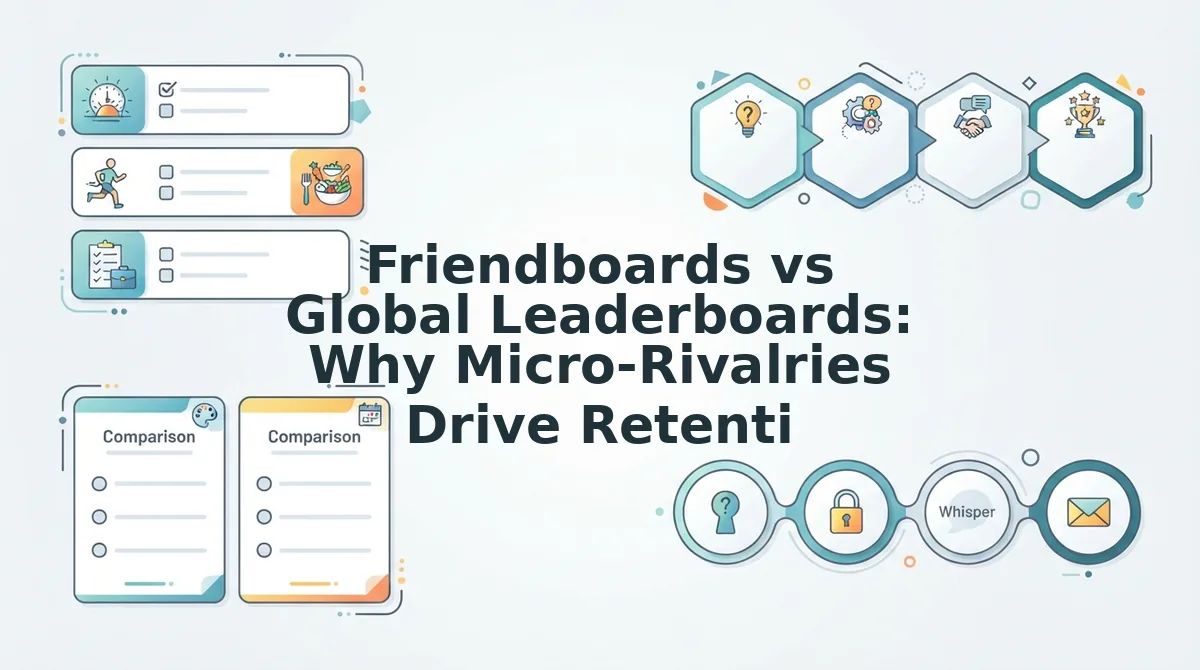
Friendboards drive higher social retention than global leaderboards because players care about outscoring real acquaintances rather than competing against millions of anonymous internet profiles. Global scoreboards create detachment, whereas private, micro-rivalry leaderboards trigger immediate competitive stakes inside personal circles.
Here's the thing. Seeing yourself ranked #48,219 on an open global leaderboard produces what behavioral designers call the global void.
A friendboard is a closed social scoreboard that isolates performance metrics exclusively among people who share an existing interpersonal connection. Under the Circle of Relevancy Matrix, rank #3 of 8 among your daily group chat sparks fierce bragging rights, while rank #48,219 on a worldwide ladder sparks complete apathy. In fact, gamify retention data demonstrates a 3x increase in repeat plays when rankings are restricted to direct peers rather than public pools, aligning with established industry benchmarks documented by the Nielsen Norman Group on gamification mechanics.
Why do massive public ranks fail casual groups? Consider the shift in player psychology:
| Leaderboard Format | Competitive Scope | Primary Friction Point | 2026 Engagement Model | Best For |
|---|---|---|---|---|
| Global Leaderboards | Worldwide public player base | Unbeatable scores set by power users and bots | Passive viewing after initial attempt | Best for hardcore competitive gamers seeking macro-skill validation |
| Legacy Friend Scoreboards (e. g., Buddy Meter, QuizYourFriends) | Direct social circles | Intrusive display ads and multi-step setup flows | Static completion with low repeat utility | Best for casual users comfortable with classic, ad-supported questionnaires |
| Mobile-First Friendboards (e. g., Friend Quiz) | Hyper-local peer networks | Zero registration barriers | Viral re-challenges driven by group chat banter | Best for group chats, classmates, and viral social circles |
To choose the right ranking system for your network, use this decision framework:
- Choose a global leaderboard if you are measuring universal technical gaming skill against a worldwide audience.
- Choose a legacy friend platform like Buddy Meter if you want a familiar, long-standing questionnaire and do not mind slower load times.
- Choose a mobile-first friendboard like Friend Quiz if you want immediate, one-tap mobile guessing without registration roadblocks.
Our recommendation: For social bonding, micro-rivalries win every time. Restricting rankings to people you actually talk to replaces impossible global grinds with fast, repeatable group chat banter.
Ready to see who in your inner circle actually knows your habits? Create a speed-run personal trivia quiz on Friend Quiz in minutes and launch a live friendboard for your group chat with zero app downloads.
While psychological rivalry fuels the drive to win, keeping score across dozens of simultaneous mobile sessions requires a resilient technical framework under the surface.
How Modern Real-Time Score Tracking Works Under the Hood
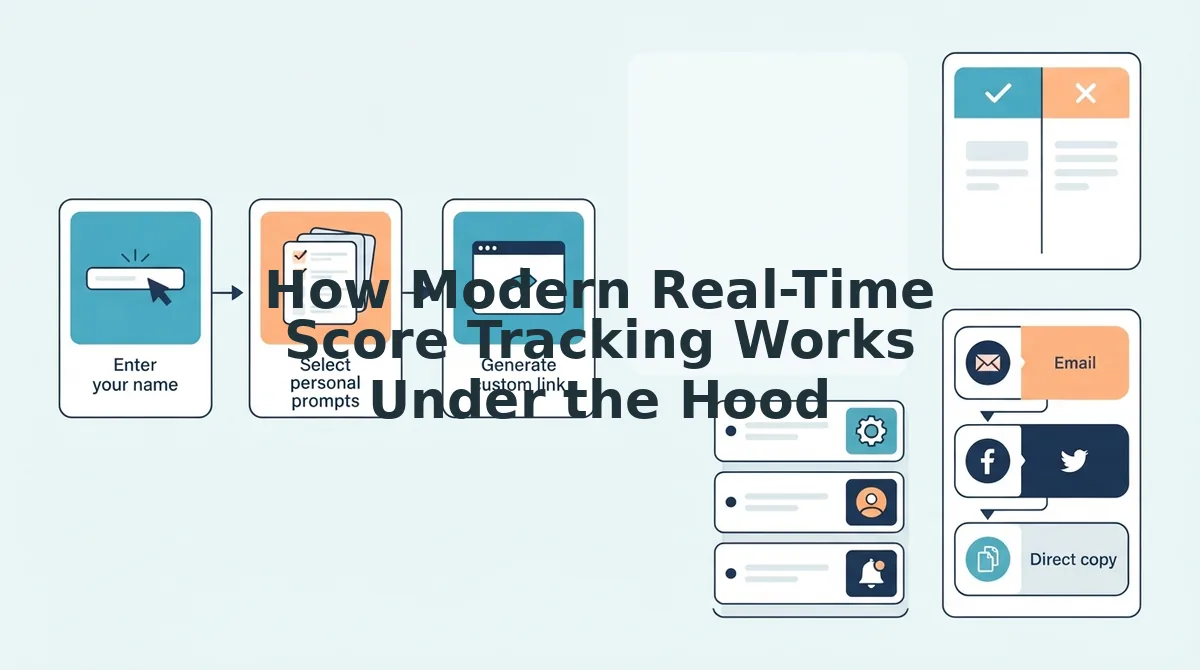
Modern real-time score tracking works by recording user inputs on an authoritative web server, updating in-memory ranking collections instantly, and pushing the new positional standing back to all active browsers. In 2026, lightweight social platforms achieve this dynamic sync in the browser without demanding app downloads, account creation, or manual page refreshes.
Here is the thing.
Imagine a friend submits an answer 1,000 miles away, and your screen shifts their rank ahead of yours in under 200 milliseconds. How does that happen without native mobile software running on your device?
In plain English, score tracking is the automated recording and ranking of participant results across a shared trivia challenge. Think of real-time score tracking like a digital whiteboard at a bowling alley. Instead of every player erasing and writing their own tally with a marker, the overhead machine registers every pin drop automatically, recalculates the totals, and updates the shared overhead display instantaneously for everyone sitting in the lane.
Real-time score tracking is an automated, server-authoritative system that computes individual trivia responses, stores them as ordered numerical values, and immediately distributes relative positional ranks to connected clients. On modern web-based quiz platforms, this mechanism processes incoming answer payloads, compares them against an established answer key, assigns points, and updates an indexed leaderboard. Because this entire sequence operates within in-memory structures and lightweight browser transport layers such as MDN WebSockets or Server-Sent Events (SSE), participants see live rank adjustments instantly upon submission, maintaining competitive excitement across group chats without requiring user registration or external software installations.
To deliver rapid updates without lag, modern backends rely on in-memory sorted sets, notably using Redis sorted-set data structures. When a participant submits their final response, the server executes a ZADD command, which inserts the player's unique identifier and score into a sorted set in logarithmic time (O(log(N))). When a participant views the friendboard, the system executes a ZRANGE query to pull the exact leaderboard sequence, sorting highest to lowest instantly. By keeping the leaderboard in memory rather than reading from a relational disk database, score updates remain virtually instantaneous.
How do browser games keep these leaderboards fair when anyone can inspect the webpage code? They apply a strict three-step anti-cheat protocol:
- Server-side answer validation: Correct answers are never sent to the client browser beforehand; incoming guesses are verified exclusively on the server.
- Cryptographic session tokens: Each quiz session receives a unique, short-lived digital signature that ensures scores cannot be altered or injected externally.
- Rate-limiting and timing checks: The server discards submissions received faster than humanly possible or sent via automated replay requests.
The result? Players get instantaneous, cheat-resistant leaderboard updates directly inside their standard web browser.
Technical speed provides the baseline, but raw execution without intentional player psychology falls flat.

Social Leaderboard Gamification Best Practices for Maximum Engagement
Social leaderboard gamification maximizes engagement by restricting competition to tight peer groups and stripping away complex secondary metrics in favor of direct personal bragging rights. In 2026, social scoring functions best when interfaces prioritize speed, immediate rank visibility, and seamless mobile interaction over complex point systems.
Here's the catch: adding more metrics to a leaderboard actually lowers user activity unless every single data point directly fuels social comparison. Social scoring is a lightweight gamification framework that translates personal knowledge and interpersonal dynamics into real-time competitive ranks. To maximize group chat participation, platforms must follow the four core rules of social scoring:
- Instant Visibility: Present updated standings immediately upon quiz completion without requiring account registration or application downloads. Delayed feedback kills the competitive impulse, whereas immediate score display keeps participants invested in where they stand against their peers. Implement this by rendering the live leaderboard screen the moment a participant submits their final response.
- Relatable Point Spreads: Calibrate point calculations so that friend rankings stay within tight, surmountable margins rather than astronomical totals. Massive scoring gaps cause trailing friends to abandon competition entirely, while narrow point spreads spark instant rivalries. Structure point rewards so that a single correct answer can re-sort the top positions on the board.
- One-Tap Bragging: Provide frictionless share buttons that allow participants to send their score and rank directly back to group threads with one tap. Leaderboards lose momentum when confined to an isolated browser tab, but active chat callouts pull inactive members into the challenge. Position one-tap export options right beside the final score so players can instantly issue a friendship dare quiz to their circle.
- Ephemeral Resets: Cycle scoreboard dynamics through fresh challenges rather than maintaining static, permanent score sheets. Permanent boards entrench early leaders and discourage latecomers, whereas fresh prompts give every participant an equal shot at redemption. Creators who know how to make a quiz for friends regularly generate fresh links to restart the leaderboard chase.
Consider how this works during an active group chat dare workflow. A creator generates a personal trivia link and shares it directly into a messaging group. Several friends tap the link simultaneously on standard mobile browsers, guessing answers without logging in. As each participant finishes, the shared board immediately re-sorts placements, pushing previous leaders down the list. Seeing their rank drop, displaced friends call out the new leader in the chat, driving everyone else to take the quiz and claim the top spot.
Knowing the behavioral principles is one thing, but putting them into action for your immediate circle takes less than two minutes.
How to Launch an Instant Friendboard for Your Crew Without App Downloads
To launch an instant Friendboard without app downloads, create a personal trivia quiz in your mobile browser, generate your custom link, and share that URL directly to your group chat. The platform compiles incoming player scores into a live, interactive ranking board the second your friends tap and submit their answers.
Here is the thing: you have two minutes before class starts or a sudden lull in the group chat, and you want to spark immediate debate. A Friendboard is a live social leaderboard that ranks contacts based on how accurately they guess a creator's personal trivia choices. In 2026, social gaming belongs entirely inside frictionless web links, no app store downloads, native installations, or user accounts required.
Prerequisites: Any standard mobile web browser and a group chat or direct message thread where you can paste a web link.
-
Navigate and build your trivia profile (Estimated time: 90 seconds).
Open the mobile-first online quiz maker, type your name into the creator field, and cycle through the curated personal trivia prompts regarding your daily habits, secrets, likes, and dislikes. Tap your true answers to finish the speed run setup.
Expected outcome: The system instantly compiles your responses and presents a unique, shareable challenge URL on your screen.
Pro tip: Select questions with unexpected personal habits rather than obvious favorites to ensure your friends get varied scores across the board. -
Distribute your challenge link to your inner circle (Estimated time: 10 seconds).
Click the copy prompt next to your custom link, switch to your messaging thread, and paste the URL directly into your group chat.
Expected outcome: Recipients tap the link and immediately load your customized friend group quiz in their browser without encountering registration walls or app store redirects.
Troubleshooting: If an in-app messaging browser fails to load your custom URL smoothly, tell participants to tap the menu icon and select "Open in System Browser." -
Monitor real-time rankings on your dashboard (Estimated time: Real-time).
Keep your creator dashboard open as your crew taps their guesses one prompt at a time.
Expected outcome: As friends finish the last question, their names and point totals populate the Friendboard immediately, creating a ranked hierarchy showing who knows you best.
Turn everyday friendship dynamics into friendly competition. Create your custom trivia on Friend Quiz to claim your link, bypass friction-heavy signups, and watch your crew battle for the top spot on your live Friendboard.
Once your board is live and scores begin pouring in, questions naturally emerge about mechanics, privacy, and fair play.
Frequently Asked Questions About Score Tracking and Friendboards
Score tracking and friendboards provide private benchmarking that ranks personal connections rather than anonymous public gaming lobbies.
What is a friendboard compared to a public leaderboard?
A friendboard is a closed, localized leaderboard displaying rankings exclusively among an invite-only social circle. While public leaderboards aggregate thousands of anonymous players based on play volume, friendboards focus on intimate group chat dynamics, testing direct personal trivia scores to spark immediate peer rivalries without public exposure.
Do participants need an app or account to join a friendboard?
No, participants do not need an app download or registered account to join a friendboard. Friends open a shared web link directly inside their mobile browser or messaging app, enter a display name, complete the quiz prompts, and automatically record their score onto the live group board.
How do modern friendboards prevent duplicate scores and cheating?
Modern friendboards prevent score tampering by pairing lightweight device fingerprinting with automated session checks:
- Browser Locking: Prevents a single device from submitting multiple attempts under alternating nicknames.
- Completion Audits: Flags impossible completion speeds before committing the points to the visible scoreboard.
Why do micro-leaderboards drive higher engagement than global rankings in 2026?
Micro-leaderboards drive higher engagement in 2026 because participants compete against recognizable contacts rather than detached usernames. Behavioral data shows social accountability and direct banter motivate players to engage, whereas massive global ladders cause user churn once participants realize reaching top percentiles against strangers is mathematically impossible.
Can a quiz creator see individual answer breakdowns?
Yes, quiz creators can inspect question-by-question breakdowns alongside aggregate rank positions. While participants viewing the shared link only see final scores and leaderboard standings, the creator dashboard reveals which specific prompts each friend guessed correctly, making post-quiz group chat discussions and friendly debates far more interactive.
With clarity around the underlying mechanics and player dynamics, the path to dominating your inner circle becomes straightforward.
Turn Friendly Banter into Bragging Rights Today
Transforming casual group chats into high-stakes rivalries succeeds because friendboard micro-competitions anchor rankings in authentic relational dynamics rather than anonymous global tiers. The result? Friendboards generate 3x the replay volume of traditional scoreboards because the stakes are rooted in actual relationships where every missed question stings.
Executing this shift requires a deliberate progression from setup to sustained competition:
- Today: Deploy the 3-step micro-competition blueprint by cycling through personal trivia prompts, generating your link, and dropping it into your primary group chat.
- This week: Audit your Friendboard standings to crown your inner-circle champion without forcing anyone through app downloads or account registrations.
- This month: Refresh your custom trivia prompts around new inside jokes and habits to turn casual banter into an ongoing group tradition.
You no longer have to guess which friend actually pays attention to your stories, the live leaderboard reveals the truth in under two minutes. Take sixty seconds to start your own Friend Quiz with zero friction and let your crew settle the score right now.
True social engagement thrives not on competing against strangers across the internet, but on putting your reputation on the line with the people who know you best.