One quiz that fills a group scoreboard
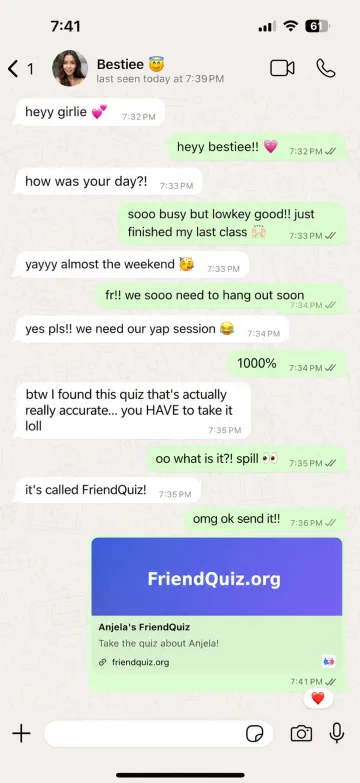
A friend group quiz is one set of locked answers, one link, and one live board a whole room can watch fill up. You type a name - no account - answer about ten questions about yourself, and paste the link into a place that already has a name: roommate chat, class WhatsApp, cousin thread, house-party table. Friends open it in a browser. No app. No sign-up. Each person guesses your answers, gets a score out of ten, and lands on that quiz’s own Friendboard with a rank, a name, a score, and a country flag.
The screenshot people pass around is the ranked list, not a private result. If you only wanted a generic “send this to friends” landing, that already exists as a quiz for friends. This page is narrower: the social unit is a group, and the event is the board filling up. The product underneath is the same friend quiz maker - about two minutes to create, one URL, scores out of ten. No Myers-Briggs letter. No required email. No paid wall in 2026. You are not hoping one bestie plays. You are trying to get a room onto the same ranked list before the conversation moves on.
Not the same job as a generic quiz for friends
People search “quiz for friends” when they want a link they can send - a bestie, a couple of classmates, a story audience. That is a real use. A friend group quiz measures something else. Success is not “someone played.” It is “the Friendboard has enough names that the group has something to argue about.”
A one-to-one quiz can afford deep-cut prompts only two people would know. A squad quiz cannot. If half the class was not on the trip, those questions become a DNF machine. Group quizzes need a wider on-ramp: habits the room has already roasted, food orders, who is always late - not the secret you told one person at 2 a.m. Share motion is different too. A generic send can live in DMs. A group quiz wants one paste into a named thread. Posting the same link in five private chats still collects scores on one board, but it splits the social proof. The pile-on only happens when people can see that other people already played.
Roommate chats, kitchens, and the person who never texts first
Roommate quizzes work because the evidence is already in the apartment. Who leaves dishes. Who “borrows” chargers. Who will be ready in five minutes. You do not need cinematic questions. You need questions the kitchen has already litigated, and you need to lock the true answers - not the flattering ones - or the board rewards whoever guesses the performance.
Group chats reward people who talk. A Friendboard rewards people who noticed. Drop the link in the house chat, not in three DMs, so the quiet roommate sits on the same ranked list as the loud one. If you also have a class group and a cousin thread, make one quiz per room. A kitchen quiz with lecture-only lore feels like homework to the roommate who was not there. Creating another quiz still takes about two minutes. You cannot edit a live quiz after friends have played, so do not try to “fix” the roommate set by swapping in class questions after the first scores land. Skip anything that would start a real fight rather than a roast. Roommate chats screenshot everything.
Class WhatsApp, cousin threads, and other crowded rooms
Class groups and family threads have the same shape: lots of names, uneven closeness, and someone opening the link between two other obligations. Speed matters. Friends type a name, guess ten answers, get a score out of ten. Paragraph-length options get skimmed. Random taps fill the board with noise.
Class WhatsApp already ignores half the messages. A quiz cuts through that better than a weekend poll because the first 8/10 is a status the rest of the class can react to. Keep questions in the shared world: campus food, lecture habits, the group-project role you always end up with. Leave out family drama and medical details. A class of thirty is not a vault.
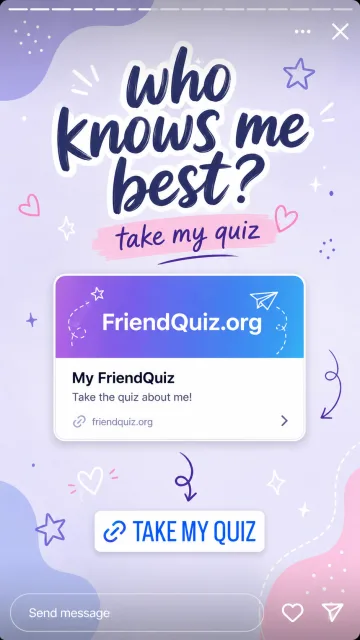
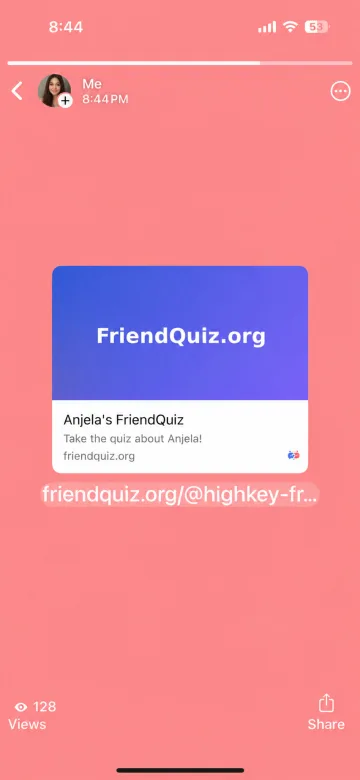
Cousin threads add age range. The teenager and the aunt should both be able to finish - durable habits, not nightlife. Match the room: food thread, food questions; hosting complaints, hosting questions. If the group lives on Instagram more than chat, the same quiz still works, but the paste motion is a Story. That path is the Instagram friend quiz. The Friendboard is still the same object. Only the door changes.
House parties: pass the phone without losing the plot
A house party is the setting where people might share a device. Pass-the-phone works because nobody needs an account. They type the name they want on the board, guess, see a score, hand the phone back. The Friendboard updates as each person finishes. You do not stand there with a notebook.
Two failure modes show up every year, including 2026. Questions so inside-joke that a plus-one bounces after question two. And a run of “most likely to” items that are funny in a chat and awkward shouted across a living room. Keep the set light enough to finish between snacks. Steal chaos energy from most likely to questions for friends and still rewrite anything only five people in the room would understand. Set a soft window - “board locks when the pizza arrives” - then screenshot the ranking back to the party chat. People who missed the pass-the-phone round can open the same link later from their own phones. One quiz, two waves is fine. Three different quizzes in one night is how you lose the plot.
Why the first score starts a pile-on
Group chats ignore links that look like homework. They do not ignore a name sitting at 9/10 with a flag next to it. The first finish tells the room the quiz is real, fast, and already being judged. “I bet this group cannot put anyone at 10/10” outperforms “please take my quiz” because the first line is a dare and the second is unpaid labor.
Once two or three scores exist, people play to beat a specific name, not to be a good friend in the abstract. A private spreadsheet cannot start that; nobody else can see the rows. Send the link while the room is already talking. A class chat at 11 p.m. before a deadline is a bad window. A roommate chat on a Sunday in the kitchen is a good one. Party tables work when phones are already out. The product takes about two minutes to create so you can catch a live conversation instead of scheduling a game night that never happens.
Inside jokes that make half the group DNF
Inside jokes feel like loyalty tests. They are filter tests. The people who were there will play. Everyone else closes the tab, and your Friendboard looks like a clique even if you did not mean it that way. If the squad is mixed - new roommates plus old friends, class plus cousins, party guests plus the host’s inner circle - write for the widest person you actually want on the board.
At least six of the ten questions should be answerable by someone who has hung out with you this month without being in the original group: usual order, sleep schedule, cancel-or-late, the snack you disappear with. Save two or three harder cuts for people who will be annoyed if it is too easy. Short options help more than clever writing. Most of this audience is on a phone in a noisy room. One funny wrong answer per question does more for completion than a paragraph of lore. Tap funny questions for friends if you want comedy without writing from scratch, and still drop anything that requires a briefing. Read each question as if a new roommate opened the link. If they would need a story first, rewrite it.
This product is not a group vote
“Who is the mom friend” is a poll. Friends here are guessing what you would pick about yourself. Phrase group-role chaos as your answer - “What do I think my unofficial role is?” - or pick another app. Libraries are starting points. You still lock your real answer on each item. Ten questions is the whole set. If you want a longer night, make a second quiz with a new Friendboard rather than stuffing twenty topics into a list nobody finishes.
Dares stay optional
A ranked Friendboard is already a consequence. You do not have to add forfeits for the quiz to work as a group event. Some rooms want stakes anyway: loser buys snacks, under 5/10 picks the next song. If your group likes that layer, announce the rule in the chat before people play, and keep the forfeits light. That extra framing lives on the friendship dare quiz page.
FriendQuiz.org does not enforce dares. It scores guesses out of ten and ranks names. Springing a forfeit after the fact starts an argument about retroactive rules. Skip dares entirely for class groups, mixed-age cousin threads, and any room where a punishment could land on someone who did not opt into being roasted. A 3/10 is already public.
Host it once, then leave the live quiz alone
Each quiz has its own Friendboard - not the global most-played list, not a trending browse page. When a friend finishes, their name, score out of ten, flag, and rank appear on your board. Ranks shuffle as more people finish. Nobody who plays needs an account. The cost of joining is ten guesses, not a download. Write for spread: all easy makes a tie pile at 10/10; all cryptic makes a pile at 2/10 and a chat full of people who bounced.
It is not a type test, a classroom assessment, or a medical exam. A 4/10 means someone guessed badly or rushed. Treat the board as entertainment with receipts. Privacy is still on you. Do not lock secrets, medical details, passwords, or anything that could impersonate you. A roommate quiz about cereal is plenty.
You cannot edit a live quiz after friends play. Changing questions would invalidate scores already ranked. If question four is too inside-joke, live with it or send a fresh link. Read the ten questions as the least-informed person in the room. If they can finish, paste once into the group that should fill the board, wait for the first score, and screenshot when the ranking looks like a story: one quiz, one group, one Friendboard.
FAQs (People Also Ask)
What is a friend group quiz?
One quiz, one link, the whole squad on a single Friendboard. Roommates, class chats, cousin threads, party tables - everyone guesses the same ten answers about you and fights for rank.
How is this different from quiz for friends?
Same engine. Quiz for friends is the generic send-to-friends landing. This page is about filling a group scoreboard on purpose - pile-on, pass-the-phone, one crowded rank list.
Can a whole WhatsApp or Discord group play one quiz?
Yes. Paste the link once in the group that already replies. The first score is usually what pulls everyone else in. There is no player cap.
What questions work for a mixed group?
Keep inside jokes to one or two slots. If half the group was not in that memory, they will drop off. Mix easy observables with a few harder habits. Funny questions help completion.
Can we add dares for low scores?
Announce the stakes in the chat. The scored product with a forfeit frame is the friendship dare quiz. Keep dares wholesome - the site is not a humiliation machine.
Does everyone need to make their own quiz?
No. One creator is enough for a group round. Other people can make their own later if they want a second Friendboard. Scores do not merge across quizzes.
Can we play in person at a party?
Yes. Pass one phone, or have people open the same link on theirs. Browser play means nobody installs anything between songs.
Where does the group ranking live?
On that quiz’s Friendboard. That is not the global most-played list. Screenshot it back into the same chat.
Do players need accounts?
No. They type a name and play. You do not need an account to create it either. About two minutes to launch.
What if the group is huge and questions are too personal?
Soften the set. Skip secrets and third-person gossip. A cereal question still ranks a squad. A trap question becomes a screenshot you cannot pull back.
Enter your name above, lock ten answers about yourself, and share the link. The Friendboard fills in as friends finish - no app, no sign-up.