How to Verify Friendship Test Accuracy Scores in Real Time
Your group chat instantly erupts into chaos when a lifelong companion logs a dismal 3/10 on your custom trivia link. Accusations of rigged algorithms fly immediately, leaving everyone questioning whether the platform miscalculated the results.
You can verify friendship test accuracy scores in real time by confirming the underlying deterministic math rather than blaming platform bias. In this breakdown, you will learn how dynamic leaderboards register answers, how scoring formulas work, and how zero-friction sharing on WhatsApp or Snapchat keeps every rival completely honest.
Most challenges calculate bragging rights using a straightforward baseline:
- (Correct Responses / Total Prompts) * 100
Consider a standard workflow: a creator enters their name to launch a mobile friendship quiz, answers personal habit prompts, and drops the generated challenge link into a message thread. A participant taps the link, submits answers without an app download or account creation, and the live Friendboard immediately displays their verified score. This guide covers the operational limits of web-based scoring, excluding third-party device errors or intentional trick questions.
Understanding the server-side mechanics behind these instant updates clarifies why sudden score disputes happen in the first place.
What Are Real Time Friendship Score Verification Systems?
A real-time friendship score verification system is an automated data architecture that validates quiz submissions against a creator's saved preferences instantaneously. It replaces subjective personality evaluations with programmatic record matching to ensure leaderboard fairness.
Most viral quizzes rely on arbitrary psychological profiles or unverified click counts. A real-time verification system operates entirely on deterministic binary matching, comparing a participant's input sequence against an unalterable creator baseline.
Think of this verification process like a traditional digital lock. The creator sets the unique pin combination when setting up the challenge, and every friend who participates enters their own guess; the mechanism only registers a true score when the entries align digit for digit.
A real-time verification engine is an automated evaluation framework that compares a respondent's live inputs directly to a stored reference array to compute instant, immutable test results. When a host builds a challenge on a modern web platform, the application records their selected habits, trivia, and personal preferences into a definitive answer key. As friends play through the resulting link, the platform matches incoming selections against that baseline in real time without requiring user logins. This deterministic design guarantees that scores on the live leaderboard reflect direct factual accuracy rather than random psychometric guesswork.
This verification infrastructure relies on a three-tier operational sequence:
- Ground-Truth Key Creation: The quiz author records their personal habits and preferences during initial setup, generating a locked, reference data array inside a lightweight mobile web session.
- Session State Transmission: The participant completes the shared challenge link, generating a parallel input array through zero-login mobile navigation.
- Deterministic Audit Log: The application runs a field-by-field binary check between both arrays, logging point increments and pushing the verified total to the shared leaderboard immediately.
Why do these automated safeguards matter?
Zero-friction social games thrive on genuine rivalry. Without deterministic verification, participants could manipulate responses or dispute outcomes inside group chats.
You can see this deterministic process in action by launching your own friendship test to test your circle's memory against your verified baseline answers.
Understanding how incoming selections pair with an author's baseline requires examining the mathematical rules governing point distribution.
How Friendship Quiz Scoring Algorithms Calculate Results
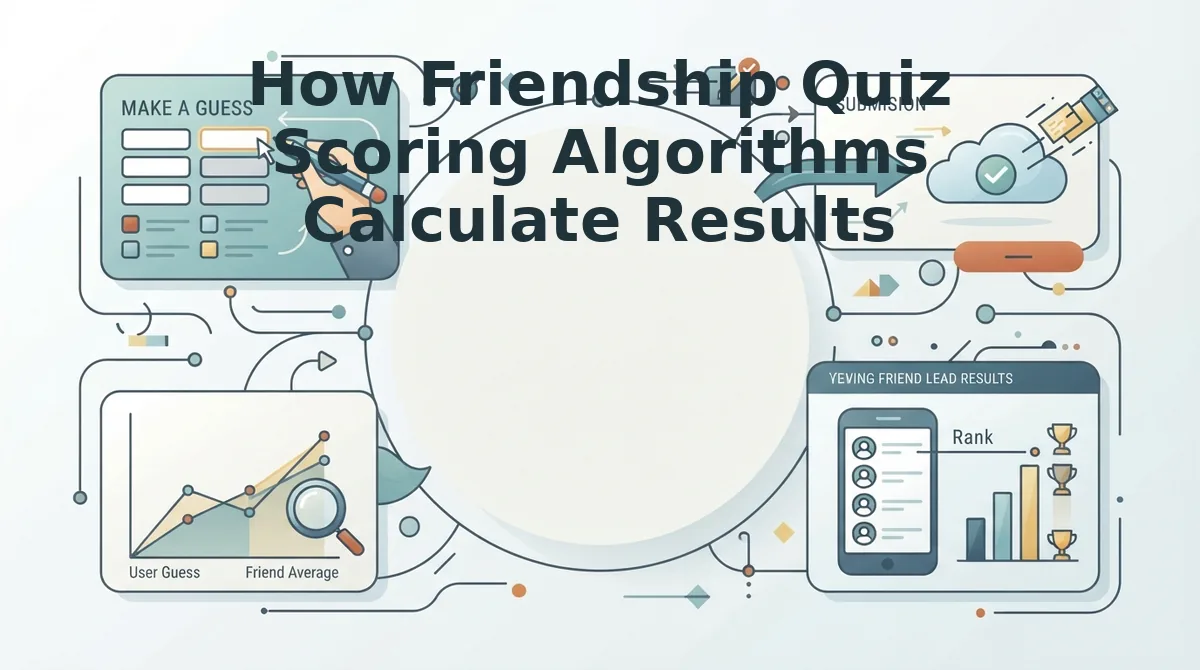
A friendship quiz scoring algorithm calculates results by executing binary matches between creator answers and friend submissions, then applying timestamp logs to order identical scores on a live leaderboard. Each response converts into a precise point metric the moment a participant taps submit.
A friendship quiz scoring algorithm is an automated computational ruleset that measures answer alignment across personal trivia challenges to establish accurate participant standings. Think of this scoring system like an optical grading scanner for a standardized test: it scans each participant's submitted responses against the creator's master answer key, awarding one exact point whenever both choices match and zero points when they differ.
Ever wonder why two participants with 8/10 accuracy hold different positions on the Friendboard?
The system evaluates submissions across three distinct architectural layers:
- Discrete Binary Matching: Every prompt acts as an independent truth check. The database checks whether the user selection matches the author's recorded index, returning a simple true or false flag.
- Equal Prompt Weighting Logic: Each question carries identical statistical value. The backend computes the overall accuracy percentage using the direct formula: Score = (Sum of Matched Indices / N) * 100, where N represents the total number of questions answered.
- Millisecond Timestamp Hierarchy: When multiple friends achieve identical accuracy percentages, the platform uses specific tie-breaker rules that evaluate the exact millisecond completion timestamp to determine who locked in their answers first.
This automated hierarchy eliminates manual tallying errors and prevents favoritism during peer competitions. Knowing how the platform calculates these values allows you to validate your group standings accurately.
How to Verify Friendship Test Accuracy Scores Step by Step
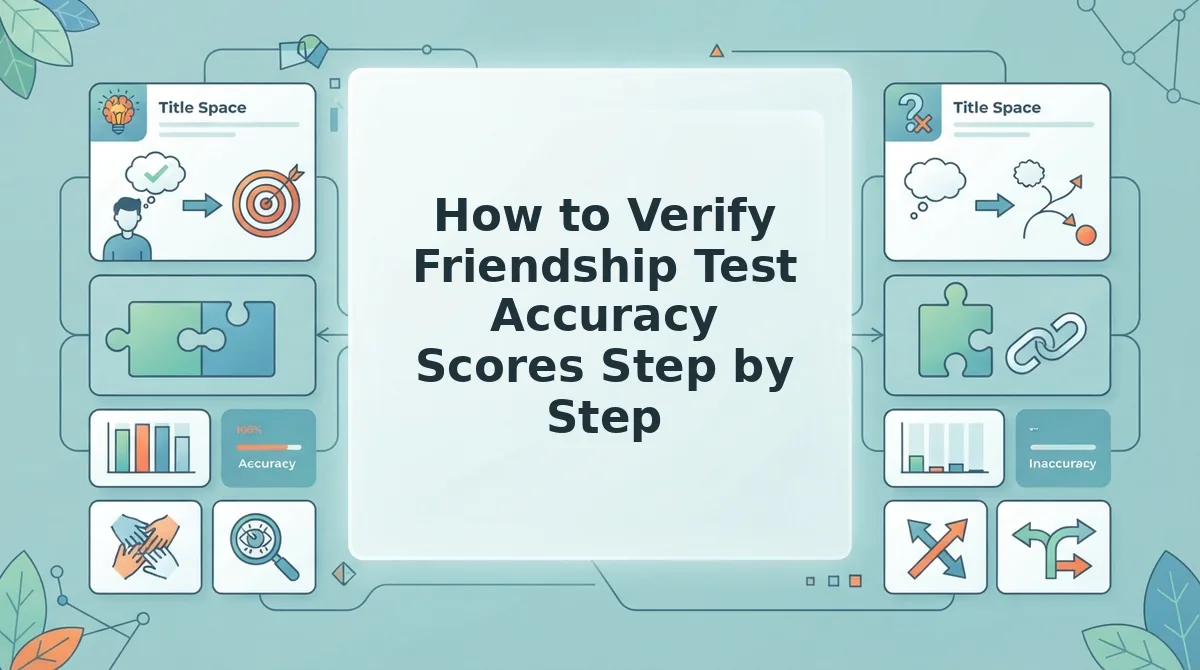
To verify friendship test accuracy scores in real time, open your creator administrative view to inspect specific answer breakdowns against live participant submissions on your Friendboard. This administrative check confirms response validity instantly without requiring account passwords or email logins.
A Friendboard is a real-time leaderboard that records scores, participant names, and answer selections directly inside the web browser session. Before starting an audit, ensure you have your original quiz creation device accessible with the active administrative session retained in your browser cache.
Auditing scores takes less than two minutes when following this four-step verification sequence:
- Open the creator administrative view on your mobile browser by navigating to your original quiz link to access the administrative dashboard controls. You should see your summary interface display the overall participant count and live Friendboard rankings without a login prompt.
- Select the specific participant entry from the Friendboard ranking list to open that player's detailed response panel. You should see an expanded list showing the participant's chosen answers alongside your original answer key.
- Cross-check participant display names against duplicate session tokens in the response log to detect repeated entries from the same device. You should see a single, distinct submission record for each verified run rather than multiple timestamps originating from one browser session.
- Compare each recorded question choice against your saved personal habits to isolate exact question mismatches. You should see matching responses marked as correct and discrepancies flagged where the player's guess diverged from your configuration.
Can a single mismatched response alter bragging rights across your entire group chat?
Consider an audit scenario where a participant posts a 7/10 score on your customized challenge. You open your creator administrative view, tap the participant's name on the Friendboard, and scroll to the flagged responses. The breakdown reveals the player correctly answered daily habits and music likes, but missed your breakfast preference, weekend wake-up time, and pet peeve. The interface confirms the 7/10 calculation instantly based on three clear mismatches without calculation errors.
When you want to settle rivalries, launch a best friend quiz to generate shareable links and track live banter across your group chat without software installs.
Manual score verification confirms individual answers, but maintaining broader competition integrity requires active defenses against random guessing.
How to Prevent Guesswork and Verify High Score Integrity
You can prevent guesswork and verify score integrity on friendship quizzes by replacing predictable choices with tailored answers and tracking device-level submissions.
Score verification ensures that leaderboard positions reflect authentic relationship knowledge rather than lucky guesses or repeated trials. To keep your group chat rankings legitimate, apply these five verification safeguards when building and monitoring your challenge.
- Eliminate predictable binary distractors: Replace generic opposite answers like yes-or-no options with nuanced alternatives reflecting your real-life quirks. Binary choices artificially inflate random accuracy to 50%, while distinctive distractors force respondents to recall actual conversations. Curate tailored options by selecting customized personal trivia prompts that feature plausible, hyper-specific habits only close companions recognize.
- Implement session fingerprinting to block retakes: Track browser instances and client tokens to flag duplicate attempts from the same participant. Session fingerprinting is a browser-level identification process that associates quiz submissions with unique hardware and software configurations. Cross-check your Friendboard entries for rapid duplicate timestamps so players cannot systematically test answer combinations across multiple browser tabs.
- Seed counterintuitive trap answers: Place superficially obvious options into personal habit questions where your actual routine defies standard social expectations. Most casual acquaintances default to conventional behavioral patterns, while true confidants remember your contradictory preferences. Verify submissions by checking whether high scorers deliberately bypassed the popular decoy to pick your authentic idiosyncrasy.
- Analyze completion speed anomalies: Review the elapsed duration between link generation and leaderboard entry submission. Instantaneous responses usually indicate rapid button spamming across choices, whereas thoughtful answers require realistic reading pauses of several seconds per prompt. Disqualify flawless submissions completed in under twenty seconds as low-effort guesswork.
- Audit situational edge-case responses: Incorporate questions centered on your specific micro-reactions during unusual group emergencies or road trips. Broad lifestyle trivia is easily memorized through casual social observation, whereas crisis habits test private emotional history. Use these prompts as decisive tiebreakers when multiple friends tie for the top leaderboard position.
Genuine test accuracy ultimately depends on whether a quiz measures shared life history or simple surface trivia.
Trivia Recall vs Relationship Depth: Are Best Friend Tests Accurate?
Best friend tests accurately measure deterministic trivia recall rather than emotional depth or relationship stability. While a perfect score confirms close attention to daily habits, it does not assess loyalty or mutual trust during personal crises.
Observational trivia recall is the measure of a contact's ability to retain concrete personal details, including daily habits, specific preferences, and routine quirks. When a close friend fails hyper-specific prompts, such as an exact morning coffee order or a minor pet peeve, their result may drop to 3/10 despite years of unwavering personal support. Scoring low on a casual friendship challenge reflects observational memory variance, not a lack of genuine devotion.
| Evaluation Dimension | Observational Trivia Metrics | Clinical Support Metrics |
|---|---|---|
| Core Focus | Daily preferences, habits, and specific lifestyle details. | Emotional reliability, mutual empathy, and crisis presence. |
| Data Verification | Objective comparison against creator-selected answers. | Longitudinal interpersonal behavior and lived experience. |
| Primary Purpose | Group chat entertainment and friendly rivalries. | Assessing foundational trust and relationship longevity. |
| Best Persona | Digital natives and active group chat participants. | Partners or lifelong friends conducting deep assessments. |
Observational trivia tests verify memory retention across explicit surface details, while qualitative relationship frameworks measure emotional safety.
Choose an observational challenge if you want to spark casual banter and see who scored highest on active lifestyle facts. Choose clinical relationship evaluations if you need to resolve communication breakdowns or verify long-term partnership reliability.
Our recommendation is to treat digital quizzes strictly as zero-friction tools for social engagement rather than relationship audits. Because they require no account logins or app downloads, rapid mobile challenges excel at delivering instant group chat entertainment without imposing heavy psychological weight.
Common edge cases around test scores clarify how simple misunderstandings happen during real-time scoring runs.
Frequently Asked Questions About Friendship Quiz Accuracy
Can a simple trivia challenge definitively measure true social loyalty?
How do creators see which specific questions friends missed?
Creators inspect missed prompts by opening their private challenge administrative view to review itemized response breakdowns. The system maps the participant's selections against the creator's original answer key, highlighting exact mismatches. This transparency reveals whether a low score stemmed from forgotten trivial habits or genuine misunderstandings without exposing creator credentials.
Why does a friendboard show multiple scores for the same name?
A live friendboard lists duplicate entries when a participant retakes the challenge using identical or slightly altered display names across separate browser sessions. Unless restricted by administrative settings, platforms record each finished attempt as an independent timestamped submission rather than automatically overriding the original baseline score.
Can participants cheat on friendship tests by inspecting the page source code?
Participants cannot uncover correct answers via browser source code because answer evaluation happens on the web server. The platform delivers quiz prompts without attaching the underlying answer key to the client device. Correct selections remain inaccessible until the server finishes calculating the completed submission.
How do live leaderboards handle tied accuracy scores?
Live leaderboards resolve tied accuracy scores by prioritizing the participant who completed the challenge first. If two friends both achieve nine out of ten correct answers, the system places the earlier submission higher on the rankings based on the recorded completion timestamp.
Establishing clear scoring parameters sets the stage to settle group chat rivalries for good.
Take Control of Your Friendboard Rankings
Verifying friendship test accuracy requires zero downloads, no account setup, and less than two minutes of your group chat's attention. That early question of who truly knows your habits best is settled not by assumptions, but by an audited leaderboard backed by precise recall.
Run your next live verification audit using this four-point framework:
- Name your baseline: Type your display handle to initialize an instant, unique session.
- Select distinct prompts: Cycle through daily habits, likes, and quirks that rule out generic guesswork.
- Deploy directly: Share your custom link to WhatsApp or iMessage in under 120 seconds.
- Audit the Friendboard: Monitor incoming submission timestamps alongside final scores to confirm who answered from genuine memory.
Picture this scenario: your chat debates who your closest confidant is, someone claims a flawless bond, and within two minutes, your live Friendboard reveals they mixed up your coffee order.
Launch your challenge by building a personalized bff test on Friend Quiz, drop the generated challenge link into your chat, and let verified data crown your real inner circle.
Authentic bragging rights depend on verified accuracy, transforming casual trivia recall into an undeniable record of genuine connection.