How to Settle a Tied Friendboard Ranking in Group Banter
Two group chat members just locked in identical 9/10 scores on your personal trivia challenge, sparking hours of debate over who truly holds the top spot. Knowing how to settle a tied friendboard ranking quickly stops the debate before the banter turns into genuine frustration. Generic tiebreakers fail in mobile messaging because coin flips ignore the actual trivia context, whereas simple leaderboard criteria declare a definitive winner.
You need a decisive way to rank close friends without stalling group banter. This guide shows you how to establish undisputed bragging rights using straightforward scoring protocols and real-time board updates. You will discover the single metadata factor that settles any standoff before anyone calls for a rematch.
Consider this standard group chat workflow:
- The situation: Multiple challengers finish a friend quiz link with identical top scores, deadlocking the board.
- The action: The creator checks the live challenge board to evaluate who logged their answers first rather than relying on random chance.
- The outcome: Bragging rights are verified instantly using existing challenge records, ending the debate without re-running the prompts.
Before launching your next challenge link, reviewing built-in live scoreboards helps prevent future deadlocks automatically.
Establishing an immediate protocol resolves any contested score within moments.
How to Settle a Tied Friendboard Ranking in Under 30 Seconds
To settle a tied Friendboard ranking in under 30 seconds, group chats resolve duplicate point totals by checking completion timestamps, reviewing high-value answers, and calling an immediate sudden-death question. Flipping a coin or rolling dice completely ruins group chat banter because it discards real personal knowledge in favor of blind luck.
A Friendboard tiebreaker is an agreed protocol used to determine bragging rights when two or more participants finish with identical scores on a friendship test. Think of a tiebreaker like a photo finish in track and field: when two sprinters hit the tape at the exact same split second, judges look at high-speed frame captures rather than giving both runners a split gold medal. Group challenges work the same way when rivals claim the top spot.
The 3-Tier Friendboard Tiebreaker Hierarchy is a sequential resolution system designed to break score deadlocks through submission speed, question difficulty, and direct banter. When two players match point-for-point, the group first checks the recorded browser submission timestamp to reward the faster responder. If timestamps match, the tie falls back to specific accuracy weighting across nuanced personal quirks versus obvious baseline questions. If parity remains, the host triggers a sudden-death trivia dare inside the active chat thread. This structured progression preserves competitive stakes while delivering an undisputed winner within seconds.
Why let random chance decide who knows you best?
Applying this system prevents unresolved arguments after reviewing the Friend Quiz accuracy score calculation on your dashboard. Moving through the tiers sequentially ensures every competitive claim rests on actual friendship trivia instead of sheer convenience.
Executing this sequence smoothly requires knowing precisely how to verify each stage inside your conversation thread.
Step-by-Step Guide to Applying the 3-Tier Tiebreaker Matrix
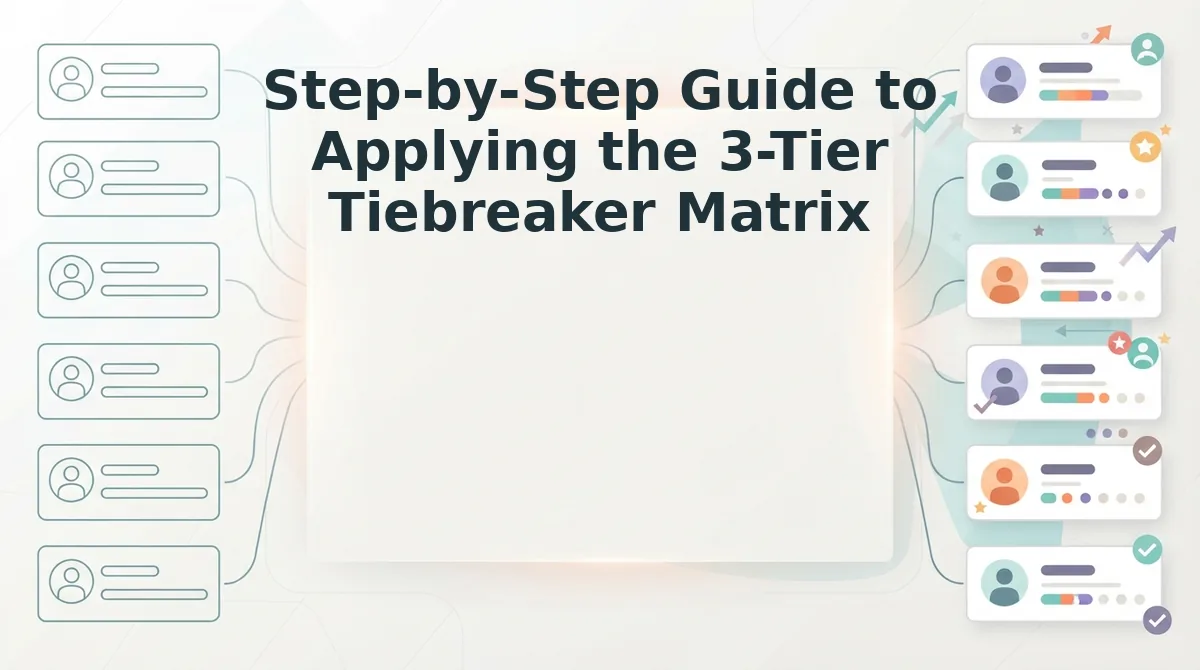
To settle a tied Friendboard ranking, execute a sequential check across raw browser-level submission timestamp telemetry, first-to-finish link records, and personal habit precision. This systematic matrix identifies the true winner when multiple players display the exact same score on the board.
What happens when the leaderboard shows two players with identical accuracy and identical completion minutes? The 3-Tier Tiebreaker Matrix is an objective protocol used to determine bragging rights on lightweight quiz boards without requiring account logins or app downloads.
Before beginning, ensure you have the active quiz URL opened in your mobile browser and access to your group chat thread where participants originally shared their completion notices. Completing the entire sequence takes roughly two minutes.
- Audit the live Friendboard order (Est: 30 seconds): Open your mobile browser, refresh the active results screen, and observe the listed sequence of tied names. Because lightweight friendboards display rounded minutes on the public view, the system natively places the earlier entry higher based on raw browser-level submission timestamp telemetry recorded at the moment of quiz completion. You should see one friend anchored directly above the other despite identical numerical totals.
- Verify chat submission receipts (Est: 45 seconds): Switch to your group chat messaging thread on WhatsApp or iMessage and locate the exact timestamps when both contenders posted their finished challenge alerts. Compare the sent times down to the minute to verify who returned to the chat first. You should confirm which player finalized their challenge link before the other.
- Cross-reference disputed habits (Est: 45 seconds): Review the specific personal habits and quirk prompts selected during setup to evaluate which tied contender correctly guessed your rarest daily routine. Point out the exact answer discrepancy directly inside the conversation to finalize the leaderboard standing. You should see an undeniable winner established by verifiable trivia accuracy.
Browser telemetry never lies, even when rounded display minutes look identical.
Need to run a fast, fresh challenge to reignite rivalry and see who truly claims the top spot? Set up an instant best friend quiz to generate a personalized link, challenge your group chat, and settle your next rivalry in seconds.
Next comes evaluating how precise submission timing measures up against individual challenge prompt values.
Submission Timestamps vs Vault Question Weighting
To settle a deadlocked leaderboard, group chats must choose between raw completion speed and trivia difficulty to decide whether velocity or intimacy earns the higher rank. When two players finish with identical scores, deciding between submission timestamps and vault question weighting establishes whether your leaderboard celebrates rapid reflex or deep personal loyalty.
A vault question is an intentionally obscure personal trivia prompt about a creator's niche habit, hidden fear, or private memory that casual acquaintances routinely miss. Consider the classic group chat standoff: a speed runner taps through choices in thirty seconds and scores an eight by guessing common favorites, while a methodical best friend takes two minutes, scores an eight, but correctly identifies the creator's hyper-specific childhood phobia. Resolving this tension requires aligning your group's values with standardized tie-breaker rules for friend quiz rankings before banter turns into genuine frustration.
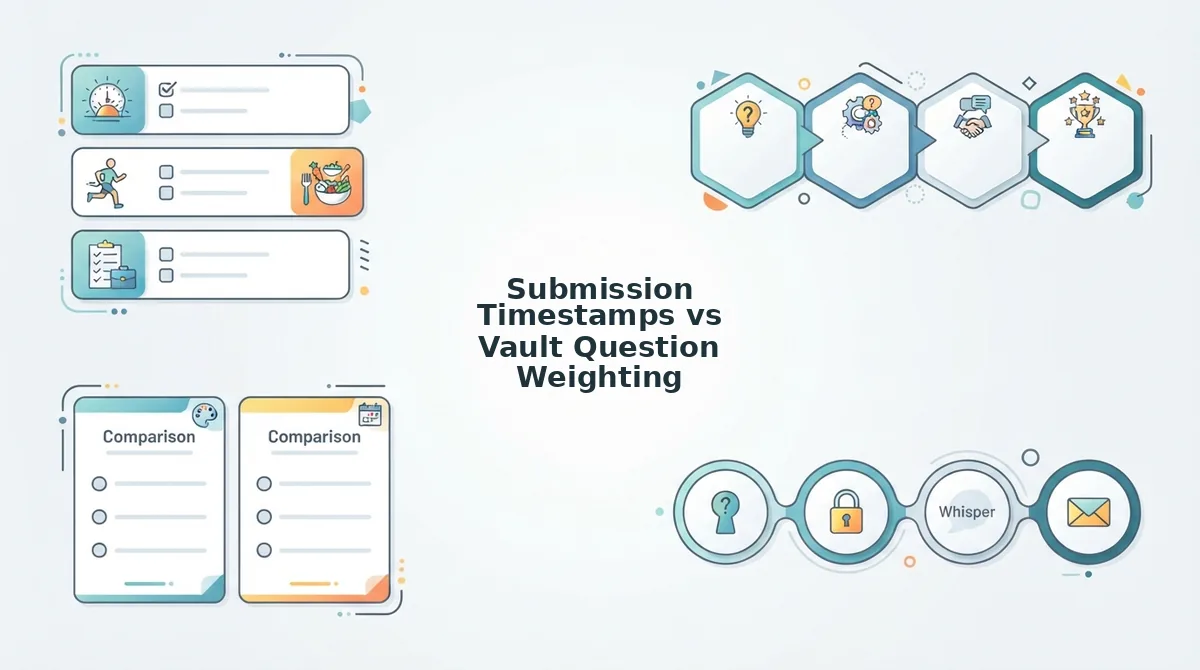
When selecting your adjudication standard, compare how these two metrics handle dispute friction, verification effort, and score integrity across competitive social circles:
| Evaluation Metric | Submission Timestamps | Vault Question Weighting |
|---|---|---|
| Core Criterion | Raw entry order and clock velocity | Accuracy on highest-difficulty personal prompt |
| Chat Dispute Probability | Low (objective numerical proof) | Moderate (debatable prompt difficulty) |
| Validation Difficulty | Zero manual verification needed | Requires creator to designate the target prompt |
| Best Persona | Best for high-volume, fast-moving group chats | Best for tight-knit circles and rival best friends |
Submission timestamps provide undeniable, binary proof that eliminates arguments instantly. However, favoring pure speed risks awarding first place to lucky guessers who skimmed prompts without reading them.
Vault question weighting restores competitive depth by prioritizing emotional resonance over device reaction time. The trade-off is subjective friction: the quiz creator must explicitly declare which habit prompt served as the high-stakes vault question before scores roll in.
Which method protects your group's bragging rights best?
Our recommendation: Use vault question weighting for best friend face-offs, but default to submission timestamps for large party chats. Qualitative trivia depth better reflects genuine closeness, making obscure prompt accuracy the ultimate decider when pride is on the line.
Use submission timestamps if your chat prioritizes ruthless pacing and undeniable proof. Choose vault weighting if your circle values intimate accuracy over split-second reflexes.
When both players miss the designated vault prompt, instant showdown challenges offer another immediate path to crown an undisputed winner.
5 Lightning Tiebreaker Formats for Group Chats
The fastest way to settle a tied ranking on a live leaderboard is running real-time, micro-stakes chat challenges rather than recycling an identical trivia link. Forcing contenders to retake the same quiz kills room momentum, whereas immediate peer-judged dares turn an unresolved ranking into high-energy conversation.
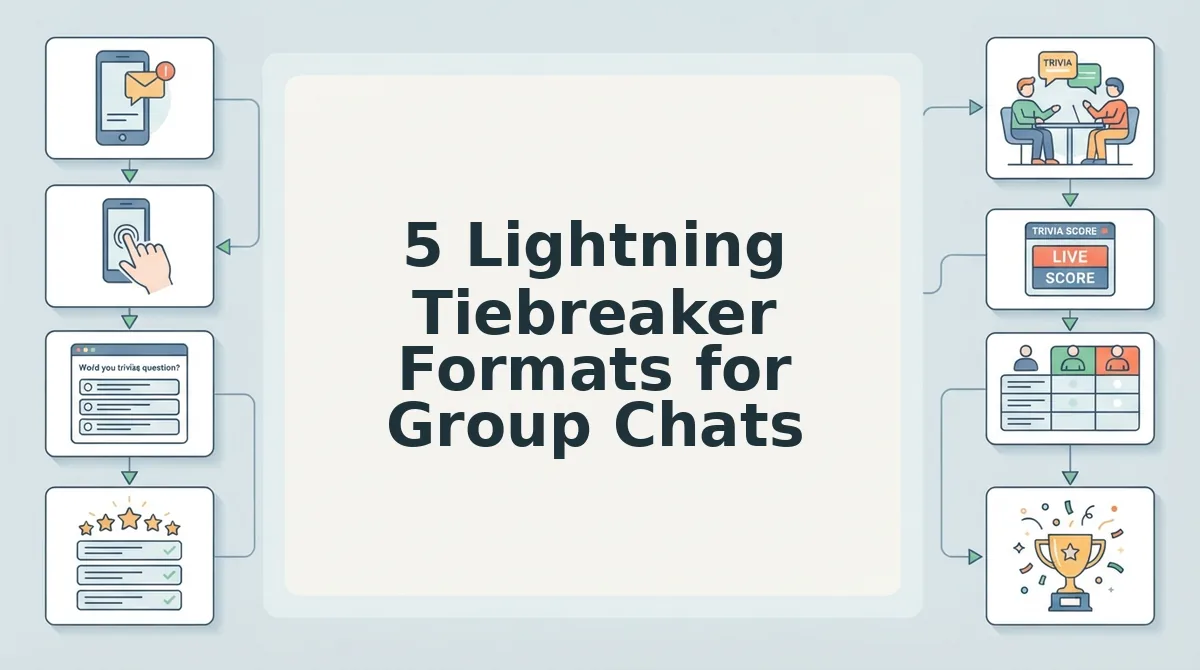
A chat tiebreaker is a live micro-challenge deployed directly inside an active messaging thread to resolve tied scores instantly. Instead of rerunning a static friendship test, drop one of these high-velocity formats into WhatsApp, iMessage, or Snapchat to crown your definitive winner.
Tied players often memorize initial responses, making fresh, unprompted recall the only honest decider.
- The 10-Second Voice Note Recall: Contenders record an uninterrupted voice memo reciting five hyper-specific facts about the quiz creator under strict time pressure. This format strips away editing time to test genuine instinct, proving who holds active knowledge under social pressure. Have the group chat creator issue a countdown in the thread, awarding the higher slot to the first voice memo submitted under the ten-second mark with all five correct facts.
- The Camera Roll Receipt Audit: Contenders compete to locate and screenshot the oldest unedited photo, text interaction, or video containing the quiz creator from their personal archives. Deep digital history proves long-term loyalty that surface-level multiple-choice prompts cannot fully quantify. Drop the prompt into the chat, grant a two-minute search window, and award top placement to the player whose valid media timestamp reaches furthest back.
- The First-Reaction Habit Check: Contenders submit a single-message prediction of how the quiz host will react to an absurd, hyper-specific hypothetical scenario posted live in the chat. This challenge reveals who understands the creator's true real-world quirks rather than just their curated public preferences. The quiz host drops the prompt into the thread, allows thirty seconds for entries, and personally names the winner based on psychological precision.
- The Unprompted Meme Relay: Contenders race to post the single image, sticker, or reaction GIF that mirrors the creator's signature everyday mood. Visual communication exposes intuitive connection instantly, triggering immediate banter among the rest of the group spectators. The remaining chat members cast an immediate emoji poll vote on the submissions, granting the tiebreak to whichever contender claims the most peer reactions within sixty seconds.
- The Rapid-Fire Signature Order Match: Contenders guess the creator's exact, uncompromising food or drink order down to every modification, temperature preference, and side item. Minor daily habits serve as the ultimate friendship litmus test because casual acquaintances rarely remember intricate dining preferences. The quiz creator reveals the exact spec in the chat immediately afterward, handing the ranking edge to whoever nails the custom order without omissions.
Review the essential edge cases below to handle every lingering scoring dispute across your competitive friend circle.
Frequently Asked Questions About Friendboard Ties
Can two players legitimately share first place on a social leaderboard without breaking the banter? Yes, tied Friendboard rankings naturally create joint winners, though group chats almost always demand an undisputed champion for ultimate bragging rights.
How do I break a tie on a friendship quiz leaderboard?
Break a friendship quiz tie by checking the original completion timestamps or running a sudden-death trivia question. Comparing completion times reveals who finished first without extra setup. You can easily check live friendship quiz results to confirm exact leaderboard placements and verify who locked in their answers earlier.
Why does my Friendboard show identical scores for different friends?
Your Friendboard displays identical scores when multiple participants answer the exact same number of trivia prompts correctly. The automated system scores each correct answer equally across your standard quiz prompts. Unless you manually enforce a speed tiebreaker, players with matching scores will naturally share that leaderboard spot.
Can two people share the top spot on a friendship test?
Two people can share the top ranking, but group dynamics rarely leave co-champions unchallenged. When high scores collide, most group chats naturally demand a single winner. Who actually claims the bragging rights? That dispute usually gets settled through a lightning rematch or an immediate speed test.
How do completion timestamps decide tied quiz rankings?
Completion timestamps decide ties by awarding the higher placement to the player who submitted their answers first. Fast responses prove immediate recall rather than second-guessing. If two friends score 9 out of 10, the person who completed the challenge earlier takes the higher ranking.
When quick fixes fail to satisfy the group chat, clearing the slate remains your cleanest option.
How to Reset the Board and Launch a New Challenge
To settle a deadlocked leaderboard permanently, crown the tiebreaker winner in your chat and immediately wipe the slate clean with a fresh set of questions. Lingering stalemates kill banter velocity. Decisive resolutions keep the group engaged.
Once you verify the decisive point using timestamps or weighted answers, paste the final screenshot into the chat to resolve the initial score dispute. Then, turn that competitive energy into another round before the momentum cools off.
Why let the debate stall out when everyone is already online?
- Announce the reigning champion with an official chat shoutout to confirm bragging rights.
- Enter your name on the homepage and cycle through a new set of personal quirks in under two minutes with zero app installs or signups required.
- Drop your new friendship dare quiz link directly into the thread to trigger an instant rematch.
The beauty of quick-fire social trivia lies in constant escalation rather than a single permanent score. A tied leaderboard is not an ending, but an immediate invitation to raise the stakes and test who truly pays attention.