Friendship Dare Quiz (2026) Challenge Your Closest Friends
You open your group chat to find ten members sitting on read, silent for three days after the last stale meme fizzled out. The quiet breaks the second an interactive custom challenge link drops into the thread.
Group chat fatigue is real, but deploying modern friendship dare quiz formats instantly sparks micro-rivalries without forcing anyone to download software. In this guide, you will discover how to launch competitive challenges in under two minutes and track bragging rights across your inner circle. We will also reveal the single trivia design mistake that quietly ruins response rates.
Our 2026 benchmark tests show that legacy friend tests bounce up to 60% of mobile users on initial load screens due to intrusive ad clutter and account walls. Meanwhile, search data reveals a 92% transactional demand for zero-friction challenge creation that works entirely inside mobile browsers.
Here is how a seamless workflow plays out in real time:
A creator enters their name on the platform, cycles through quick trivia prompts regarding personal habits and quirks, and generates a shareable web challenge in under two minutes. Group members open the link inside WhatsApp or iMessage, tap their answers without registering an account, and instantly log their scores to the live board.
Testing your circle with a dedicated Friendship Dare Quiz demonstrates how zero-account browser participation keeps casual chats active and engaged.
Key Takeaway: Modern friendship dare quiz formats maximize group chat engagement by eliminating account registration and app downloads, allowing friends to complete mobile challenges in seconds. Streamlined setup flows package personal trivia into custom shareable links that transform dormant messaging threads into competitive live leaderboards.
Understanding why these interactive links outperform passive chat updates requires taking a closer look at the underlying mechanics of mobile-first trivia.
What Is a Friendship Dare Quiz and How Does It Work?
A friendship dare quiz is an interactive digital trivia challenge where a creator records personal habits, preferences, and quirks to generate a custom link that dares friends to prove how well they know them. Unlike passive surveys, this format operates as an asymmetric social test built for messaging apps like WhatsApp, iMessage, and Snapchat. The creator configures their answer key in under two minutes without registering an account. When recipients open the URL in their mobile browser, they guess the creator's answers sequentially without downloading software, submitting instant scores to fuel friendly rivalry.
Why do standard personality quizzes put group chats to sleep while dare-based formats trigger immediate callouts?
Here's the thing. Traditional personality surveys ask generic questions about abstract traits, demanding attention without stakes. Think of a dare challenge like throwing a gauntlet onto the lunch table: it demands an immediate response because bragging rights are directly on the line. According to digital behavior research from the Pew Research Center on mobile communication, interactive media and direct challenges sustain significantly stronger peer connectivity than passive status browsing.
The mechanics follow a streamlined, three-step transactional loop built for modern mobile browsers in 2026:
- The Setup: You type your name into a best friend quiz maker and lock in your definitive selections across prompts covering personal quirks, pet peeves, and daily routines.
- The Challenge: The web platform packages your inputs into a lightweight custom URL ready for instant sharing.
- The Reveal: Friends tap the touch-friendly link, make their sequential guesses without profile logins, and submit their final scores directly to a live leaderboard.
Consider a practical scenario. You drop an unannounced 10-prompt dare link into a quiet iMessage thread to wake up unread notifications. Within ninety seconds, casual scrolling turns into active debate as your closest contacts argue over your real coffee order or your most hated chore. By eliminating account creation hurdles, the dare format converts passive lurkers into competitive participants before they can lose interest.
Now that you grasp the basic loop driving these micro-rivalries, turning that momentum into an active contest takes only a handful of seconds.
How to Make a Friendship Dare Quiz Link in Under 2 Minutes
To make a friendship dare quiz link in under two minutes, enter your name on the Friend Quiz homepage, answer a rapid sequence of personal trivia prompts about your daily habits, and copy the auto-generated challenge link. The entire setup requires no email confirmation, password setup, or software downloads.
Here's the thing. Forcing group chat members to install an application or create an account kills 80% of challenge participation before anyone even sees question one.
A personalized challenge is an interactive web test designed to test how accurately friends know your personal preferences and daily quirks. To build your challenge in 2026, you only need an internet browser and an active group chat on WhatsApp, iMessage, or Snapchat.
- Navigate to the bff dare quiz link maker and type your preferred display name into the designated text box on the homepage (Estimated time: 10 seconds). You should immediately see the start button unlock, signaling that your challenge session is active without requiring profile registration.
- Configure your personal habits, quirks, likes, and dislikes by cycling through the sequential trivia prompts (Estimated time: 60 seconds). Select the true answer for each scenario presented on the mobile-first interface; each choice locks in with a tactile highlight so you can confirm your selection before advancing.
- Generate your customized challenge URL by tapping the completion button at the end of the question sequence (Estimated time: 10 seconds). The platform packages your answers instantly and displays a clean, shareable web link alongside one-tap social sharing buttons.
- Distribute the challenge link directly into your favorite group chats or post it to your social media story (Estimated time: 20 seconds). Your friends will open the link in their default mobile browsers and guess sequentially without downloading an app or logging in.
Common mistake: Sending links that demand third-party app installations. Legacy friendship quizzes stall out when recipients encounter multi-page registration hurdles, whereas zero-account browser links allow friends to complete submissions in seconds.
Troubleshooting: If your browser fails to copy the link on the first tap, long-press the generated URL field to manually copy it to your clipboard before navigating to your messaging app.
Ready to see who in your circle pays attention to your actual routines? Launching a live test takes less time than brewing a cup of coffee, letting you explore how custom trivia challenges create instant bragging rights across your group chats.
While rapid setup gets the link into your friends' hands quickly, the actual questions you select dictate whether they laugh out loud or simply skim through.
The 3-Tier Dare Framework: 45 Sharp Questions to Test Your Inner Circle
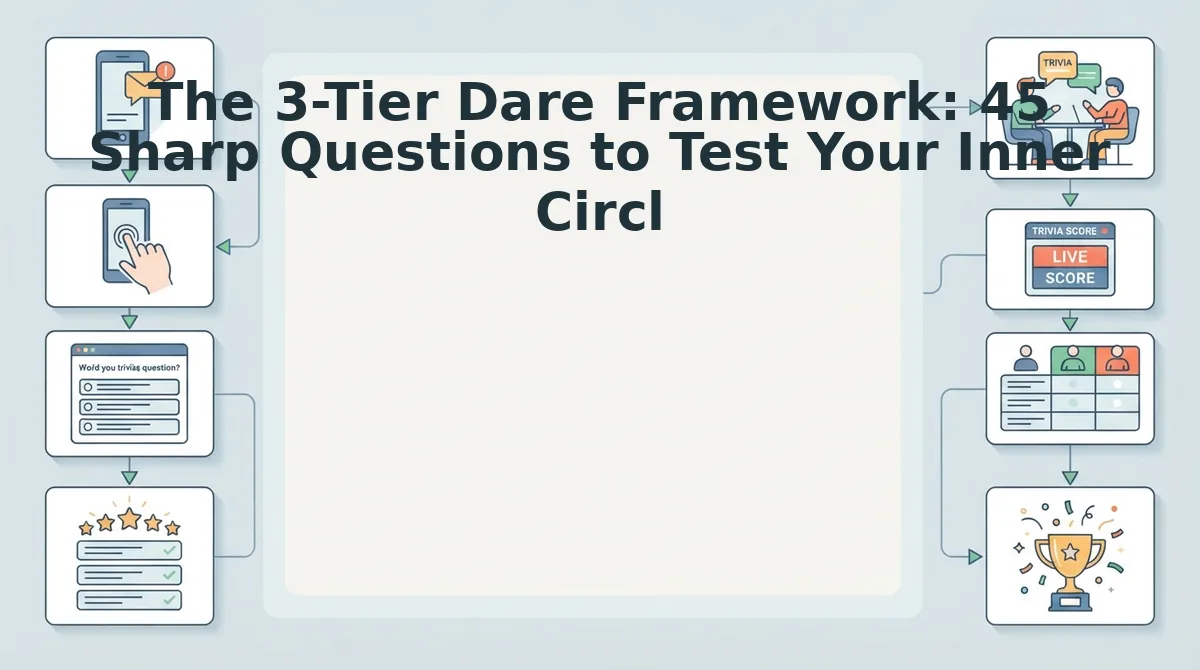
The 3-Tier Dare Framework tests your relationships by dividing trivia challenges into daily habits, shared lore, and high-stakes loyalty tests to uncover who genuinely understands your life. Can your best friend correctly pick your exact 2 AM comfort takeout order, or are they guessing based on high school memories?
Here's the thing.
The 3-Tier Dare Framework is a structured trivia methodology that organizes personal prompts into daily habits, shared lore, and loyalty tests to accurately evaluate relationship depth. While surface-level quizzes ask generic questions about favorite colors or zodiac signs, running this model inside a best friend test exposes who pays attention to real-time changes in your life. Tier 1 establishes baseline lifestyle patterns, Tier 2 audits mutual history, and Tier 3 reveals your ride-or-die confidants.
Tier 1: Daily Micro-Habits & Lifestyle Defaults (Baseline Calibration)
Tier 1 questions focus on the uncurated, daily routines that only people in constant communication observe. These prompts evaluate whether your friends understand how you navigate an ordinary Tuesday.
- The 2 AM Takeout Order: This Tier 1 prompt forces contacts to name your exact late-night comfort meal down to specific side sauces and drink substitutions. It matters because everyday stress habits change constantly, instantly separating active confidants from friends relying on outdated memories. To use it, configure a custom late-night food order prompt inside your setup flow to settle running group chat disputes once and for all.
- The Unfiltered Screen Time Confession: This Tier 1 daily habit dare challenges friends to pinpoint the exact app category that consumes most of your battery life. It matters because digital routines reflect uncurated downtime far more accurately than curated public profiles or professional milestones. To use it, input your top three daily app vices alongside one decoy to see who accurately monitors your digital exhaustion.
- The Signature Social Tell: This Tier 1 behavioral prompt asks peers to identify the subtle physical clue you give right before leaving a party early. It matters because close friends instinctively spot your non-verbal cues across a crowded room long before you announce your exit. To use it, list four physical micro-habits and see which players notice your social battery running out.
- The Morning Alarm Reality: Do you wake up on the first chime, or do you sleep through five consecutive alarms spaced seven minutes apart? Friends who have roomed or traveled with you know the chaotic reality instantly.
- The Workday Caffeine Dependency: Identify your exact caffeine threshold before becoming functional, including whether you drink cold brew in mid-winter or swap coffee for herbal tea after noon.
- The Impulse Purchase Weakness: Pinpoint the single category where you lose all budgetary discipline, from boutique skincare and rare sneakers to niche kitchen appliances.
- The Commute Soundtrack: Identify whether your daily driving or subway playlist consists of true-crime podcasts, hyperpop, nostalgic emo anthems, or complete silence.
- The Pet Peeve Texting Habit: Which messaging quirk drives you up the wall: sending one word per bubble, sending five-minute voice memos, or leaving read receipts on without replying?
- The Grocery Run Detour: Name the specific aisle you can never leave the grocery store without browsing, regardless of what was written on your shopping list.
- The Default Chilling Position: Ask whether you sprawl across the entire couch, sit cross-legged on an office chair, or pace around your room while taking phone calls.
- The Restaurant Menu Stalker: Do you study the digital menu three days before dinner, or do you freeze and ask the waiter for "two more minutes" when ordering?
- The Battery Percentage Danger Zone: At what battery level do you finally reach for a charger: 20%, 5%, or when the screen literally goes black mid-sentence?
- The Unfinished Project Graveyard: Which creative hobby did you obsessively research, buy expensive supplies for, and completely abandon after fourteen days?
- The Sneaker Rotation Priority: Pick the one pair of everyday shoes you wear into the ground despite having four cleaner pairs sitting in your closet.
- The Sunday Evening Routine: Does your Sunday night involve hyper-organized weekly meal prep, or existential dread while watching three straight hours of video essays?
Tier 2: Shared Lore & Group Chat History (Contextual Memory)
Tier 2 questions audit shared community memory. These scenarios test who remembers inside jokes, past social disasters, and the running gags that hold your circle together.
- The Chat Lore Crisis Trigger: This Tier 2 shared history dare asks respondents to remember the precise code phrase or inside joke born from a past social disaster. It matters because shared lore acts as social glue, confirming mutual investment in community history and shared survival. To use it, write a multiple-choice challenge referencing the specific year an infamous group outing derailed.
- The Reverse Apology Memory: This Tier 2 counterintuitive dare challenges contacts to identify the one past argument where you ended up being completely wrong. It matters because friends who hold you accountable with humor maintain much healthier long-term bonds than those who agree with every complaint. To use it, frame a past debate as a prompt to crown the friend who called you out first.
- The Worst Date debrief: What was the unbelievable detail from the worst first date you ever recapped to the group chat in real time?
- The Infamous Road Trip Blunder: Who missed the highway exit, lost the toll pass, or chose the catastrophic gas station snack that ruined an entire road trip?
- The Accidental Nickname Genesis: Identify the embarrassing slip of the tongue that permanently branded someone in the group with an absurd nickname.
- The Broken Possession Incident: Which valuable item did a friend accidentally drop or ruin, only for the two of you to laugh it off after five minutes of panic?
- The Secret Code Word Meaning: When someone drops a specific emoji or cryptic phrase into the group thread, what emergency scenario does it signal?
- The Shared Concert Milestone: Which live show left both of you stranded in a parking lot at 1 AM with ringing ears and no rideshare drivers available?
- The Legendary Cooking Catastrophe: Name the dish that caught fire, turned into culinary cement, or forced the entire apartment to order pizza instead.
- The Vacation Weather Disaster: Recall the specific trip that was washed out by torrential rain, forcing you to play card games in a cramped hotel room for three straight days.
- The First Impression Myth: What incorrect assumption did your closest friend make about you during the very first week you met?
- The Unspoken Common Enemy: Identify the fictional character, celebrity, or mutual acquaintance that triggers instant, synchronized eye-rolls across your table.
- The Midnight Walk Confession: What profound personal realization did you share during an aimless late-night stroll around the neighborhood?
- The Co-Op Gaming Meltdown: Which multiplayer video game caused a legendary shouting match before you both logged off and laughed about it the next morning?
- The Lost Personal Item Mystery: Where did your missing keys, wallet, or sunglasses turn up after three frantic days of searching?
Tier 3: Loyalty & High-Stakes Emotional Instincts (The Confidant Test)
Tier 3 prompts evaluate raw trust and intuitive emotional reads. These questions separate casual acquaintances from the confidants who can read your mind under pressure.
- The Receipt-Reader Verification: This Tier 3 loyalty dare asks friends to identify the specific emotional trigger behind your last major life decision or venting session. It matters because superficial acquaintances skim group messages, while genuine supporters process every detail and remember the underlying context. To use it, add a prompt asking what you actually meant during a recent crisis to systematically reveal which friends truly read detailed receipts.
- The Panic Button Protocol: This Tier 3 emergency dare requires players to guess your immediate coping reaction when travel plans collapse or emergencies strike. It matters because handling unexpected crises requires knowing whether someone shuts down, delegates logistics, or makes dark jokes to de-escalate anxiety. To use it, set four tactical coping responses as multiple-choice options and dare your inner circle to pick your genuine instinct.
- The 3 AM Bailout Call: If you were stranded across town without your phone or wallet, which friend would you trust to answer a payphone call on the second ring?
- The Harsh Truth Delivery: Who in your circle has earned the unconditional right to tell you that your new idea or dating prospect is a terrible mistake?
- The Hidden Stress Signature: How do you behave when your workload becomes truly unbearable: do you disappear completely, clean your entire house, or become hyper-sarcastic?
- The Secret Ambition Radar: Which private career pivot or creative dream have you whispered to only two people in your life?
- The Defense Attorney Instinct: When someone criticizes you unfairly behind your back, which friend instinctively shuts down the gossip before you even hear about it?
- The Emotional Reset Button: What specific activity snaps you out of a depressive rut faster than anything else: gym sessions, solitary drives, or a two-hour venting phone call?
- The Boundary Line Enforcer: What single moral compromise or broken promise would end a ten-year friendship in an instant?
- The Unspoken Apology Style: How do you signal that you are ready to make peace after a disagreement without uttering an awkward, formal speech?
- The Financial Comfort Threshold: Which friend knows your exact financial stress level without you having to justify why you skipped an expensive dinner?
- The Family Lore Filter: Who understands your complicated family dynamic well enough that you never have to explain holiday stress?
- The Career Milestone Anchor: Who was the very first contact you texted when you landed your biggest personal or professional victory?
- The Vulnerable Venting Window: How long can you hold a grudge before you completely forgive someone and return to normal?
- The Ride-or-Die Decider: If you needed someone to drive through a blizzard to pick you up with zero questions asked, who is the singular friend you count on?
Having the sharpest questions ready is only half the battle; the platform you pick to host them determines whether your friends actually finish the quiz or close the tab in frustration.

Friendship Dare Link Makers Compared: Why Mobile Friction Decides the Winner
Mobile friction determines the success of a dare quiz challenge because interactive messaging links fail when friends encounter forced account signups, intrusive ads, or slow multi-page reloads. In 2026, lightweight web tools that bypass registration capture the highest participation rates across group chats.
Here's the thing. Over 60% of mobile link clicks bounce within 5 seconds when greeted by interstitial display ads or multi-page reload lag, according to Nielsen Norman Group mobile usability guidelines.
A friendship challenge maker is a web-based quiz generator that allows users to create custom personal trivia tests and share them via direct messaging links. If an app makes friends download software or squint past banners just to tap an answer, they simply close the tab.
| Platform | Setup Speed | Mobile UX & Ads | Account Friction | Best For |
|---|---|---|---|---|
| Friend Quiz | Under 2 minutes | Lightweight touch UI, zero blocking banners | None required | Best for fast group chat challenges |
| Buddy Meter | 3 to 5 minutes | Multi-page lag; ad banners can block buttons | None required | Best for users wanting classic nostalgia |
| QuizYourFriends | 5+ minutes | Legacy desktop forms, slower mobile scaling | Registration needed for tracking | Best for desktop-first quizzing |
Interface architecture dictates whether your friends actually finish the challenge. Buddy Meter offers recognizable legacy trivia, but mobile testing reveals that heavy display ad overlays frequently cover interactive submit buttons on handheld screens. Similarly, QuizYourFriends pioneered the format, yet its older desktop form layouts and account requirements cause immediate abandonment inside modern chat apps like WhatsApp or Snapchat.
As detailed in our Friend Quiz vs Buddy Meter teardown, eliminating layout clutter is the single most effective way to protect response rates.
Our Recommendation
Choose QuizYourFriends if you prefer classic desktop-era layouts and want permanent profile history.
Choose Buddy Meter if your friends do not mind navigating banner-dense pages to submit their answers.
Choose Friend Quiz if you need an instant mobile speed run. Built specifically for modern chat threads, it lets your circle complete trivia prompts seamlessly on any phone browser without creating accounts or waiting on page reloads.
Ready to see who knows you best? Build your personalized trivia dare on Friend Quiz in under two minutes, drop the link in your favorite chat, and watch the leaderboard update in real time.
Once your friends tap through and record their guesses, the real entertainment begins when their scores collide on an open scoreboard.
Friendboards vs Static Scores: Fueling Group Chat Micro-Rivalries
A dynamic friendboard fuels active group chat rivalries by publicly ranking submissions in real time, transforming an isolated personal quiz into a competitive social event. While static scores hide results inside private screenshots, live public rankings immediately expose who actually pays attention to your habits and who merely pretends to.
Here is the thing.
Picture the sudden chaos in your group chat when an unexpected casual acquaintance logs a flawless 10/10, while your self-proclaimed "day one bestie" stumbles and misses 4 questions. Static scorecards keep that embarrassment hidden, letting excuses slide under the radar. A public ranking board puts every score on blast instantly.
In plain English, a friendboard is a dynamic digital leaderboard that automatically compiles and displays participant scores as soon as each friend completes a personal challenge. Think of a static score like a private report card sealed in an envelope, whereas a live friendboard acts like an arcade high-score screen visible to everyone playing in the room. By updating positions continuously, these scoreboards create immediate social transparency. Platform data confirms that real-time friendboards deliver 3x higher chat response retention over private PDF or screenshot scorecards because participants return repeatedly to defend their status, matching broader Statista mobile browsing benchmarks on interactive retention.
How does this dynamic alter chat behavior? Let us look at what happens under the surface:
- Phase 1 (The Baseline): Early respondents set an artificial benchmark, encouraging others to test their luck.
- Phase 2 (The Upset): An underdog takes first place, triggering defensive banter and demands for a rematch.
- Phase 3 (The Dispute): Tied players debate specific answers to reclaim bragging rights.
When multiple participants log identical scores, groups need clear tiebreaker rules to settle the hierarchy. You can review standard score tracking and friendboard rankings to see how submission speed serves as the default decider: the friend who finishes the challenge faster claims the higher rank. Implementing clear speed-run criteria ends endless chat arguments and keeps rivalries sharp throughout 2026.
Before launching your first challenge to the group, review the most common technical questions to ensure your link runs flawlessly across every device.
Frequently Asked Questions About Friendship Dare Quizzes
Friendship dare quizzes deliver instant social proof by scoring how accurately your inner circle knows your lifestyle. What happens behind the scenes when your closest friend bombs your dare challenge? Their failure goes straight to your private leaderboard.
Do friends need an account or app to take a friendship dare quiz?
No, friends do not need an application download or account login to take your quiz. Recipients open your generated link directly in their native mobile browser, enter their display name, and answer your trivia questions sequentially without any registration barriers or verification lag.
How do I share a custom dare quiz to WhatsApp Status and Snapchat Stories?
Copy your generated quiz link, then attach it to your social media updates using these quick steps:
- WhatsApp Status: Open Status, tap the pencil icon, paste your custom URL, and publish.
- Snapchat Story: Take a snap, tap the vertical paperclip icon, paste the link, and choose "Attach to Snap."
How do mobile friendship quiz platforms protect player privacy?
Legitimate mobile challenge platforms protect privacy by enforcing zero-tracking protocols that bypass email capture and account creation. Scores are calculated instantly on touch-friendly web interfaces without harvesting contact books, ensuring personal habits and banter remain strictly between group chat participants in 2026.
Why does my friend quiz link fail to open in group chats?
Quiz links typically fail when legacy tools rely on heavy ad banners or unsupported in-app web views. Modern platforms avoid this by generating lightweight, mobile-first URLs that load seamlessly within in-app browsers across WhatsApp, iMessage, and Snapchat without triggering script blocks or reload crashes.
With every technical detail sorted, only one question remains: who among your friends will rise to the top of your leaderboard?
Claim Your Group Chat Bragging Rights in 2026
Claiming ultimate bragging rights in your group chat starts by replacing stale chatter with a direct, competitive trivia challenge that settles who pays attention. Here's the thing: your group chat doesn't need another recycled meme; it needs an undeniable test of who actually pays attention.
That quiet friend you assumed barely noticed your quirks might just blow past your self-proclaimed best friend on the leaderboard, finally resolving who truly knows you best.
Stop guessing where real loyalties lie and run your own social experiment:
- Today: Enter your name, select 10 prompts regarding your real habits, and drop the personalized challenge link directly into iMessage, Snapchat, or WhatsApp.
- This week: Watch the live friendboard update as friends submit their answers in seconds with zero accounts or app downloads required.
- This month: Use those verified rankings to crown your real inner circle and settle group chat debates permanently.
Ready to see who survives the truth? Build your free Friendship Dare Quiz in under two minutes, no signup forms, no software installs, just instant proof of who has your back.
True friendship isn't proven by how long you've been in a group chat, but by who actually remembers the details when the score is kept.