Settling a group chat debate with best friend test rankings
Four friends finish the same quiz, every one of them posts a screenshot, and nobody can prove a thing.
That is the dead end most group chats hit: a 7-out-of-10 and a 7-out-of-10 look identical in a message thread. You ran the test, you got numbers, and the argument got worse. What you need is not another quiz but a way to convert those numbers into best friend test rankings â an order, with rules, that everyone accepts as final.
In under five minutes you can turn any finished quiz into a ranked table with a stated tie-break, no app install and no account. Below you get three formats â knowledge, loyalty, and a combined two-axis version â plus the question count that makes an order fair.
One flag before you start: the two most popular quiz styles do not score on the same scale, which is why half of these debates restart at the same sentence. Ordered results are what people clearly enjoy â the Beta Squad best friend test edition has drawn about 9.7 million views â yet those videos show the ranking and skip the arithmetic. That gap is what this guide fills, and a friend quiz link you can share without a download is where most chats should begin.
How Do You Pick a Best Friend Test That Can Actually Rank?
Choose the test that returns an order, not just a score. Question count, closed-book asynchronous answers, percentage scoring, tie-break handling, and no login wall are the five things that decide whether a ranking is possible at all.
A rankable test is one that asks enough questions to separate people, scores answers as a percentage so different totals compare, accepts closed-book answers at different times, states a tie-break rule, and never asks a friend to sign up before question three.
The knowledge format dominates the space â Quiz N' Chill's How Well Do You Know Your Friend test has around 343,000 views, while its loyalty variant Are You the ULTIMATE Best Friend sits near 70,000 â so traffic will push you toward habits and favourites. Neither format is ranked by default, which is why scoring rules matter more than the quiz brand.
| Knowledge formats | Loyalty formats |
|---|---|
| Score factual accuracy: habits, favourites, routines. | Score stated willingness: dares, sacrifices, "would you" prompts. |
| Answers are right or wrong, so ranking is mechanical. | Answers are self-reported, so ranking depends on the scale you set. |
| Best for small, detail-obsessed groups. | Best for mixed groups whose trivia scores bunch mid-table. |
How Friend Quiz Scores Get Ranked
Each friend's answers are marked against the creator's recorded answers and converted to a percentage, so 6-out-of-8 and 9-out-of-12 land on the same 0â100 scale. Sort those percentages highest to lowest and you have an order. Break ties on the harder questions first â habit and preference prompts rather than name-level ones â and flag anyone who answered after scores were posted, because a late entry is not a closed-book one.
Account friction is the most common reason a group never reaches a ranking: if friends hit a login wall before question three, the chat stalls at two scores and the debate dies. A friendship test that opens straight into the questions keeps the whole group in play, and a best friend test with a live Friendboard gives everyone the same visible table instead of scattered screenshots. Close by naming the criterion people forget: a score you cannot screenshot is not a ranking.
Which Ranking Fits Your Group? The Three Options at a Glance
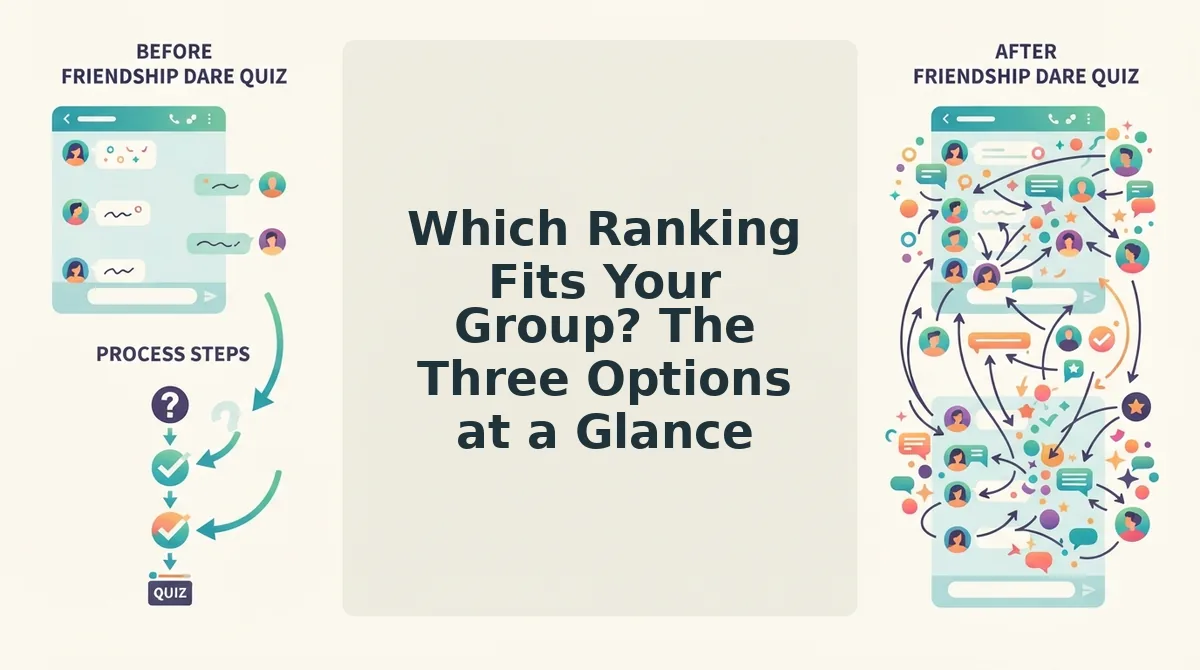
Match the format to your headcount first and your friends' strengths second. A knowledge-only ranking suits three to five people who genuinely pay attention, while six or more needs percentage scoring to stay readable.
- Knowledge ranking â best for small, observant groups (3â5 people). Friends answer closed-book questions about your habits and the answers are marked right or wrong, which produces a clean order with no debate about what counts. Use it when the chat already argues over who remembers details, and run it through a best friend quiz so every score sits on the same scale.
- Loyalty ranking â best for mid-tier trivia scorers and mixed groups. Dares and "would you" prompts score what friends say they would do rather than what they recall, which gives the people who lose on habits a way to win. Keep it separate from knowledge scores; the two numbers are not comparable.
- Two-axis ranking â best for groups of six or more, or repeat debates. Plot each friend on knowledge against loyalty and the order stops being one number. Percentage scoring keeps a seven-person table readable where raw counts produce clusters of identical scores, and a BFF test supplies the loyalty axis in the same sitting.
Start with the format most groups default to: the knowledge ranking, which rewards paying attention.

1. The Knowledge Ranking, Which Rewards Paying Attention
The knowledge ranking is a leaderboard that orders friends by the percentage of factual prompts they answered correctly about you, ignoring how much they'd do for you. It answers one narrow, testable question: who has been paying attention?
Think of it like a pub quiz where the subject matter is your life. Two teams can both score nine out of ten, but the team that guessed the same three answers as everyone else learned nothing â they just absorbed the trivia floating around the room.
How a score becomes a Friendboard position
You type your name, answer a run of prompts about your habits, quirks, likes and dislikes, and the quiz packages those selections into a shareable link. Friends open it in a mobile browser, answer, and submit. The Friendboard then orders everyone by percentage.
Percentage matters more than it looks. If one friend answers ten prompts and another answers eight, raw counts compare apples to oranges; percentages keep the ranks stable. When results land, they appear in order â you can watch live Friendboard rankings fill in as each person finishes.
The sample-size rule
Our house rule: fewer than eight to ten questions and you are ranking noise, not knowledge. With five prompts, two friends who share your coffee order and your dog's name tie for first without either of them knowing you well.
Name the bias
That is shared-trivia bias â the group's common knowledge inflating scores equally, so the board reflects how much the chat talks rather than how close anyone is. Longer prompt sets dilute it: one shared answer out of ten barely moves a percentage.
Concrete workflow: five friends, one link sent once, everyone answers closed-book, and the board orders itself as results arrive.
2. The Loyalty Ranking, for Friends Who Flunk the Trivia
The loyalty ranking is a scoring round built from would-you-do-it prompts rather than fact questions, so friends who moved cities or never memorized your birthday can still compete. You need a prompt set, a shared link, and one rule everyone agrees to before the first answer.
- Pick your prompt set (2 minutes). Choose eight to ten prompts across habits, quirks and likes â "What do I order when I say I'm not hungry?", "Which chore do I complain about most?", "What song do I play on repeat?" â or open a ready-made BFF quiz and skip writing them. You should have a filled list you can read aloud without editing.
- Add three would-you-do-it prompts for the loyalty axis. Examples: "Would you drive two hours to pick me up at 2am?", "Would you tell me the truth about a bad haircut before a job interview?", "Would you sit through my favorite film twice?" These score effort and honesty, not recall, so a flunked trivia friend can still place high on a friendship dare quiz round.
- Set the closed-book rule before you share anything. Everyone answers alone, no screenshots, no asking the chat which option is right. State it in the message the link travels in.
- Send the link once to the whole chat. One message, one link. If you want the full walkthrough, here is how to make a friend quiz in two minutes.
- Have everyone submit a result before replies land. Answer privacy and async answering are the two mechanics that decide whether a group chat finishes a test at all â visible answers turn the quiz into a copying exercise.
- Read the board in order. You should see ranks by percentage, with loyalty prompts weighted into the same board.
Pro tip: closed-book answering is the single change that makes a chat ranking reproducible a week later â repeat the test and you get a comparable board instead of a fresh argument.
Ready-made prompts beat written-from-scratch prompts in group settings, because hesitation is what kills chat momentum before question three. Start a round at Friend Quiz and let the board do the arguing.
3. The Two-Axis Friendboard, Which Ends the Argument
The two-axis Friendboard is a ranking that plots each friend on knowledge against loyalty instead of collapsing both into one number. One number produces arguments; two axes produce a ranking you can actually read.
It works like a school report card that grades effort and attainment separately. A student can ace the exam and skip every group project â both are true, and averaging them hides the story.
This is why the split matters: a friend who moved cities loses on habits and wins on loyalty, and nothing about that is contradictory.
Settling a tie
Tie handling is where most quizzes stop, returning a score with no protocol. Ours is two steps.
- Head-to-head. Both tied friends answer the two hardest prompts again, closed-book.
- Shared rank. If they still match, they share the position. A shared rank is a real result, not a failure to decide.
The paragraph that answers it plainly
Want to know who your real best friend is without a fight? Collect every result before revealing the board. Async play creates a copy-the-leader problem â the friend who answers after everyone has posted sees the answers and can match them, so late submissions drift upward. The screenshot-first rule is the cheapest fix: everyone posts their own score to the chat first, then you reveal the board. If two friends tie anyway, run a head-to-head on the two hardest prompts and, if they still match, award a shared rank. For the mechanics, see this guide to a friendboard tie between two friends.
And the friend in last place has lost a trivia round, not a friendship.
Crown a winner before the chat goes quiet again.
Crown a Winner Before the Chat Goes Quiet Again
You can rank your friends tonight and have a name at the top of the board before the thread goes quiet â one honest session, eight to ten questions, everyone answering blind.
Three formats, three separate verdicts: Knowledge shows who was paying attention, Loyalty shows who would show up, and the Two-Axis Friendboard shows who wins the argument outright. The shortlist of rules that decide whether the ranking holds:
- Eight to ten questions minimum â five is noise.
- Closed book: nobody reads the questions before answering.
- Results posted before replies, so the last friend can't copy the leader.
That third rule rescues more rankings than any question you'll write. And say the limit once, plainly: this ranks one session, not the friendship.
Then run it. Open the best friend test, type your name, and drop the link in the group chat â no account, no download, browser-only, which is exactly what makes a same-evening ranking realistic for a group scattered across iMessage, WhatsApp, and Instagram.
A quiz can't measure a friendship, but a shared leaderboard can end the debate â and that's the part your group chat actually came for.