How to make a friend quiz in two minutes on your phone
The quiz usually dies in the group chat. Someone types "we should do a friendship test," three people reply with the crying-laughing emoji, and then nothing happens, because actually building the thing sounds like work: an account, a form builder, a settings page, a link that breaks on someone's phone.
Here is the short version of how to make a friend quiz: you need a phone, a name, and about two minutes. No account, no email, and no app download sits between your first tap and the finished link.
What follows is the full zero-to-link sequence, timed out second by second, plus the question framework that decides whether friends score well or bail halfway through. There is also one thing most quizzes get backwards about question count, and it is worth staying for.
Skip the reading entirely and make a BFF quiz now â the maker hands back a shareable link plus a live Friendboard that ranks every friend as the scores land, so nobody has to keep score by hand.
What you end up with and what you need before you start
A friend quiz is a short personal trivia challenge built around one specific person's habits, likes, and quirks, which their friends answer to prove how well they actually know them. The output is one tap-able URL that opens in any mobile browser, scores each friend instantly, and posts the result to a live Friendboard.
That is the whole artifact: not a PDF, not a screenshot, not a form with eleven fields. A single link that behaves the same on an iPhone, an Android, and whatever tablet someone's little brother is using.
Think of it like a group chat poll â one place to answer, results that pile up without anyone tallying by hand. The difference is what gets tested. A poll asks what the group thinks; a quiz asks what the group knows about you.
Prerequisites, in order of how much effort they cost:
- Simple: a phone with a browser. That is the entire technical requirement.
- Intermediate: six to ten facts about yourself that your friends have actually witnessed, not facts you find flattering.
- Advanced: a share message with a reason to tap now rather than "later," which in group chat means never.
A Friendboard is the running scoreboard attached to your quiz link; it updates in real time as friends answer, so the ranking settles arguments without you refereeing. It is also the part that pulls latecomers in, because nobody enjoys sitting at the bottom of a list.
One distinction worth holding onto: a personality quiz sorts the taker into a type ("which friend are you?"), while a friend quiz tests knowledge of one named person. Different mechanics, different result, and the second one is what your group chat will actually argue about.
Step 1 â Open the maker and type your name
Step 1 takes roughly twenty seconds: open the maker in your phone's browser, type the name your friends actually use for you, and move on. All you need is a phone and a browser tab â no account, no email, no install.
Here is the clock the rest of the flow runs on, so the two-minute promise is something you can check rather than take on faith:
| Clock | What you are doing |
|---|---|
| 0:00 | Type your name |
| 0:20 | Cycle the personal trivia prompts |
| 1:15 | Review your answers |
| 1:30 | Copy the returned link |
| 2:00 | Paste it in the group chat |
- Open friendquiz.org in the browser your chat app already opens links in â Safari, Chrome, whatever is default. Expected outcome: the homepage loads straight into the flow, asking for your name before anything else.
- Type the name your friends say out loud. "Sam," not "Samantha Reyes." This is the only personal data the entire process requests; no email field appears at any point. Expected outcome: the field accepts your name and the continue control becomes tappable.
- Tap continue to move into the prompts. Expected outcome: the first personal trivia question replaces the name screen in place, with no page reload and no new tab.
Does making a friend quiz on your phone require an app or an account? No. The maker runs inside the mobile browser your group chat already uses, and the entire flow â name, prompts, link â completes without a signup, an email address, or an install. That matters more than it sounds: every additional gate between the idea and the link is a place where the group chat loses interest, and the name field is deliberately the last thing standing between you and question one.
That the link itself is a separately searched intent is not a guess. A "how to make ur bestfriend quiz link" walkthrough on YouTube has pulled 16,581 views, which tells you people are hunting for the endpoint, not the theory.
Name entered, you are ready to fill the thing with questions worth answering.
Step 2 â Pick six questions friends can actually guess
A friend quiz needs six questions split 3:2:1 â three habit questions, two preference questions, and one embarrassing-but-safe question. That mix keeps the quiz finishable in under 60 seconds while staying specific enough that nobody can Google their way to a perfect score.
Most question lists online are fifty-item dumps with no selection logic at all. The ratio is the part that decides whether your quiz gets finished or abandoned at question four, so write to the mix rather than to a word count.
- A daily-routine habit. This is something you do at roughly the same time every day, which means anyone who has spent a morning with you has seen it. Ask "What do I drink first thing in the morning?" or "How many alarms do I set?" â the answer is guessable from observation but not searchable.
- A tell people tease you about. A quirk your friends already imitate behind your back is the single most answerable question type on the list. Try "What do I do with my phone when I'm nervous?" or "What do I say when I'm pretending to agree?"
- A recurring order or ritual. Habits repeat, so they leave witnesses. Write "What do I order at a coffee shop every single time?" or "What's the first app I open in the morning?" â specific enough to be un-Googleable, predictable enough to be fun.
- A like with a concrete fork in it. Preference questions work when both options are plausible, because a 50/50 split creates argument in the chat. Use "Beach day or movie marathon?" or "Text or voice note?" rather than open-ended favourites.
- A hard no. Dislikes are stickier in memory than likes, and they let friends feel clever. Ask "What's the one food I refuse to eat?" or "What chore will I always avoid?"
- One embarrassing-but-safe question. Save this for last so it lands as a punchline rather than a barrier. "What song do I sing badly in the car?" is the register to aim for â revealing, harmless, and impossible to answer correctly unless they actually know you.
If you want a ready-made pool to borrow from before writing your own, our best friend quiz questions roundup is grouped by the same habit, preference, and confession buckets.
Step 3 â Get the link into the chat before the idea dies
Copy the quiz link, paste it into the group chat as a bare link rather than a screenshot, and post it while people are already looking at their phones. The full sequence takes about 40 seconds and requires nothing from your friends but a tap.
Before you start, have the quiz link from Step 1 in hand and the target chat open in a second tab or app. Nobody on the receiving end needs an account, an app, or a download â the quiz opens in their mobile browser.
- Copy the link (5 seconds). Tap the copy control on the confirmation screen and confirm your clipboard holds the full https:// link ending in your quiz's address. You should see a "Link copied" confirmation before you switch apps.
- Paste it into the chat as plain text (10 seconds). In WhatsApp, paste into the message field and send without attaching anything, so the link auto-expands into a preview card. In iMessage, paste and send the same way; the preview should render above your text. In Snapchat, send it as a direct chat message first â a Story post gets views but no scores.
- Add one line of provocation (5 seconds). Type "Nobody in this chat is getting above 4 out of 6" directly under the link. A bare link reads like homework; a dare reads like a challenge, and the framing is what converts taps.
- Send it while the chat is live (timing matters more than wording). Drop it during an active conversation rather than at 2am. A BFF friendship test video with 341,475 views makes the same point from the other direction: it plays better with your friend present, so aim for the moment people are together or already typing.
- Check that it worked (10 seconds). Watch for the first score appearing on your results board. If the preview card is missing, the link was pasted with a stray space or a shortened fragment â resend the full https:// address and it will unfurl.
A link beats a screenshot because a screenshot can't score anyone. When the first answers land, the Friendboard ranks the group automatically, so you're not chasing replies one by one â which is the entire reason a quiz for friends spread through a chat actually finishes.
Google Forms vs a purpose-built friend quiz link
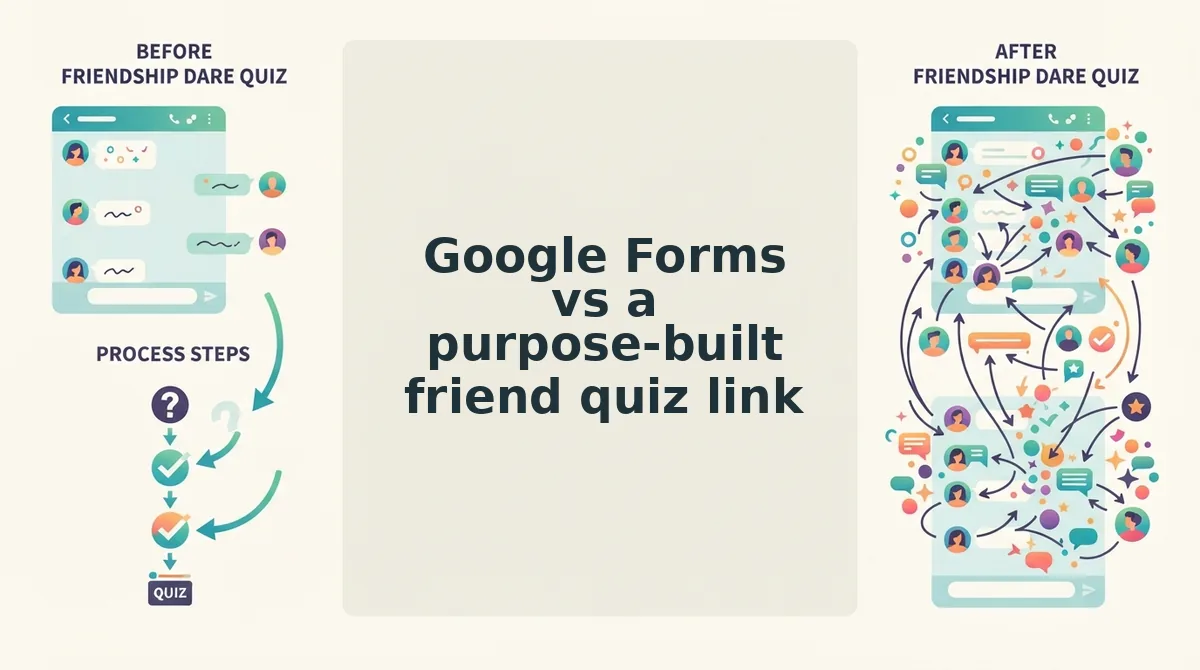
Google Forms wins if you want total control over question types and already live inside Google's ecosystem; a purpose-built friend quiz link wins if you want friends to answer without an account and see a live scoreboard. Both hand back a shareable URL, but only one is designed for banter.
Honest credit where it's due: Forms is free, fully customisable, and handles long quizzes, images, sections, and response validation better than most dedicated tools. That flexibility is exactly why Kevin Stratvert's Google Forms tutorial, at 583,077 views, remains the default route people are taught.
| Comparison point | Google Forms | Purpose-built friend quiz link |
|---|---|---|
| Account or install | Google account required to build; respondents answer without signing in | No account or app download for creator or respondents |
| Setup shape | You write every question from scratch in a form builder | You cycle through pre-written personal prompts |
| Live scoreboard | None â responses arrive as rows in a spreadsheet | Friendboard ranks friends as answers come in |
| What the respondent sees | A survey with a progress bar | A challenge with a score at the end |
| Question types | Multiple choice, short answer, scales, grids, validation | Fixed personal trivia format |
| Best for | Teachers, organisers, anyone collecting data at scale | Group chats that want a rivalry settled in five minutes |
Best for the data collector: Google Forms â pick it if you need branching, images, or more than twenty questions, or if you'll reuse the same form for a class or a club.
Best for the group chat instigator: a purpose-built maker that returns one live link you can drop straight into WhatsApp, iMessage, or Instagram, like this friendship test. The artifact is a single URL friends open and answer in their browser, which is the difference between a form and a dare.
Can you make a friend quiz without a Google account?
Yes. A Google account is only needed to build a Form, not to answer one, and purpose-built friend quiz makers skip the requirement entirely for both sides. The creator types a name, answers a run of personal prompts, and the site generates a shareable link in the same session. Nothing is installed, no email is collected, and friends who receive the link answer in their mobile browser as anonymous taps rather than as form respondents. The practical effect is fewer drop-offs: no sign-in wall sits between the chat and the first score.
Knowing which tool to pick is half of it â the other half is checking that the quiz you sent actually works.
How to check it worked and why the chat sometimes goes quiet
Tap your own link in a private browser tab, answer one question, and confirm your name and the score screen both load â that takes about ten seconds and catches nearly every broken quiz. If the link itself works but nobody replies, the cause is usually one of five creation-side mistakes, listed here from most to least common.
- You sent a screenshot instead of the link. A screenshot is a dead end: friends can see the quiz but can't tap, answer, or score anything, so the thread dies after a few laughing emojis. Copy the actual URL from the address bar or your phone's share sheet and paste that instead, then tap it once yourself to confirm it opens.
- Your questions are too obscure to guess. If fewer than half your friends could plausibly know an answer, they guess at random or quit, and a quiz nobody can score feels rigged rather than fun. Stick to the three easy, two medium, one wildcard mix so the group stays in the game until the last screen.
- You sent it mid-afternoon. A link dropped at 2pm lands under three other conversations and gets buried before anyone opens it. Send when the chat is already moving, and if it stalls, reply to your own message once in the evening rather than posting it fresh again.
- Your display name is too long to read. Long names get truncated in link previews, so friends can't tell whose quiz they're looking at and scroll past. Use a first name or nickname under about twelve characters, then check how the preview card actually renders before you send.
- There's no shared scoreboard for anyone to argue over. Answers that arrive as separate replies never get compared, so the quiz ends with no bragging rights and no reason to replay. Pick a maker with a live Friendboard, where every score lands in one visible ranking the group can refresh and contest.
If the thread went quiet for reasons beyond these five, the recovery playbook in how to fix a friend quiz that went flat covers re-sending, re-scoring, and running a second round.
Friend quiz questions people keep asking
Do I need an account or an app to make a friend quiz?
No. You can build and share a friend quiz in a mobile browser with no account, no email, and no download â you type your name, answer the prompts, and get a link. Google Forms tutorials imply a Google login, which is where most of the confusion comes from.
How many questions should a friend quiz have?
Six is the default. Build them on a three easy, two medium, one wildcard split so early questions feel winnable and the last one separates the real friends. Fewer than four ends too fast to argue over; more than ten makes answering feel like homework.
Can I edit the quiz after I share the link?
Treat the link as final. Once friends have opened it, changing questions mid-round means different people answered different quizzes and the scores stop comparing. Check every question on your own phone before sending, then run corrections as a fresh round instead.
Where should I send a quiz for a group, not one person?
Send it to the group chat where the banter already happens â WhatsApp, iMessage, or Instagram â not to individual DMs. One shared thread keeps every score visible in the same place, which is the difference between a group quiz and four private results nobody compares.
The link is the whole point, so send it
The two-minute budget isn't a marketing line â it holds because the work is three moves: type your name, pick six questions friends can actually guess, and paste the link into the chat you're already in. Everything else, from length to sharing, is a judgement call you can make in seconds.
What you get for those two minutes is a scored, arguable result instead of a vague "haha so true" reaction. The closed loop from the start of this guide is the part most people miss: the payoff isn't the quiz, it's the ranking your friends refresh and dispute long after they've stopped reading the questions. A quiz that lands without a shared scoreboard is just a poll.
So open the maker, type your name, and send the link before the idea cools â start your friend quiz and let the group settle who actually knows you.