How to Write Dare Prompts That Spark Friendly Rivalry
Your group chat has gone quiet. The last message was a meme from Tuesday. You want to write dare prompts that spark friendly rivalry, but every list you find online reads like a middle school yearbook, flat, predictable, and dead on arrival.
Here's the truth: flat dare lists kill momentum because they ignore difficulty calibration and sequencing. The fix isn't more dares. It's structuring them so scores stay close and tension builds. In this guide, you'll learn the Rivalry Curve, a three-stage model for sequencing prompts, plus the 60/40 Rule for calibrating difficulty so every round ends in a rematch demand, not a shrug.
We'll also show you how to turn these prompts into a shareable friendship dare quiz in minutes, no app download required. Stick around for the one calibration decision that separates flops from rematch wars, it's simpler than you think and most people get it backwards.
What Makes a Dare Prompt Competitive Instead of Just Funny?
A competitive dare prompt is one that forces a choice, creates a measurable outcome, and leaves room for dispute. Funny dares get a laugh and vanish. Competitive dares get screenshotted, argued about, and replayed.
Think of a competitive dare like a penalty kick in soccer. A funny dare is a trick shot, entertaining once, forgotten after. A competitive dare has stakes: someone scores, someone misses, and the scoreboard changes. That scoreboard pressure is what turns a casual quiz into a rivalry.
The Rivalry Curve is a three-stage model for sequencing dare prompts so scores stay close and tension builds. It moves through Warm-Up, Escalation, and Tie-Breaker phases. Flat dare lists fail because they ignore score dynamics and escalation, every prompt hits with the same intensity, so nothing builds and players disengage.
Here's the progression in practice. Warm-Up dares are low-stakes and answerable by most friends: "Which of my go-to coffee orders would I pick on a Monday morning?" Escalation dares split the group: "What's the one habit I'd never admit to on a first date?" Tie-Breaker dares force a binary call under pressure: "If I could only text one person during a crisis, who is it?" Each stage raises the emotional stakes while keeping the score within reach.
When scores stay close, players stay invested. If one friend runs away with the lead by round three, the rest check out. The Rivalry Curve exists to prevent that. For guidance on resolving dead heats when the curve works too well, see these tie-breaker rules for friend quiz rankings.
The 60/40 Rule: How to Calibrate Dare Difficulty
This balance keeps scores close enough to sustain tension without making anyone feel hopeless or unchallenged.
Prerequisites: A list of 10 dare prompts, a rough sense of your friends' shared knowledge about you, and about 10 minutes. You can build the final quiz using Friend Quiz's creator flow, no account or app install needed.
- Sort your existing dares into two piles. Go through your list and label each prompt "Most Can Answer" or "Splits the Group." A prompt like "What's my usual pizza topping?" goes in the first pile. "Which friend would I call first after a breakup?" goes in the second. You should see a clear distribution emerge.
- Count and adjust to hit the 60/40 split. For a 10-prompt quiz, you want 6 answerable prompts and 4 split-the-group prompts. If you have 8 answerable and 2 splitting, rewrite two of the easy ones. Change "What's my favorite color?" to "What color would I never paint my room, even for a dare?", same topic, sharper edge.
- Sequence the prompts along the Rivalry Curve. Place your 6 answerable prompts in the Warm-Up and early Escalation slots. Save all 4 split-the-group prompts for late Escalation and the Tie-Breaker. This ordering means early scores stay tight, and the final rounds decide the winner.
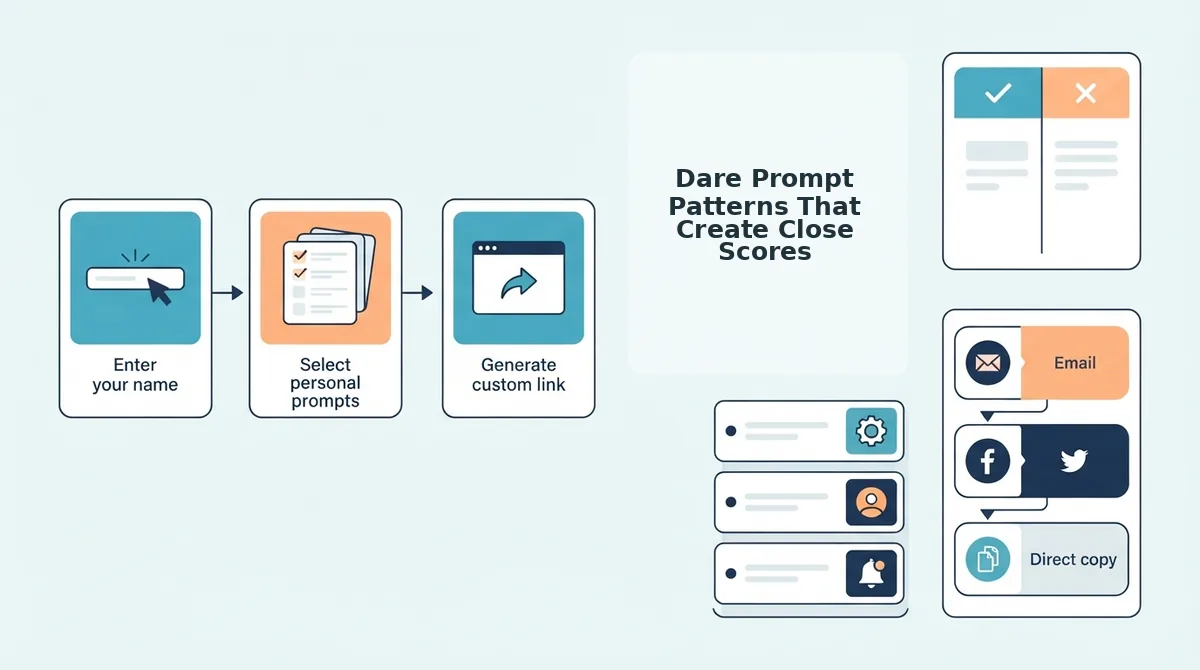
- Run the prompts through Friend Quiz's creator flow. Enter your name, cycle through the trivia prompts, and generate your instant quiz link. You should see a shareable URL ready for your group chat in under two minutes, the same flow described in this guide to create a friend quiz in under two minutes.
- Check the score spread after the first playthrough. If the final gap is wider than 2 points, your split-the-group prompts are too hard or too easy. Swap one out and retest. Success looks like a final score within 1-2 points, with at least one player demanding a rematch.
Next, we'll look at dare prompt patterns engineered to produce those nail-biting close scores.
Dare Prompt Patterns That Create Close Scores
Close scores are engineered, not accidental. The right prompt pattern splits opinions predictably, forcing tight finishes and instant rematch demands.
- Either/Or prompts force binary commitment. These prompts present two equally defensible options with no middle ground, which splits friend groups into camps and keeps score gaps razor-thin. Use them when a quiz feels lopsided after early rounds. Example for Friend Quiz: "Would I rather lose my phone for a week or lose my voice for a week?"
- Ranking prompts reward partial credit naturally. These prompts ask players to order three to five items by your preference, so even wrong answers earn points for correct adjacent placements. Use them to soften difficulty without making the quiz feel easy. Example for Friend Quiz: "Rank my weekend priorities: sleep, snacks, social plans, screen time."
- Prediction prompts tap into inside knowledge. These prompts ask players to forecast your reaction to a hypothetical scenario, which tests how well they model your personality rather than recall trivia. Use them when you want to separate close friends from acquaintances. Example for Friend Quiz: "If my group chat went silent for 24 hours, what would I do first?"
- Habit-frequency prompts create near-miss answers. These prompts ask players to estimate how often you do something, and most friends will be off by one increment, producing tight score clusters. Use them mid-quiz to reset momentum. Example for Friend Quiz: "How many times do I check my phone before getting out of bed?"
- Preference-vs-principle prompts expose value gaps. These prompts pit a comfort choice against a moral stance, which reveals who actually listens when you talk. Use them as late-round tie-breakers. Example for Friend Quiz: "Would I rather keep a secret or win an argument?"
- Reverse-dare prompts flip the pressure onto the quiz taker. These prompts ask players to predict what you would dare them to do, which rewards friends who know your sense of humor. Use them to end on a laugh instead of a score. Example for Friend Quiz: "What would I dare you to post in the group chat right now?"
- Time-capsule prompts reference shared history. These prompts ask about a specific past moment only true friends remember, which creates emotional stakes and close scores among your inner circle. Use them sparingly to keep the quiz feeling personal. Example for Friend Quiz: "What did I say the first time we met?"
Tie-breaker patterns work because they split opinions predictably. Either/Or, Ranking, and Prediction prompts each force a different cognitive commitment, binary choice, ordered preference, or behavioral forecasting, so no single player can dominate all three. When scores land within two points, players immediately demand a rematch, and that rematch loop is what keeps Friendboards active. Avoid the friendboard score tracking mistakes that kill momentum by rotating these three patterns across every quiz you build.
The Roast vs. Respect Matrix: Keeping Rivalry Friendly
Friendly rivalry lives inside a narrow band between boring and brutal. The Roast vs. Respect matrix maps every dare prompt on two axes, intensity (mild to spicy) and target (self or friend), so you can calibrate tone before anyone feels attacked.
| Quadrant | Prompt Style | Example | Best For |
|---|---|---|---|
| Mild + Self | Self-deprecating confession | "What's my most embarrassing food order?" | New friend groups testing the waters |
| Mild + Friend | Playful observation | "Which friend is most likely to cancel plans?" | Established groups wanting laughs without heat |
| Spicy + Self | Bold self-roast | "What's my worst habit I refuse to fix?" | Close friends who already roast each other |
| Spicy + Friend | Direct callout | "Which friend would survive a zombie apocalypse least?" | High-trust groups with thick skin |
The line between rivalry and resentment is thinner than most people think. A prompt that lands as a laugh in one group reads as a jab in another, which is why the matrix matters more than any single prompt idea. Spicy + Friend prompts generate the strongest reactions and the highest friendboard vs global leaderboard engagement, but they only work when trust already exists. Start in Mild + Self and move right only after the group proves it can handle heat.
How to Turn Dare Prompts Into a Group Chat Event
Great prompts die in drafts. The goal is a quiz that takes under 90 seconds to build and under two minutes to play, so momentum never stalls in WhatsApp or iMessage.
- Open Friend Quiz and type your name. Go to friendquiz.org on your phone and enter your first name in the homepage field. You should see the first dare prompt appear instantly with no account setup required.
- Answer each prompt with your thumb, not your brain. Cycle through the personal trivia prompts and pick your first instinct for every answer. Each tap should take under three seconds, keeping total build time around 90 seconds.
- Review your dare prompts for thumb-speed playability. Scan each prompt and rewrite any that require more than five seconds of thought. Short prompts with binary or ranked answers perform best when friends answer on mobile keyboards.
- Tap share and drop the link in your group chat. Use the share button to copy your quiz link, then paste it directly into WhatsApp, iMessage, or Snapchat. Friends open the link in their browser with no app download or login required.
- Watch the Friendboard update in real time. As friends submit answers, scores appear on the Friendboard instantly. Call out the current leader in the chat to trigger a rematch wave within minutes.
Thumb-speed answering is the difference between a quiz that gets finished and one that gets abandoned. Follow the fast friend quiz setup workflow to keep your build under 90 seconds, then let Friendboard bragging rights do the follow-up work for you. Ready for the questions everyone asks next?
FAQ: Writing Dare Prompts That Spark Friendly Rivalry
Direct answers to the most-searched questions about dare prompts, group chat quizzes, and keeping competition fun.
What is a dare prompt in a friend quiz?
A dare prompt is a challenge question that asks friends to predict or perform something specific about the quiz creator, like "What's my go-to karaoke song?" or "How many alarms do I set before waking up?" It turns passive trivia into active competition by forcing a concrete, checkable answer.
How do I make a dare quiz for my group chat?
Start with three to five prompts that mix easy observations with one wildcard nobody would guess. Use the 60/40 rule: 60% of prompts should be answerable by anyone who pays attention, 40% should be near-impossible. Then build a friend quiz in 60 seconds and drop the link in your chat.
Why do dare prompts create closer scores than trivia questions?
Dare prompts reward social observation, not factual recall, so the playing field levels out. A friend who knows you order the same coffee every day scores the same as one who memorized your birthday. Close scores trigger tie-breakers, which extend the rivalry and keep the chat active longer.
What are good dare prompts for a group chat?
Strong examples include "What's the first thing I do when I wake up?", "Which friend would I call first in an emergency?", and "What's my most-used emoji this month?" Each has one verifiable answer, invites debate, and gives every participant a realistic chance to score.
How do I break a tie in a dare quiz?
Use a sudden-death prompt that requires a prediction, not a memory: "What will I order at dinner tonight?" or "What time will I actually go to sleep?" The first correct answer in the chat wins. This mechanic keeps the rivalry alive after the quiz ends and gives losers a rematch path.
Why does my friend group argue about dare quiz answers?
Arguments happen when prompts are ambiguous or unverifiable. Fix this by writing prompts with one objectively checkable answer, like "What's my phone battery percentage right now?" instead of "Am I more introverted or extroverted?" Specificity converts disputes into bragging rights.
The Prompt That Keeps Scoring
The Rivalry Curve, the 60/40 calibration, and tie-breaker mechanics all point to one conclusion: the best dare prompt is the one your group chat is still arguing about tomorrow. A prompt that ends the conversation is a trivia question. A prompt that starts a rematch is a dare.
Your next move is to write three prompts using the 60/40 split, add one sudden-death tie-breaker, and create a dare quiz on Friend Quiz. Send the link before your next group hangout and let the scoreboard do the instigating. The rivalry you start today becomes the inside joke your friends reference for months.