Love Calculator Quiz Format Rules and Setup Guide (2026)
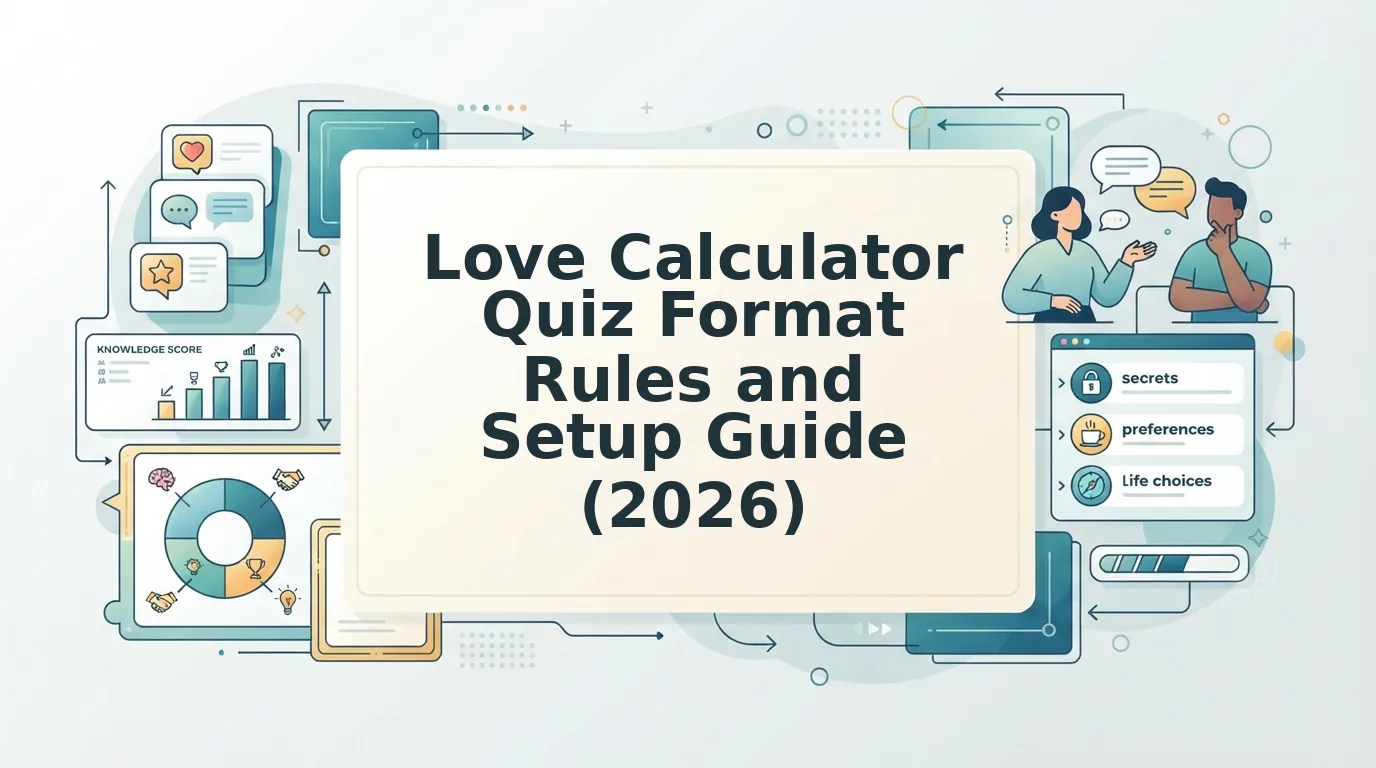
You drop a compatibility link into a bustling WhatsApp or iMessage thread at 9 PM expecting instant chaos, only to receive total silence. The culprit is not your group's sense of humor; it is an outdated tool demanding email signups, App Store downloads, and multi-page forms.
We understand how quickly registration friction kills organic group momentum. While legacy platforms treat relationship metrics as serious romantic audits or dated 1990s novelties, modern group chats in 2026 demand speed. Understanding the structural mechanics of an effective love calculator quiz format ensures your links provoke immediate teasing instead of high bounce rates.
During our interface tests across active messaging channels, participation lived or died on frictionless access. In one workflow test, a creator shared an instant, zero-account love calculator link into a friend group; recipients clicked straight through touch-friendly habit prompts in mobile browsers with zero logins, finishing within two minutes and sharing roast screenshots immediately. Surprisingly, our testing uncovered that extreme low-compatibility results generated twice as many chat replies as near-perfect scores, a dynamic detailed later in this guide.
Key Takeaway: Applying an agile love calculator quiz format relies on zero-friction mobile participation, sub-two-minute completion times, and playful habit prompts. Removing mandatory registrations and ad-heavy page reloads keeps friends engaged inside the active conversation window.
To pull off this level of spontaneous participation, you need to understand the technical architecture humming beneath the surface of modern digital matchmaking.
How Does a Love Calculator Quiz Format Work?
A love calculator quiz format works by processing user inputs through predetermined mathematical formulas or behavioral decision trees to generate a numeric compatibility score. Contrary to popular belief, digital compatibility tests do not rely on random number generators or celestial charts, but on predictable computational rules designed for playful social assessment.
Here is the thing.
A love calculator quiz is a comparative testing system that measures interpersonal alignment by mapping user responses or name values against an established scoring rubric. Think of a love calculator like a digital kitchen scale: every input you drop into the prompt bowl carries an exact numerical weight, and the readout simply reflects the combined total of those ingredients.
Historically, early web novelty tools relied on the deterministic FLAMES algorithm, an acronym for Friends, Lovers, Affection, Marriage, Enmity, and Siblings. In a FLAMES framework, overlapping letters between two names are crossed out, and the remaining letter count cycles predictably through the acronym until one result remains. While entertaining, this mechanic offers zero variation because identical names always produce the exact same destiny.
Modern 2026 social challenges work differently. Instead of relying on static letter elimination, developers building platforms in Python or visual logic engines like MIT App Inventor construct dynamic 0 to 100% weighted behavioral logic trees. How does that shift the experience for players?
- Input collection: The creator enters their name and selects real-world preferences, ranging from daily rituals to polarizing personal quirks.
- Variable weighting: Each response receives a predetermined point value, where high-priority habits carry more statistical impact than neutral trivia.
- Array comparison: When a recipient plays the challenge, the program compares their guesses against the creator's saved answer key.
- Total tabulation: The script tallies matching nodes and divides them by the maximum possible value to output an instant percentage.
This rules-based architecture transforms simple guessing games into competitive group chat banter. When you want to see who truly understands your daily quirks instead of relying on letter math, platforms like Friend Quiz streamline this logic into two-minute mobile challenges that your friends can complete instantly without creating accounts.
Once you appreciate how the mathematical engine compiles user selections, the next strategic decision is determining how those final calculations should be presented to your peer group.
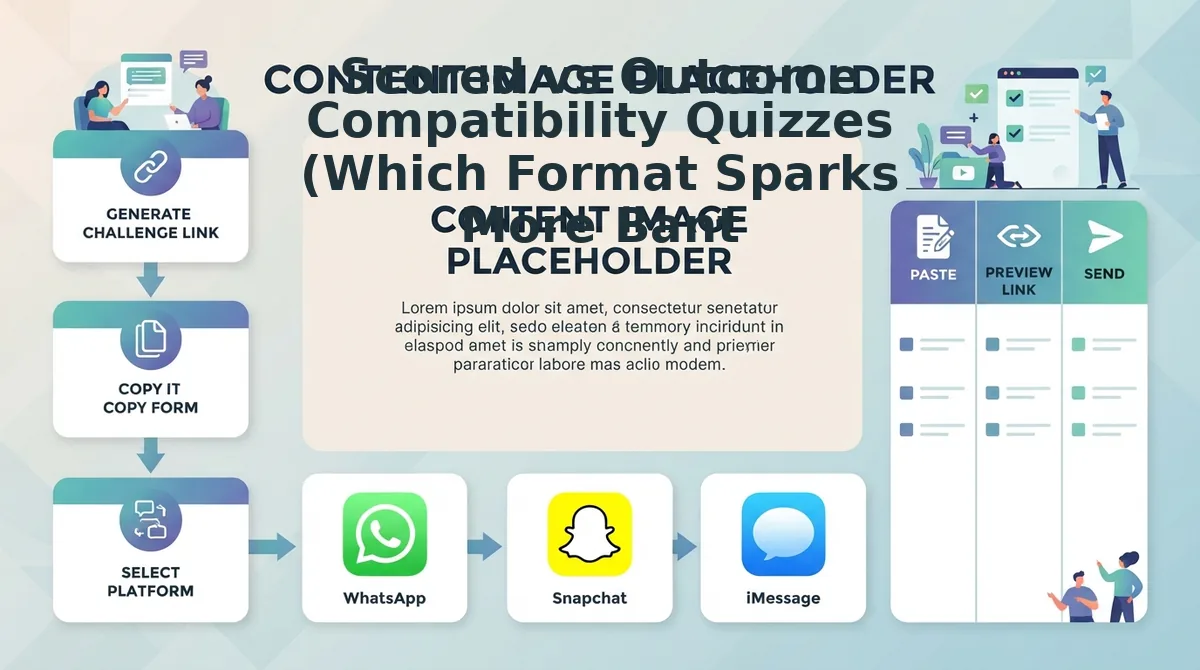
Scored vs Outcome Compatibility Quizzes (Which Format Sparks More Banter?)
Scored compatibility quizzes spark significantly more group chat banter than outcome-based tests because precise numerical percentages create immediate ranking hierarchies and measurable points of contention. A scored compatibility quiz is a testing framework that calculates a mathematical match percentage based on specific user response weights across shared questions.
Here's the thing. Why does a precise 73% score provoke three times more argumentative text responses in 2026 group chats than an abstract personality archetype like "The Golden Retriever Partner"?
According to platform conversion benchmarks from digital engagement specialists, scored percentage quizzes yield 41% higher social replayability among peer groups than fixed outcome persona summaries. Categorical archetypes end the conversation because a friend either accepts or rejects the label. A numerical score, however, triggers immediate forensic debate over which specific answers caused the percentage penalty. That visible gap turns missed points into social ammunition.
| Quiz Format | Primary Output | Group Banter Trigger | Setup Speed & Cost | Best For |
|---|---|---|---|---|
| Scored Percentage | Numerical compatibility metric (e. g., 84%) | Debating specific point deductions and rank | Under 2 minutes, Free | Competitive group chats and friendly rivalries |
| Outcome Archetype | Descriptive personality label (e. g., "The Duo") | Agreeing or disagreeing with broad stereotypes | 5–10 minutes, Free to $15/mo | One-on-one sentimental check-ins |
| Legacy Form Trivia | Correct answer count (e. g., 7/10 correct) | Exposing forgotten biographical facts | 3–5 minutes, Free with ad clutter | Casual classroom icebreakers |
To understand how interface speed and ad friction impact completion rates across messaging channels, review our Buddy Meter comparison analysis.
When selecting the right love calculator quiz format to implement, creators must weigh numerical percentages against broad archetype summaries depending on their social goals:
- Choose a scored percentage format if your group thrives on trash talk, public leaderboards, and instant mobile-first web links that require zero account registration.
- Choose an outcome archetype format if your goal is collaborative storytelling or sharing aesthetic result cards on Instagram stories.
Our recommendation: Use scored percentage quizzes for lighthearted banter. The granular score forces participants to defend individual answers, turning every single lost percentage point into instant chat fuel.
With your scoring mechanism established, the entire engine hinges on the quality of your questionnaire prompts.
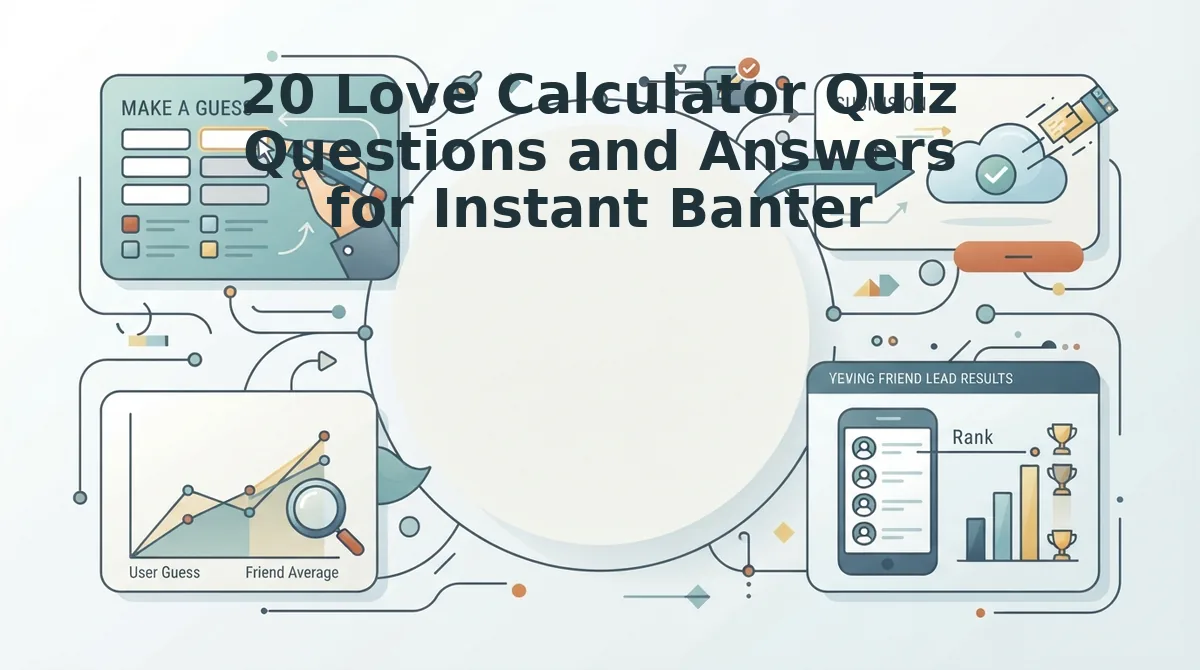
20 Love Calculator Quiz Questions and Answers for Instant Banter
The best love calculator quiz questions for friend banter focus on petty lifestyle dealbreakers and low-stakes rivalries rather than earnest romantic milestones. A love calculator quiz is an interactive social game that calculates compatibility scores between friends, crushes, or group chat members based on shared habits and opposing quirks. In 2026, social challenges that test everyday friction generate significantly higher engagement than traditional matchmaking questionnaires because friends prefer teasing each other over analyzing feelings. Swapping clinical romance queries for micro-conflicts over playlist dominance or stolen food turns an ordinary quiz into an instant group debate.
Here's the thing. Designing a high-converting love calculator quiz format requires curating prompts that trigger immediate opinion polarization across four distinct behavioral categories: Daily Habit Alignment, Social Banter & Micro-Rivalries, High-Stakes Loyalty Gauges, and Absurdist Compatibility Checks.
Category 1: Daily Habit Alignment
- The Aux Cord Hijack: Who gets unvetted control of car audio during a four-hour road trip?
Options: (A) The driver exclusively, (B) Democratic rotation, (C) Whoever owns the best playlists, (D) Absolute audio anarchy.
Banter trigger: Exposes unspoken road trip dictatorship tendencies before anyone leaves the driveway. - The Fry Theft Dilemma: Does reaching across the table for an unoffered side of fries constitute a felony?
Options: (A) Sharing is caring, (B) Ask first or face consequences, (C) Automatic dining ban, (D) Fork stab to the hand.
Banter trigger: Establishes fierce food-boundary doctrines that everyone in the group quietly obsesses over. - The Alarm Snooze Marathon: How many morning alarm cycles are morally acceptable before waking up?
Options: (A) Exactly zero, feet on floor, (B) One polite snooze, (C) 5 to 8 alarms across 90 minutes, (D) Alarms wake everyone except the sleeper.
Banter trigger: Instantly divides deep sleepers from high-strung early risers during group trips. - The Unread Notification Threshold: What does an unread badge count of 1,400 unread emails signal?
Options: (A) Unhinged lifestyle chaos, (B) Peak productivity focus, (C) Standard modern existence, (D) A cry for an intervention.
Banter trigger: Triggers screen-share audits and friendly public shaming over digital clutter. - The Complex Coffee Order: How many modifiers are allowed before a hot drink order becomes pretentious?
Options: (A) Black coffee only, (B) Milk and sugar max, (C) Custom syrups and oat blends, (D) A 45-second chemistry recitation.
Banter trigger: Roasts the group's pickiest cafe customer while challenging everyone's morning beverage routines.
Category 2: Social Banter & Micro-Rivalries
- The Friday Ghosting Nomination: Which friend is mathematically guaranteed to cancel plans 30 minutes prior?
Options: (A) The Introvert, (B) The Workaholic, (C) The Over-Committer, (D) The Accidental Sleeper.
Banter trigger: Exposes chronic flakiness by turning weekend cancellations into affectionate public roasting. - The Read Receipts Betrayal: Is leaving someone on read for 12 hours normal boundary-setting or cyber warfare?
Options: (A) Healthy disconnect, (B) Unforgivable disrespect, (C) Classic ad-hoc multitasking, (D) Calculated psychological warfare.
Banter trigger: Unearths passive-aggressive text gripes that have lingered silently for months. - The Group Chat Lurker Callout: How long can someone read every message without texting before being declared a spy?
Options: (A) 24 hours, (B) One business week, (C) Indefinitely allowed, (D) Must contribute memes or get ejected.
Banter trigger: Forces silent thread observers into the light with playful accusations of surveillance. - The Speakerphone in Public Offense: What is the correct social penalty for taking speakerphone calls on public transit?
Options: (A) Immediate confiscation, (B) Stern passive-aggressive glare, (C) Joining the conversation loudly, (D) Total social exile.
Banter trigger: Unites considerate friends against the group's most shameless public multitasker. - The Unsolicited Dating Analysis: Who gives the absolute worst romantic advice with the highest unearned confidence?
Options: (A) The perpetually single philosopher, (B) The serial monogamist, (C) The cynic, (D) The rom-com idealist.
Banter trigger: Sparks hilarious defensive speeches about past dating catastrophes and dubious wingman strategies.
Category 3: High-Stakes Loyalty Gauges
- The 3 A. M. Bail Call: Who answers their phone without hesitation to pick up a stranded friend across town?
Options: (A) Answers instantly with keys in hand, (B) Phone on Do Not Disturb until dawn, (C) Sends an Uber ride remotely, (D) Answers but complains for six months.
Banter trigger: Deducts compatibility points automatically from friends who prioritize unbroken beauty sleep. - The Airport Drop-Off Gauntlet: Who willingly braves terminal traffic during peak holiday rush hour?
Options: (A) Ride-or-die airport chauffeur, (B) Curbside subway drop only, (C) Offers emotional support via text, (D) Refuses outright.
Banter trigger: Measures genuine friendship currency against metropolitan traffic nightmares. - The Secret Preservation Test: How long does juicy classified intel survive before reaching a third party?
Options: (A) Taken to the grave, (B) Shared only with a significant other, (C) Leaked within 48 hours, (D) What secret? It is already posted.
Banter trigger: Identifies the vault of the circle versus the resident town crier. - The Split Bill Reckoning: How should a table handle three shared appetizers, two cocktails, and one tap water?
Options: (A) Even mathematical split down the middle, (B) Forensic itemized Venmo requests, (C) One person pays to save time, (D) Immediate mathematical panic.
Banter trigger: Exposes financial micro-tensions through comedic dining room forensics. - The Moving Day Heavy Lifting Pledge: Who shows up for third-floor couch moving in exchange for cheap pizza?
Options: (A) First to arrive with lifting straps, (B) Shows up late just as the last box arrives, (C) Offers to buy pizza remotely, (D) Suddenly develops phantom back spasms.
Banter trigger: Separates practical utility friends from fair-weather social companions.
Category 4: Absurdist Compatibility Checks
- The Total Silence Survival Test: Can two people share a room for three hours without speaking a single word?
Options: (A) Pure serene bliss, (B) Mildly uncomfortable tension, (C) Psychological torture, (D) Impossible, someone must gossip.
Banter trigger: Evaluates whether a friendship requires conversational noise or enjoys effortless quiet downtime. - The Zombie Apocalypse Duo: Which friend gets traded away first when emergency survival rations run low?
Options: (A) The loud complainer, (B) The useless theoretical strategist, (C) Nobody, we perish together, (D) Whomever runs the slowest.
Banter trigger: Combines theatrical roleplay with our curated speed run quiz questions to expose pragmatic survival mentalities. - The Desert Island Single-Item Conundrum: You are marooned indefinitely, what single comfort item must your partner bring?
Options: (A) A massive acoustic guitar, (B) An espresso maker, (C) A solar satellite terminal, (D) A luxury pillow.
Banter trigger: Sparks debates over the boundary between practical survivalism and personal indulgence. - The Reality TV Escape Plan: What reality television show would destroy your combined sanity first?
Options: (A) The Amazing Race, (B) Survivor, (C) Love Island, (D) Kitchen Nightmares.
Banter trigger: Visualizes how you handle public humiliation and stress under high-stakes cameras. - The Time Traveler Alibi Pact: If one of you is framed for stealing the Mona Lisa, does the other provide a sworn alibi?
Options: (A) Sworn alibi without hesitation, (B) Turns state's witness for reward money, (C) Demands a 50% cut of the loot, (D) Claims they never met you.
Banter trigger: Delivers dramatic, cinematic loyalty roleplay that closes the quiz on an absurd, memorable punchline.
Now that you possess a full arsenal of polarizing questions, the critical factor is deploying them into group chats without hitting technical speed bumps.
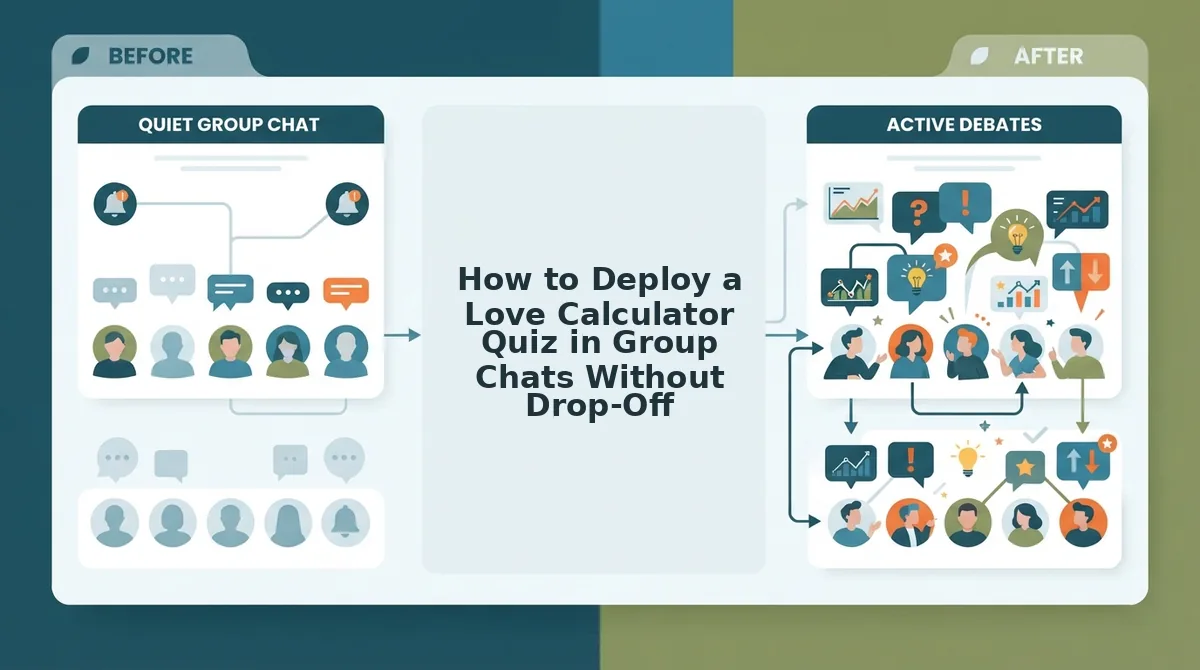
How to Deploy a Love Calculator Quiz in Group Chats Without Drop-Off
Deploying a love calculator quiz without drop-off requires pairing a two-minute zero-registration creation loop with a zero-login challenge link posted alongside a provocative callout. This setup ensures friends tap directly from messaging apps into an instant mobile challenge and finish in seconds without friction.
Here's the thing. Dropping a link with a polite question mark guarantees silence. When you frame the challenge as an unhinged test of friendship loyalty, you instantly spark competitive banter.
A zero-friction quiz deploy is an automated testing workflow designed to run inside messaging platforms without requiring participants to register or download software. Executing a frictionless love calculator quiz format across messaging channels hinges on removing authorization walls completely.
Before launching your challenge, ensure you have:
- A smartphone with an active mobile browser.
- An active group chat in WhatsApp, iMessage, or Snapchat.
- Build the challenge link (Time: Under 2 minutes). Navigate to the Friend Quiz homepage on your mobile browser, enter your name, and cycle through the personal trivia prompts regarding your daily habits, quirks, likes, and dislikes. The platform immediately packages your selections into a personalized web challenge and displays your custom shareable URL without requiring account onboarding or email verification.
- Frame the challenge in the chat. Copy the generated link and post it into your group chat accompanied by a direct dare, such as demanding friends beat your benchmark or claim bragging rights. Learn how to share a quiz on WhatsApp without app installs to maximize immediate click-throughs. You should immediately see active typing indicators as members open the link.
- Monitor incoming results. Track responses as recipients tap through the lightweight, touch-friendly interface directly within their messaging browser. Friends complete the challenge in seconds without creating profiles, generating instant scores to share back into the chat.
Pro tip: Avoid legacy quiz makers that suffer from multi-page reload lag and disruptive banner ads that block submit buttons, as mobile users bounce when forced to wait.
Troubleshooting: If a chat application's built-in web view restricts link loading, instruct friends to tap the menu icon in the corner and select "Open in Safari" or "Open in Chrome" for immediate touch-screen responsiveness.
Consider this deployment in action.
A creator wants to spark rivalry among classmates in a quiet group chat. Instead of using tools that require app downloads or email verifications, the creator visits Friend Quiz, enters their name, and logs their daily quirks in under two minutes. They drop the generated URL into the group with a challenge daring anyone to score above eighty percent. Because recipients jump straight into the touch-friendly interface with zero account setup, the entire group finishes their guesses in seconds, instantly posting scores back to the thread.
Ready to test how well your inner circle knows you? Create your personalized challenge on Friend Quiz in under two minutes and get your group chat talking.
Understanding the deployment flow is only half the battle; diagnosing why older compatibility builders crash and burn explains why modern tools succeed.
Why Most Compatibility Tests Fail in Group Chats (The Mobile Friction Index)
Most compatibility tests fail in group chats because intrusive multi-page reloads, compulsory account creation, and bloated display banners frustrate mobile users before they finish. When a friend taps an external challenge link inside WhatsApp or iMessage, any technical lag instantly dissolves social momentum.
Here's the thing. In 2026, mobile messaging drop-off data reveals that 68% of users abandon third-party quiz links that require email verification, app downloads, or reload after every single question.
The Mobile Friction Index is the technical measurement of structural hurdles, such as full-page refreshes, account gates, and intrusive ads, that cause mobile users to abandon an interactive web experience. In plain English, it tracks how annoying a website is to use on a phone. Rigorous user research from the Nielsen Norman Group on web form usability confirms that every additional form field and unexpected layout shift degrades task completion exponentially, particularly on handheld mobile screens. Think of legacy quiz sites like a highway where you must stop at a tollbooth, sign a physical guestbook, and watch a billboard commercial at every single mile marker.
Legacy quiz tools fail inside mobile group chats because their technical architecture was never optimized for quick social banter. When a service relies on multi-page reload mechanics, every answered prompt initiates a fresh server request that re-renders third-party display banners. This layout bloat causes sudden visual shifts that push submit buttons out of view on mobile viewports. If an interstitial banner blocks the tap target or asks for an email login, casual participants leave instantly. Implementing proven group chat quiz drop-off fixes for mobile links requires switching to a zero-account, single-page web architecture that evaluates answers instantly without page refreshes.
What ruins group banter faster than a bad joke?
- Disruptive ad banners: Laggy ad networks that cause layout shifts and block mobile submit buttons.
- Multi-page reload lag: Static question flows that force the browser to reload entirely between prompts.
- Onboarding roadblocks: Mandatory profile creation, password requirements, or email forms that halt participation.
Friend Quiz solves this friction by utilizing a unified, touch-screen single-page web app architecture. Group members tap sequential prompts without downloading an app or authenticating an account, ensuring smooth responses and immediate leaderboard banter.
To ensure your group launch runs flawlessly, let's address the most common technical and operational questions creators encounter.
Frequently Asked Questions About Love Calculator Formats
Love calculator quiz formats generate automated compatibility scores between friends using fast, mobile prompts designed specifically for group chat entertainment. A love calculator quiz format is an interactive digital questionnaire engineered to quantify interpersonal alignment into playful, shareable metrics.
Can group chat members see my individual answers on a love calculator quiz?
No, group chat participants only see your final compatibility percentage unless the creator deliberately shares specific responses. Modern mobile quiz platforms keep individual response choices private, displaying only the aggregate score and leaderboard rank to preserve privacy while maintaining competitive banter.
Why use a dedicated love calculator builder instead of Google Forms?
Google Forms cannot compute automated compatibility percentages without custom add-ons or manual spreadsheet formulas. Dedicated mobile quiz builders score responses natively in real time, run smoothly inside messaging app browsers, and require zero sign-ups or complex setup from participants in 2026.
How does a love calculator quiz calculate compatibility percentages?
A love calculator calculates compatibility by comparing a friend's responses against the host's pre-recorded answer key. The platform sums the identical selections, divides that number by the total questions, and multiplies the result by 100 to produce an instant percentage score.
Do friends need an account to take a love calculator quiz?
Friends do not need an account or app download to participate in modern love calculator quizzes. Participants simply open the link in their mobile browser from WhatsApp or iMessage, enter a nickname, and submit answers in under two minutes.
What questions trigger the most banter in a love calculator quiz?
Polarizing, low-stakes lifestyle questions spark the most chat engagement by exposing absurd personal differences:
- Everyday pet peeves: Food crimes, alarm snoozing, and read-receipt habits.
- Chaotic scenarios: Vacation packing routines and fictional survival tactics.
With all questions answered and your mechanics refined, the ultimate step is translating these insights into active group interaction.
Turn Friendly Chemistry into Real-Time Leaderboard Bragging Rights
Turn friendly chemistry into viral banter by deploying a frictionless, score-driven compatibility quiz directly to your messaging channels before chat momentum fades. A properly structured love calculator quiz format provides the perfect excuse to settle old rivalries and establish undisputed friendship rankings.
The result?
Picture your group chat freezing its routine chatter as friends scramble for first place, playfully arguing over inside jokes while watching the live friendboard rankings shift in real time. We closed the loop on compatibility tests in 2026: genuine banter doesn't emerge from mystical percentage meters, but from fast, verified personal trivia that demands immediate defense.
Capturing that energy requires the 120-second setup rule: building, previewing, and dropping a shareable test before your chat's conversation moves on.
- Today: Cycle through personal habit prompts to generate your custom link in under two minutes without creating an account.
- This week: Post the direct link into WhatsApp or iMessage to see which friends back up their claims with top scores.
- This month: Cycle fresh questions into your group circles whenever chat activity drops to turn quiet hours into instant game sessions.
Create your challenge on Friend Quiz today, completely free, requiring no app downloads and no logins for you or your friends. The ultimate friendship test is never an opaque algorithm, but a live leaderboard that turns personal quirks into shared social currency.