Dare Quiz Questions That Test Loyalty Without Drama
Most loyalty dares are loyalty traps, not loyalty tests. You think you're asking "would you lie for me?" when you're really asking "would you humiliate yourself for my entertainment?", and that distinction is exactly why some dare quizzes end in laughter while others end in a group chat that goes silent for three days.
If you've ever watched a dare spiral from playful to painful in under a minute, you already know the problem: dare quiz questions that test loyalty only work when they measure willingness to show up, not willingness to self-destruct. The good news is that you don't need to guess which dares are safe. A simple pre-dare checklist, the 3-Strike Drama Rule, filters out every trap before it reaches your group chat, and it will save your friendship more than once.
In this guide, you'll learn how to separate genuine loyalty tests from disguised loyalty traps, then build a three-tier dare quiz that escalates from safe banter to real reveals without anyone feeling cornered. We'll start with the psychology behind why certain dares build trust while others burn it, move through a tiered list of ready-to-use questions, and end with the surprising reason most "spicy" dares fail, plus how to fix them. And if you want to skip straight to playing, Friend Quiz lets you create a custom friendship dare quiz in under two minutes without an account.
What Makes a Dare a Loyalty Test (Not a Loyalty Trap)
A loyalty test is a dare that asks whether your friend will show up for you; a loyalty trap is a dare that asks whether they will betray someone else. The difference determines whether your quiz strengthens the friendship or quietly poisons it.
Think of a loyalty test like a spotter at the gym. A good spotter stands close enough to catch you if you fail, but never adds weight to make you fail on purpose. A loyalty trap is the opposite: it stacks plates until something breaks, then blames you for dropping the bar. The test measures capacity; the trap manufactures collapse.
Before you send any dare to the group chat, run it through the 3-Strike Drama Rule. If a dare would embarrass someone in front of the group, damage a relationship outside the group, or require lying to a third party, it is a trap, not a test. One strike and the dare gets rewritten or removed, no exceptions, no "but it'll be funny" vetoes.
Here is the Trap-to-Test Conversion Table, a quick reference for rewriting common loyalty traps into genuine tests:
| Trap Dare | Why It Fails | Converted Test Dare |
|---|---|---|
| "Text your ex right now." | Damages a relationship outside the group and invites third-party drama. | "Send a voice note defending your best friend to a mutual friend." |
| "Let me check your phone." | Embarrasses the person in front of the group and violates privacy. | "Share your phone screen while your best friend picks your next dare." |
| "Tell [mutual friend] what you really think of them." | Requires lying or cruelty to a third party. | "Record yourself saying three things you admire about your best friend." |
The conversion pattern is consistent: replace exposure with affirmation, secrecy with transparency, and third-party damage with first-party vulnerability. A dare that asks someone to risk their own comfort for a friend is a test. A dare that asks someone to risk someone else's comfort for the group is a trap.
If you want a full set of pre-vetted prompts that follow this exact framework, browse these friendship dare quiz ideas that test your bond before building your own round.
Tier 1: Safe Banter Dares (Warm-Up Round)
Safe Banter dares build trust through low-stakes vulnerability, the kind that makes everyone laugh without making anyone bleed. Each dare below includes a loyalty mechanic: reciprocity, inside knowledge, or public affirmation.
- Send a voice note describing the first memory you have of your best friend. This dare tests inside knowledge and emotional recall without any risk of embarrassment. It works because the person answering must prove they actually remember shared history, which is the foundation of loyalty. Use it as the opening dare to set a warm, nostalgic tone before anything spicier appears.
- Post a story tagging your best friend with the caption "the reason I survived [year]." Public affirmation is the loyalty mechanic here, the person answering must stake their social reputation on the friendship. It matters because loyalty is only meaningful when it costs something, and a public post costs social capital. Use this dare second, after the voice note has already softened the group.
- Reply to the group chat with the first thing you'd grab from your best friend's house in a fire. This dare tests inside knowledge through a playful hypothetical. It works because the answer reveals how well the person knows their friend's actual life, the objects, pets, and sentimental clutter that matter. Use it mid-round to keep energy high without escalating risk.
- Send a voice note finishing the sentence: "The thing I've never told you is..." Reciprocity drives this dare, the person answering must volunteer a small secret, which invites the best friend to match it later. It matters because mutual disclosure is the fastest trust-builder in any friendship. Use it as the final Safe Banter dare to create a natural bridge into deeper rounds.
- Text your best friend's parent or sibling one genuine compliment about them. This dare extends affirmation beyond the group chat into the friend's real-world circle. It works because loyalty that only exists in private is cheap; loyalty that reaches the people your friend loves is proof. Use it to close the warm-up round and signal that the quiz is about real bonds, not performance.
Each of these dares takes under a minute to answer and zero setup to run. Friend Quiz lets you build a Safe Banter round in under two minutes without an account, and you can make a friendship dare quiz link for group chat that drops straight into WhatsApp or iMessage. Once everyone has laughed through the warm-up, you're ready for Tier 2: Spicy Reveal Dares (The Real Loyalty Test).
Tier 2: Spicy Reveal Dares (The Real Loyalty Test)
Spicy Reveal dares require actual vulnerability or effort, not just a quick laugh. Each dare below maps to a loyalty archetype. Ride-or-Die, Diplomat, Instigator, or Observer, so you can self-select intensity based on who is in the chat.
- Share a screenshot of the last time you defended your best friend in a group chat. This dare targets the Ride-or-Die archetype because it demands public proof of private loyalty. The screenshot shows the exact words used, which removes any ability to exaggerate. Use this dare only after the Safe Banter round has warmed everyone up, or the request will feel like an ambush.
- Post the voice note you sent about your friend when they were not in the room. This dare works for the Diplomat archetype because it reveals how someone speaks when there is no audience to perform for. The voice note format captures tone, hesitation, and warmth that text cannot fake. Ask for the most recent one, not the best one, to keep the reveal honest.
- Send the last meme or inside joke you made about your friend to a third person. This dare fits the Instigator archetype because it exposes the playful side of loyalty, how often someone brings their friend up unprompted. The reveal is less about content and more about frequency: a friend who appears in your sent history weekly is a different loyalty signal than one who appears monthly. Use this dare when the group energy is high and people are already sharing screenshots.
- Reveal the one secret you have kept for your friend that you almost told someone. This dare belongs to the Observer archetype because it tests discretion under social pressure. The person must admit both the secret's existence and the near-betrayal, which is a double vulnerability. Frame this dare as "almost told" rather than "told" so nobody has to confess an actual breach.
- Show the last time you cancelled or changed plans for your friend without them asking. This dare maps to the Ride-or-Die archetype because it measures reciprocal effort, not words. The calendar or chat log is the evidence, and the reveal shows whether loyalty is proactive or reactive. Use this dare near the end of the Spicy Reveal round, since it can trigger genuine reflection.
Most dare lists jump straight to spicy dares without warming up the group, which kills momentum. The Safe Banter round exists precisely so that a screenshot request feels like escalation, not interrogation. If you are unsure how to introduce these dares without awkwardness, check out what to write in a group chat before sending a quiz for framing lines that lower the stakes.
How to Run a Loyalty Dare Quiz in Your Group Chat
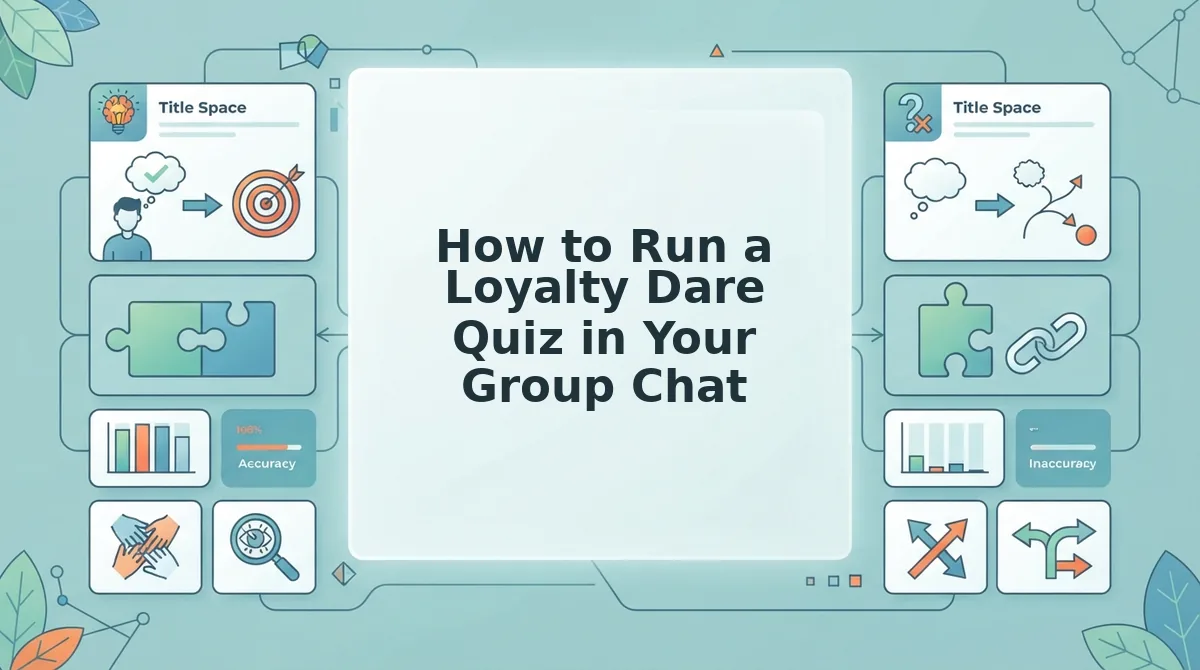
Run a loyalty dare quiz in five steps using Friend Quiz: create the quiz link in under two minutes, drop it in the chat with a warm-up message, and keep momentum alive with voice-note follow-ups when the chat goes quiet.
- Open friendquiz.org on your phone and enter your name. No account, no app download, and no email are required, just a link friends open in their mobile browsers. You should see the first personal trivia prompt appear immediately after you type your name.
- Cycle through the personal trivia prompts and select your answers. Choose the dares and questions that match your group's loyalty archetype mix. The platform packages your selections into a personalized challenge link automatically, with no multi-page reloads to slow you down.
- Copy the generated quiz link and paste it into your group chat. Pair the link with a one-line warm-up message that frames the quiz as banter, not an interrogation. Account walls, ad clutter, and multi-page reloads kill group chat momentum before question three, so the link should open instantly in any mobile browser.
- Send the first Safe Banter dare as a text follow-up within 60 seconds of the link. This keeps the group moving while the quiz loads. You should see replies start within a minute if the warm-up dare landed.
- When the chat goes quiet, send a follow-up dare as a voice note instead of a text link. Voice notes feel personal and urgent in a way that another link does not. If drop-off persists, read group chat quiz drop-off fixes for mobile links for specific tactics to restart momentum.
FAQ: Dare Quiz Questions That Test Loyalty
Direct answers to the most common questions about loyalty dare quizzes, optimized for quick reading and voice search.
What dare quiz questions test loyalty without causing drama?
Use the 3-tier system: Safe Banter dares for warm-ups, Spicy Reveal dares for real tests, and Boundary Test dares only with pre-agreed rules. This structure escalates intensity gradually so nobody feels ambushed, which is the main cause of dare quiz drama.
How many dare questions should a loyalty quiz have?
15-20 questions, structured as 5 Safe Banter, 5 Spicy Reveal, and 5 Boundary Test dares. This length is long enough to feel substantial but short enough to finish before group chat attention collapses, which typically happens around question ten without momentum tactics.
Can dare quizzes actually test loyalty?
Yes, when dares measure reciprocal effort and public affirmation rather than third-party betrayal. A dare that asks someone to show when they defended you measures real loyalty; a dare that asks someone to rank friends against each other measures insecurity and creates drama.
What is the best dare to test if someone is a ride-or-die friend?
Ask them to share a screenshot of the last time they defended you in a group chat without being prompted. The timestamp and wording reveal whether their loyalty is proactive or performative, and the public nature of the reveal makes it hard to fake.
How do I start a loyalty dare quiz without making it awkward?
Open with a Safe Banter dare that is funny and low-stakes, then escalate to Spicy Reveal dares only after the group is laughing. For more dare structures, see friendship dare quiz ideas.
Loyalty Without the Landmines
Loyalty dares work when they reveal something true without detonating the friendship. The three-tier system gives you a ramp: warm-up banter builds trust, spicy reveals test depth, and the 3-Strike Drama Rule keeps any single dare from becoming a loyalty trap. One strike for a question that feels like an ambush, one for a dare that pressures someone to lie, one for anything that would embarrass a friend in front of the group. Three strikes, the dare gets cut before it starts.
That filter is the difference between a quiz people finish and a quiz people mute.
Here's the payoff: a loyalty dare quiz that respects boundaries actually produces more honest answers, not fewer. When friends know you're not setting them up, they stop performing and start telling the truth. That's the loyalty signal you actually want.
Your next step is one link. Create your loyalty dare quiz on Friend Quiz in under two minutes, no account, no app download, just a link your group chat can open in seconds.
Loyalty isn't proven by the hardest dare, it's proven by the friend who answers honestly even when the easy out is right there.