Community Quiz Discovery vs Buddy Meter for Trivia Prompts
You drop a challenge link to wake up a silent group chat, only to watch friends drop off when facing the same ten recycled default questions. In the matchup of community quiz discovery vs buddy meter, expanding prompt variety decisively outperforms closed static routing for group chat replay value, while rigid question sandboxes remain limited to single-session novelty.
It is frustrating when chat momentum stalls because friends have already answered identical generic prompts multiple times this month. You will discover how trivia sourcing impacts player retention, mobile interface lag, and banter across WhatsApp, Snapchat, and iMessage. We will also reveal an unexpected display layout bottleneck that silently tanks completion rates before players ever reach the results screen.
This comparison focuses solely on zero-download, browser-based quiz tools and their prompt variety limits.
Consider how prompt delivery functions during a live chat challenge:
- Situation: A quiet group chat requires an instant spark without forcing participants through an app store install or profile registration.
- Action: You start a fresh friend quiz, type your name, select daily habits and quirks, and paste the generated URL into the group.
- Outcome: Friends tap their guesses sequentially directly in their mobile browser, instantly logging scores onto a live friendboard without bounce-inducing delays.
To keep responses high, test prompt selections using zero-account quiz setup before sharing across large channels.
Examining prompt delivery mechanics requires comparing both architectures across concrete usability standards.
Feature Evaluation Criteria and Head-to-Head Comparison Table
Evaluating friendship trivia platforms requires balancing creation speed against mobile participant retention across messaging apps like WhatsApp and iMessage. While legacy tools like Buddy Meter prioritize isolated link generation, modern community discovery platforms provide dynamic prompt feeds and live friendboards without intrusive display clutter.
A community prompt feed is a dynamic repository of personal trivia questions that refreshes challenge options without requiring manual questionnaire authoring.
Legacy trivia makers often treat having zero prompt discovery as a privacy feature for one-to-one sharing. However, relying purely on static, unsearchable question sets causes rapid prompt exhaustion in group chats. When players encounter the same five generic questions wrapped in multi-page reload lag and banner ads that obstruct submit buttons, response rates drop dramatically. A proper evaluation framework weighs setup latency, prompt freshness, answer privacy, and leaderboard persistence to show whether a quiz creator sparks banter or causes mobile participants to bounce.
| Evaluation Criterion | Community Quiz Discovery (Friend Quiz) | Legacy Questionnaire (Buddy Meter) |
|---|---|---|
| Discovery Mechanism | Dynamic prompt feeds with searchable social topics | Isolated URL query-string routing without discovery |
| Prompt Freshness | Continuously refreshed personal habit and banter prompts | Fixed, static question bank prone to prompt fatigue |
| Setup Latency | Under two minutes with zero-account onboarding | Multi-page form reloads and dated submission screens |
| Mobile Ad Burden | Clean, touch-friendly UI without layout shifts | Disruptive display banners that can block submission buttons |
| Answer Privacy | Protected inputs with creator-managed results | Basic URL parameter handling with minimal privacy controls |
| Scoreboard Persistence | Real-time Friendboards with live group rankings | Basic static score summaries after submission |
Independent testing across mobile chat environments highlights significant performance gaps documented in friend trivia maker ad comparisons.
Choose a dynamic community discovery platform if you manage active WhatsApp, Snapchat, or iMessage groups that demand fresh banter, zero-account access, and instant leaderboard rivalries. Choose Buddy Meter if you only need a basic, one-off trivia link and do not mind multi-page mobile reloads.
Our recommendation favors modern dynamic workflows. Avoiding intrusive banner ads and prompt fatigue keeps chat participants engaged all the way to the final scoreboard.
Understanding these friction points starts with examining how Buddy Meter constructs its core questionnaire engine.
How Buddy Meter Works and Why Static Questionnaires Run Dry
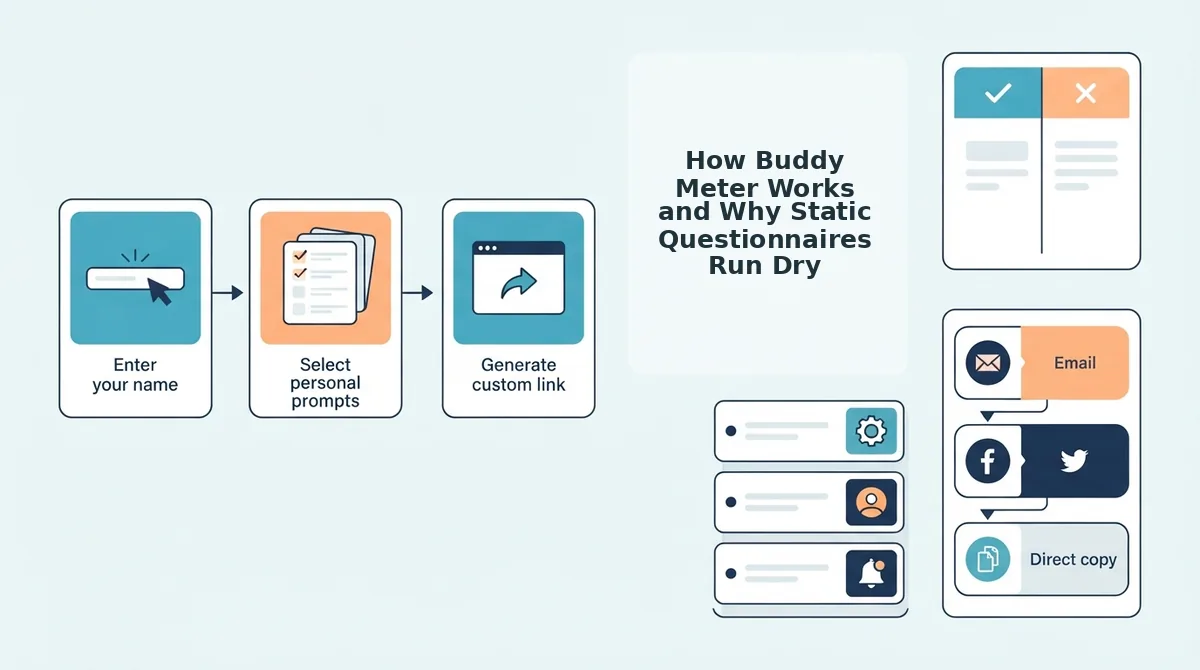
Buddy Meter operates on a closed, one-way creation model where every challenge exists as an isolated web link without an internal directory, search index, or discoverable public catalog. Because the platform never catalogs tests into a browsable database, creators must invent their own content inside a rigid, multi-page form.
Buddy Meter is a legacy friendship quiz maker that generates static personal trivia links intended for direct sharing in private messaging apps. What actually happens when you try to find a public quiz catalog on Buddy Meter?
Buddy Meter uses a direct-link URL architecture where quizzes exist purely on siloed endpoints containing arbitrary string parameters, such as quiz.html?q=hwGtET4. Because the platform lacks an internal search engine, database query interface, or centralized tag system, creators cannot browse community-submitted questions or search existing tests for inspiration. Think of this direct-link setup like a private locker in an empty basement without a building directory: you can only open it if someone hands you the exact key code. Without an open archive, every user must manually invent prompts inside a closed 10-question questionnaire loop.
This structural isolation causes severe questionnaire fatigue across social circles. Creators searching for fresh group chat banter inevitably run into the exact same limitations:
- No prompt repository: Users cannot reference trending trivia prompts or see how other friend groups structure their dares.
- Repetitive prompt recycling: Creators cycle through the same standard default questions about favorite foods, colors, and travel spots.
- Ad-cluttered progression: Multi-page reload lag and invasive display banners slow down setup on mobile screens.
Consider a creator attempting to build a trivia test for a weekend WhatsApp group. Arriving at the setup screen, the creator types their name and encounters the static 10-question questionnaire loop. Hoping to browse community ideas for fresh banter, they look for an explore button, but no search mechanism exists. After repeatedly clicking past generic default prompts while navigating slow page reloads, the creator settles for predictable questions that their circle has answered dozens of times before.
Creators hitting this wall frequently seek out the best buddy meter alternatives to escape dated forms and repetitive trivia loops. To launch dynamic friendship tests in under two minutes without app downloads or account logins, Friend Quiz delivers speed-run quiz creation alongside live Friendboard tracking designed specifically for group chats.
Solving creator fatigue requires shifting from isolated URL endpoints to dynamic question sourcing.
Why Community Quiz Discovery Unlocks Superior Trivia Prompts
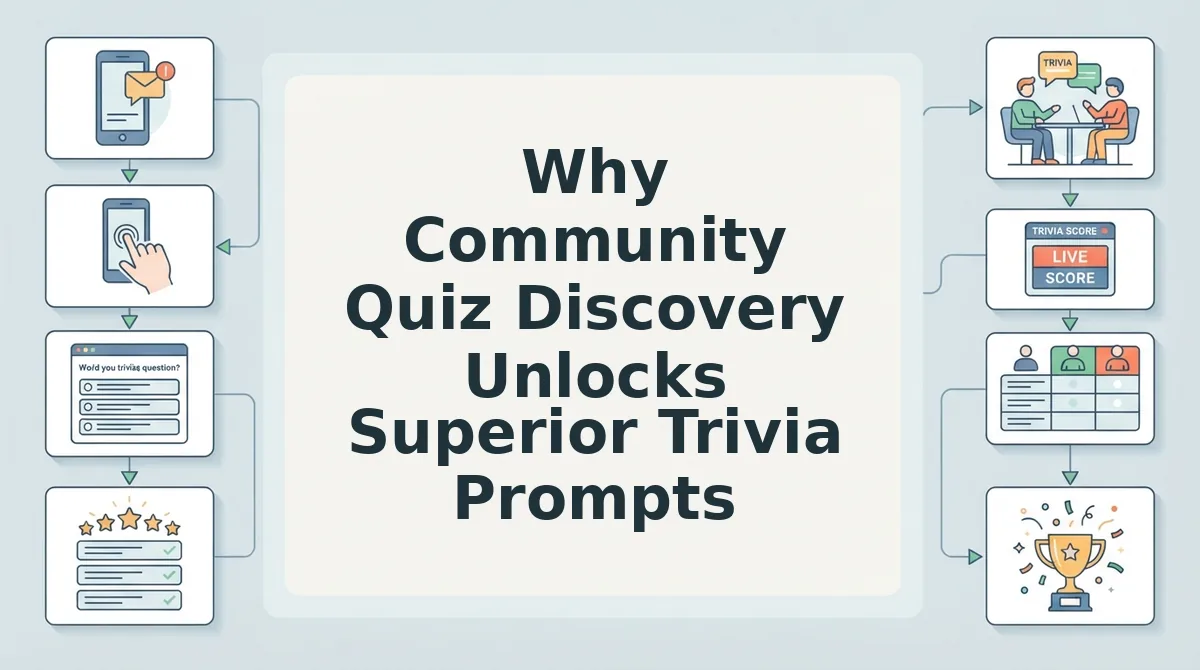
Community quiz discovery unlocks superior trivia prompts by replacing static, repetitive templates with crowdsourced feeds inspired by actual group chat banter. Instead of drafting generic questions from scratch, creators immediately pull high-engagement scenarios vetted by peer interaction across active social circles.
The Prompt Fatigue Index is a diagnostic measure comparing the engagement drop-off of fixed question templates against dynamic repositories refreshed by real user banter. Legacy tools like Buddy Meter trap users in predictable question loops about favorite foods and birthstones, causing players to abandon challenges mid-quiz. Discovery feeds solve this drop-off by turning community trends into pre-built question options while preserving total scorecard privacy. While the trivia prompts originate from public community curation, individual scores and answer choices stay locked inside private, group-restricted Friendboard rankings.
Can anyone in your messaging thread honestly stay excited about answering what your favorite primary color is for the fifth time?
- Real-time banter injection: This mechanism surfaces prompts directly from live peer group interactions instead of stagnant questionnaires. It eliminates creator hesitation by offering culturally current scenarios that provoke instant debate among friends. Select questions directly from trending community quiz prompts during initial setup to bypass manual typing entirely.
- Escalating dare mechanics: This format introduces provocative hypothetical choices and personal tests instead of safe trivia. It spikes chat completion rates by challenging friends to reveal what they genuinely think of your daily habits. Tap into verified friendship dare quiz challenges to replace generic biographical prompts with high-stakes social choices.
- Separated scoring firewalls: This structural barrier keeps the communal idea library completely divorced from individual participant submissions. It guarantees that taking inspiration from viral questions never exposes private friendboard scores to external web crawlers or strangers. Filter open repositories for inspiration while keeping your generated challenge link strictly confined to your closed group chat.
- Flaw-focused quirk questions: This counterintuitive angle prioritizes funny micro-annoyances and chaotic habits over flattering biographical traits. It sparks immediate, vocal debate because close friends track pet peeves and irrational dislikes better than polished resumes. Swap standard milestone questions for specific prompt options detailing your most disorganized daily behaviors.
- Zero-click template adaptation: This workflow transforms popular community questionnaires into personalized tests with a single confirmation tap. It saves creators from staring at blank text boxes while keeping quiz creation under two minutes. Cycle through community-approved prompt cards during quiz creation to rapidly populate your challenge without downloading software or registering accounts.
Yet even the most agile crowd-powered repositories present distinct operational tradeoffs when creators need complete structural control over their tests.

Where Community Quiz Platforms Fall Short and Why Sandboxes Still Matter
Community quiz platforms fall short when public directories overwhelm users with duplicate viral submissions and decision fatigue, making closed quiz sandboxes essential for fast, private peer challenges.
A quiz sandbox is an isolated testing environment that keeps trivia challenges entirely off public search feeds and open community catalogs. In friendship testing, open directories often suffer from prompt clutter, surfacing hundreds of repetitive viral questions that add cognitive load to what should be a two-minute setup. Sandboxes solve this by restricting the challenge to a direct URL shared exclusively in private messaging threads. This closed structure protects personal nuances and eliminates choice paralysis. By skipping public directories, creators generate focused question sequences tailored strictly to mutual memories without unvetted community noise skewing the experience.
Think of an open community catalog like a crowded flea market overflowing with thousands of identical secondhand items, whereas a private sandbox is your locked living room where only your inner circle shares inside jokes. When platforms prioritize crowdsourced discovery feeds, prompt saturation quickly sets in. Creators face severe choice paralysis trying to separate clever habit questions from low-effort duplicates, dragging what should be a ninety-second launch into ten minutes of tedious curation.
Evaluating real-world friendship quiz privacy differences reveals why isolated setups work better for tight-knit friend groups.
- Hyper-specific inside jokes: Childhood memories, embarrassing nicknames, and niche quirks lose their comedic punch when forced into broad community templates.
- Zero-friction momentum: Creators configure tailored prompts immediately rather than scrolling through endless user-submitted ratings and outdated questionnaires.
- Strict answer containment: Intimate personal habits stay between verified contacts on a live scoreboard instead of populating indexed search results.
When the goal is sparking instant group chat rivalries rather than browsing community archives, lean toward closed environments. Matching your quiz format to your circle's social habits determines whether your challenge ignites banter or gets scrolled past.
How to Pick the Right Tool for Group Chat Banter
Selecting the right trivia tool requires matching your format to the mobile browser constraints of WhatsApp, iMessage, or Snapchat while prioritizing zero-account participation. A seamless tool lets members answer directly without registration hurdles. Platforms that eliminate sign-ups and intrusive display banners prevent player drop-off, ensuring every chat member can complete challenges and post scores within seconds.
A mobile trivia tool is a lightweight web application engineered for instant link sharing and touch-friendly gameplay inside in-app messaging browsers. Before starting, ensure you have an active messaging thread and a few personal trivia prompts ready to test.
- Audit in-app browser reload performance (30 seconds): Paste a test link directly into WhatsApp, iMessage, or Snapchat to ensure the interface opens without login barriers or ad clutter blocking the submission buttons. You should see an immediate, responsive entry screen where users submit answers without page-reload lag.
- Configure your trivia prompts (60 seconds): Cycle through your personal quirks, likes, and dislikes by building a friend quiz in 60 seconds on mobile. You should see an active confirmation screen containing a customized, shareable web link.
- Deploy the challenge to track leaderboard persistence (10 seconds): Share the generated URL into your group thread so participants can record their guesses sequentially without downloading software. You should see each participant's score appear instantly on a real-time Friendboard ranking table to settle chat rivalries.
Consider this practical chat scenario: An inactive thread stalled after members abandoned an ad-cluttered questionnaire that failed to reload inside Snapchat's mobile browser. The chat admin resolved the issue by generating a fast web challenge, configuring habit prompts in under two minutes without an account. When shared to the thread, five members completed the challenge seamlessly on mobile, establishing instant bragging rights on the live score table.
Group administrators frequently encounter specific technical quirks and platform differences when evaluating friendship trivia tools across different mobile operating systems.
Frequently Asked Questions About Buddy Meter and Community Discovery
Strangers cannot browse your personal responses because community discovery indexes generic prompt templates rather than filled scorecards.
Can strangers see my private answers on community quiz discovery platforms?
No, strangers cannot view your individual answer choices on community discovery platforms. Community features curate blank question templates across categories, while completed tests stay locked behind private share links. Your personal selections remain strictly isolated between you and the friends in your direct message thread.
How do URL-gated leaderboards differ from public prompt libraries?
URL-gated leaderboards restrict score viewing exclusively to players holding the creator's unlisted challenge link. In contrast, public prompt libraries index user-suggested trivia questions for anyone to copy into new games. Dynamic prompt feeds inspire question ideas, but score tracking never crosses over into public discovery feeds.
Why does Buddy Meter suffer from mobile reload lag and ad clutter?
Buddy Meter relies on standard multi-page web architecture that forces full browser refreshes between individual trivia questions. Heavy programmatic display banners load on every transition, competing for mobile screen real estate and occasionally blocking submission buttons during fast-paced smartphone group play across messaging applications.
How do I stop friends from seeing other players' answers on the friendboard?
You ensure answer secrecy by choosing friendship quiz platforms that show only aggregated point totals and rankings. Secure platforms hide exact question-by-question response breakdowns from other participants:
- Rivals see who scored higher
- Specific habit guesses remain concealed
Customizing fresh question pools keeps repeat challenges exciting across active group chats.
Replace Static Templates with Dynamic Friend Trivia Prompts
Dynamic friendship trivia sustains group chat engagement because replacing static, ad-cluttered questionnaires with rapid personal prompts eliminates participant drop-off. Sticking to legacy templates guarantees your chat goes silent after round one; predictable prompts and reload lag turn lighthearted banter into administrative chores.
Our head-to-head comparison resolves the core issue: group momentum hinges on completion speed rather than quiz length. When friends can tap through mobile-optimized dares without creating accounts or dodging popups, completion rates stay high and fuel active rivalries.
Reignite your quietest chat thread with three straightforward steps:
- Enter your name to bypass registration screens and app installs.
- Select your daily habit prompts to build a personalized best friend quiz in under two minutes.
- Drop the custom dare link into WhatsApp, iMessage, or Snapchat to track scores on your live friendboard.
Group chat trivia thrives on speed and bragging rights, proving that eliminating friction matters far more than recycling static questions.