Why Trending Friend Quizzes Keep Group Chats Active
Your group chat has 47 unread messages, but nobody has actually said anything in three days. The memes stopped landing, the "wyd" texts went unanswered, and the once-daily banter has flatlined into a graveyard of blue ticks. This is the universal dead group chat problem, and there's a faster fix than you think.
You're not imagining it: keeping a group chat alive takes active participation, not passive scrolling. That's exactly why trending friend quizzes keep group chats active when everything else fails. A friend quiz turns a silent thread into a live competition in under two minutes, no app download or account signup required.
Here's what you'll learn: the three psychological mechanisms that make quizzes outperform memes, why speed is the silent virality factor, and how friendboards turn a one-off quiz into a persistent rivalry your friends return to. Stick around, the reason most group chat games fail isn't what you think.
Why Do Trending Friend Quizzes Keep Group Chats Active?
A trending friend quiz is a personalized trivia challenge that converts passive group chat members into active participants by exploiting three psychological mechanisms: information asymmetry, social proof, and persistent rivalry. It works because the creator knows the answers, friends feel compelled to prove they know them too, and the trending label signals that participating is safe and socially expected.
Think of a group chat like a campfire. Memes are sparks, bright for a second, then gone. A trending friend quiz is a log you throw on that keeps burning, because everyone wants to see who knows the creator best and who gets exposed for guessing wrong.
The first mechanism is information asymmetry: the quiz creator holds knowledge about their own habits, quirks, and preferences that friends don't have. This gap creates an itch, friends must resolve it by answering. The second is social proof: when a quiz trends, it signals that others have already participated, lowering the social risk of being the first to engage. The third is persistent rivalry: a friendboard that ranks answers in real time gives friends a reason to return, check scores, and challenge each other again.
Here's the key distinction most people miss: a quiz is a single interaction, but a friendboard is a persistent social object. Friends don't just answer once and leave, they return to see who climbed the rankings, who dropped, and who needs to be dethroned. That return loop is what keeps a group chat breathing long after the initial share.
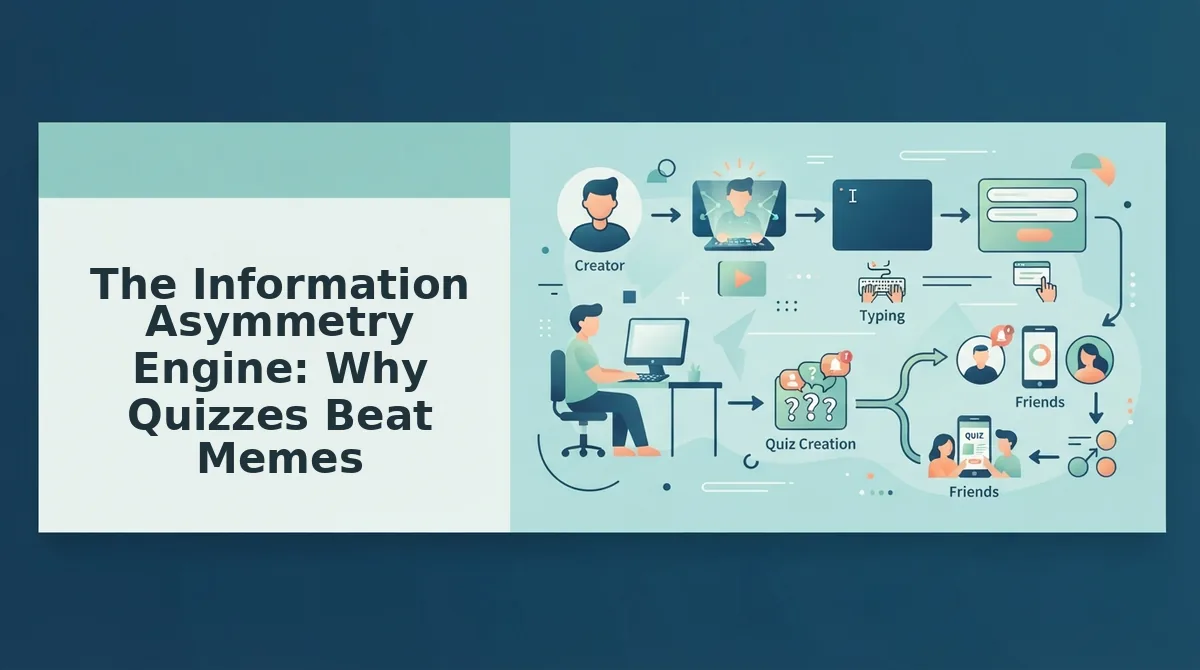
The Information Asymmetry Engine: Why Quizzes Beat Memes
Information asymmetry is the gap between what the quiz creator knows about themselves and what their friends think they know, and it's the engine that drives participation. Memes create passive consumption; quizzes create active participation because the knowledge gap demands resolution.
Think of it like a locked door in a house you visit every day. You've walked past it for years without caring. The moment someone says "you'll never guess what's behind this door," you can't stop thinking about it. A best friend quiz does the same thing to a group chat: it locks personal trivia behind a challenge and dares friends to prove they have the key.
Picture this: a group chat has been silent since Tuesday. Someone drops a link, "I made a quiz about myself. Let's see who actually knows me." Suddenly, three people are typing. The quiz creator knows the answers; nobody else does. That asymmetry is the hook. Friends answer not just for fun, but to prove their closeness, defend their status as the "real" best friend, and avoid the embarrassment of scoring lower than the group acquaintance.
Memes ask for nothing. A quiz asks for a claim, "I know you better than anyone else here", and then tests it publicly. That's why quizzes beat memes for reviving dead chats: they convert silent observers into active competitors with something to prove and a score to defend on a real-time friendboard.
But information asymmetry only works if the quiz reaches friends fast enough to matter, which is where the 3-second rule comes in.
The 3-Second Rule: Speed Is the Silent Virality Factor
A quiz link has roughly 3 seconds to load and engage before the group chat scrolls past it. Zero-account participation, under-2-minute setup, and instant link generation are the three speed factors that determine whether your quiz trends or dies in the feed.
Prerequisites: A smartphone with a mobile browser, your quiz answers ready in your head, and a group chat where you plan to share the link. No app download or email signup is required at any point.
- Open friendquiz.org on your phone and type your name. Tap the name field on the homepage and enter whatever your friends call you. You should see the first trivia prompt appear instantly, with no loading spinner or redirect.
- Tap through each personal trivia prompt in under 2 minutes total. Select your answer for each habit, quirk, like, or dislike as fast as you can. Budget roughly 5-10 seconds per question. You should see a progress indicator advancing with each tap, and the full quiz should be complete before your coffee cools.
- Click the generate button to create your instant quiz link. The platform packages your answers into a shareable URL immediately. You should see the link appear on screen in under 1 second, ready to copy.
- Paste the link into your group chat without any setup friction. Friends who tap it land directly in the quiz with no account creation, no app store redirect, and no email gate. You should see their first answers start appearing within seconds of sharing.
If you want the same zero-friction speed for a different quiz format, you can create a quiz without an account in the same under-2-minute flow. Every second you shave off the setup process is a second your link stays above the scroll line.
The Trending Loop: How Social Proof Fuels Engagement
The trending loop is a self-reinforcing cycle where a quiz's trending status signals popularity, which lowers the perceived risk of clicking, which drives more clicks and engagement, which pushes the quiz higher in trending rankings. It is a conversion mechanism, not a vanity metric.
Think of trending status like a busy restaurant: an empty dining room makes you hesitate, but a packed one convinces you the food is worth trying before you even see the menu. A quiz with visible engagement works the same way in a group chat.
The loop starts simply. When a friend shares a quiz, the first few people click because they trust the sender. Each completed attempt adds a score to the Friendboard, which makes the quiz look active. That visible activity reduces hesitation for the next person scrolling past, who clicks because others already did.
At the intermediate level, the loop compounds. More attempts generate more results to compare, which gives friends a reason to comment, challenge each other, and re-share the link. Each re-share exposes the quiz to a new micro-audience that sees the existing engagement as proof of value.
The advanced effect is algorithmic and social at once. On a platform like Friend Quiz, quizzes with high attempt velocity surface on trending quizzes this week, where the trending badge itself becomes the click trigger. The badge says "others are doing this," which is the strongest nudge in a low-stakes social context.
If your group chat has gone quiet, a trending quiz is the lowest-friction way to restart the loop: one link, zero accounts, and the social proof builds itself from the first answer.
How to Use Trending Quizzes to Revive a Dead Group Chat
A dead group chat needs one low-friction spark, and a trending friend quiz delivers it in under 2 minutes. The playbook below turns a silent thread into an active Friendboard with zero app downloads or account signups.
Prerequisites: A group chat with at least 3 people, a smartphone, and 2 minutes of uninterrupted time. No one in the chat needs to install anything.
- Open friendquiz.org and build a quiz about yourself in under 2 minutes. Type your name, tap through the personal trivia prompts, and generate your link. You should see a shareable URL appear instantly on your screen.
- Paste the link with a specific challenge attached. Write something like "I bet no one gets question 3 right" before the link. This triggers the information asymmetry effect immediately: friends click not just to play, but to prove you wrong. You should see the first "wait what" reply within a minute.
- Let the Friendboard do the follow-up work. As friends submit answers, the live rankings update automatically. You should see names shuffling positions in real time, which creates a reason for people to re-open the chat without you prompting them.
- Share the results screenshot back into the chat. Post the final ranking and call out the winner and the person who scored lowest. You should see immediate banter, rematch demands, and at least one person asking for a redo.
- Challenge friends to beat the top score. Point them to track friendboard rankings live so they can watch their position change as more people play. You should see repeat attempts within the hour as people defend their spots.
If your chat has been silent for days, this is the fastest way to restart it: one link, one challenge, and the rankings keep the conversation moving on their own. Ready to make your own trending moment?
Start Your Own Trending Friend Quiz Today
Trending friend quizzes work because they stack three psychological triggers at once: information asymmetry, social proof, and persistent rivalry. No meme, poll, or forwarded video combines all three in a single shareable link.
That's the synthesis worth acting on. The seven mechanisms in this article aren't separate tactics, they're one engine. Remove any piece and the loop stalls.
So here's the move:
- Open friend quiz on your phone.
- Type your name and answer the personal trivia prompts.
- Drop the link in your group chat before the conversation dies again.
No account. No app download. No friction between you and the banter. The friendboard does the rest, every wrong answer fuels a rematch, and every rematch keeps the chat alive.
You'll know it worked when someone sends a screenshot of their score with a caption you can't repeat.
A quiz that takes two minutes to make can buy your group chat two weeks of momentum.