What does a low friendship test score really mean?
You drop your quiz link in the group chat, the Friendboard starts filling in, and your oldest friend lands in last place. A Friendboard is a real-time ranking of friends' quiz scores, so everyone watches it happen live.
That stings, and it's fair to feel thrown by a low friendship test score from your longest friendship. This guide explains what that number actually means and shows you how to turn it into banter instead of awkward silence.
The only thing you need is a quiz link you've already shared. You'll get a Score Decoder for the real causes, a troubleshooting table that matches each symptom to a fix, and rematch steps that keep the chat alive.
Stick around, because the lowest score in the chat is often the best outcome the quiz can produce.
A low score measures how well someone recalled your specific, current habits from the prompts you wrote. It does not measure how much they care about you. Recall and loyalty are two different things.
What Does a Low Friendship Test Score Really Mean?
A low friendship test score is a measure of how many of your specific prompt answers a friend recalled correctly. It reflects how clear your prompts were, how recent your habits are, how you usually interact, and whether your friend guessed seriously. None of those factors is loyalty.
Think of it like a pop quiz on a textbook you never assigned. Someone can know you deeply and still miss which snack you've been into this month.
The Score Decoder: Four Factors Behind a Low Score
- Ambiguous prompts: A question with two reasonable answers splits everyone's guesses.
- Habit recency: Friends who knew your old routine answer from outdated memory.
- Friendship channel: Friends you mostly text see fewer of your in-person habits.
- Guess style: Joke answers count as wrong, even when they're funny.
Apply the decoder to a common scenario. You answer prompts about your daily habits and quirks, share the link in the group chat, and your oldest friend lands at the bottom of the Friendboard. Check four things in order: whether any prompts were vague, whether your habits shifted lately, whether you mostly talk by text now, and whether their answers were jokes.
To get a sharper read next time, build a best friend test from clear, current-habit prompts. It takes under two minutes and needs no account or app download. Then have the whole chat take a friendship test and compare the rankings.
Does a Low Score Mean You're Not Real Friends?
No, a low score does not mean you're not real friends. A popular video titled "How to Know Your True Friends" has drawn 10.18M views, which shows how many people want a true-friend test, but a trivia quiz measures something narrower. It checks whether someone remembers the exact answers you gave about your habits, quirks, likes, and dislikes, while loyalty shows up elsewhere, like who picks up when you call or who shows up when plans fall apart. Many quiz makers skip this explanation, and some lifestyle blogs read the score as a loyalty verdict, so treat your result as a memory game rather than a character test.
Why Did My Friend Score So Low?
Your friend most likely scored low because of a recent habit change, an unclear prompt, the way you usually interact, or a playful guess style. Match the symptom below to its likely cause, then apply the fix.
| Symptom | Likely cause | Fix |
|---|---|---|
| BFF of 10 years scored lowest | Your habits changed recently | Rematch with current-habit prompts |
| Newer friend beat your best friend | The newer friend sees your current routine daily | Ask your oldest friend to make their own quiz |
| Everyone missed the same question | The prompt was ambiguous | Rewrite it before resharing |
| Text-only friend scored low | They never see your in-person habits | Add prompts about how you text |
| Friend answered with jokes | Their guess style was playful | Call it out in the chat and invite a serious rematch |
| Score feels genuinely hurtful | It isn't about trivia anymore | Talk it through directly |
A best friend can score lower than a newer friend because the quiz rewards recency, not history. Your newer friend may see your current routine every day, while your best friend's picture of you was built over years and may still include habits you've dropped. Longtime friends often answer from an older version of you, so the quiz marks them wrong even though the memory is real, and the gap reflects daily overlap with your life right now rather than who matters more.
Here's how to fix a shared miss. First, find the question everyone got wrong. Next, rewrite it to be specific, such as swapping "favorite drink" for "what I order on weekday mornings." Finally, reshare the updated link or send a fresh BFF test.
Best for longtime best friends: a current-habit rematch.
A low friendship test score is better group chat content than a perfect one. A perfect score ends the thread, while a low score starts a rivalry. To make the most of it, post a playful comeback, build your own quiz, send a Friendship Dare link, and watch new scores land on the Friendboard. What you need: your phone, a mobile browser, and the group chat where the score was posted. You do not need an app, an account, or an email address. This is the flip in practice: the person who scored lowest becomes the quizmaster and sends the challenge back to the creator. If a low score went quiet in your chat, a two-minute rematch quiz gets the conversation moving again. A low friendship test score is a game result, not a verdict on your friendship. These answers cover the questions the sections above leave open. There is no universal cutoff for a good friendship test score. Results depend on how specific your prompts were. Broad questions like "favorite color" are easy to guess, while niche habits are much harder. Compare scores within the same quiz, not across different quizzes. A quiz only measures how well friends remember the habits you chose to ask about. It does not capture everything they know about you. Vary your prompts across food, routines, opinions, and quirks to get a fuller picture. Then rematch to see which areas your friends actually know. No, you should not delete the quiz after a low score. Deleting it ends the fun and erases the Friendboard. Instead, rewrite any vague prompts or invite a rematch. A low score gives the group a reason to keep playing. Step out of the banter and talk to your friend directly, ideally in a private message. A quiz is a game, not a relationship assessment. Make it clear that the score says nothing about how much they matter to you. Last place is not the end of the game. It is the opening move, because the lowest score is what gives the group a reason to rematch. Your next steps take only a few minutes: Setup takes under two minutes, with no account, email, or app download. Make your rematch quiz now, drop the link in the chat, and watch the Friendboard reshuffle as the former leader fights to keep the top spot.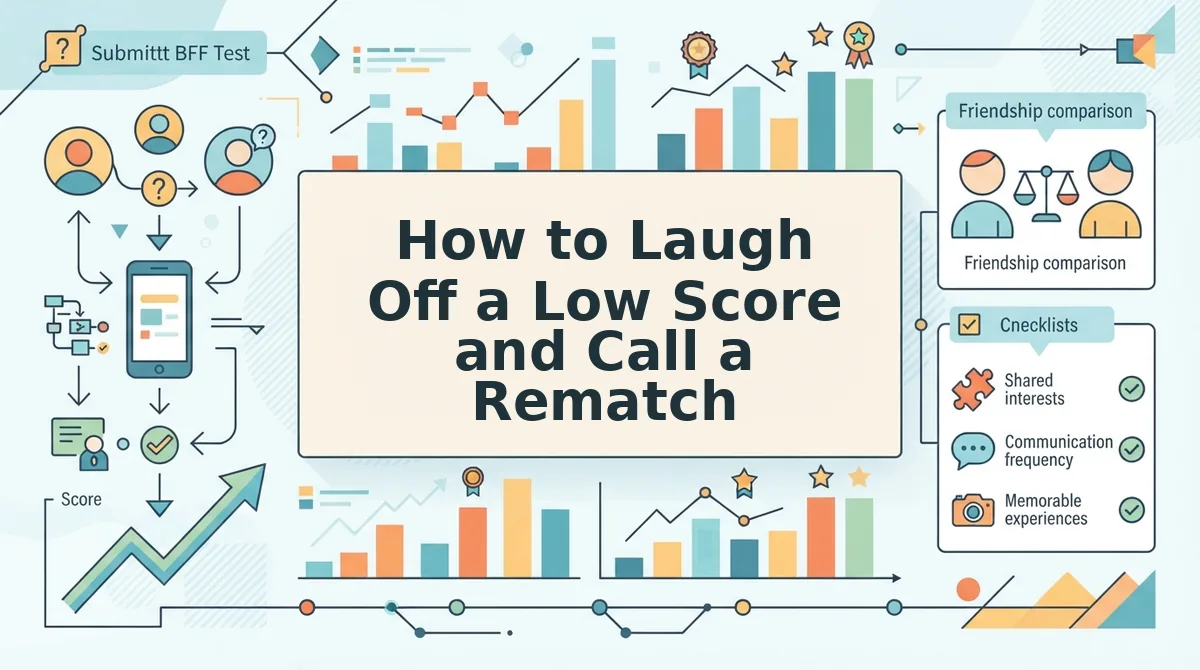
How to Laugh Off a Low Score and Call a Rematch
Success looks like laughing reactions instead of awkward silence.
Low Friendship Test Score FAQ
What counts as a good friendship test score?
How well do my friends really know me?
Should I delete the quiz if a friend scored low?
What if a low score actually hurt someone's feelings?
Turn Last Place Into the Next Round