Friendboard check-ins for long distance friend groups
Your old group chat used to buzz all day. Then everyone moved to different cities, and now nobody can find a call slot that works for more than two people at once.
That drift is normal and does not mean the friendship is over. A friendboard for long distance friends gives the group a check-in with no shared time slot: one quiz link that each person answers whenever they're awake.
This guide explains how the live ranking works as a check-in, how to set one up step by step, and how to turn scores into real conversation. The goal is an active Friendboard and a chat that talks again.
You need three things: a phone, your group chat on WhatsApp, iMessage, or Snapchat, and about two minutes. Friend Quiz lets you create a quiz without an account, email, or app download, and friends answer in their mobile browsers.
Pay attention to one ranking change in particular. It can restart a dead chat faster than any "we should catch up soon" text.
What Is a Friendboard and Why Does It Work as a Long Distance Check-In?
A Friendboard is the live ranking of who knows the quiz creator best. It works as a long distance check-in because everyone answers on their own schedule, and every new score gives the group something to react to.
How do long distance friends use a Friendboard? One person creates a quiz, drops the link in the group chat, and everyone answers whenever they're awake. Each answer updates the live ranking, so the ranking becomes the check-in. It shows who showed up and gives everyone a fresh reason to reply.
A Friendboard works as an async check-in, meaning a way to stay in touch without everyone being online at the same time. "Async," short for asynchronous, means "not at the same moment." It is like leaving a note on the fridge for a roommate instead of waiting until you're both home.
Think of a Friendboard like the scoreboard at a pub quiz, except the pub stays open for days and each friend arrives from a different city.
Popular creator advice on long distance friendship mostly says to schedule calls and plan visits. That advice is sound, but calls need a shared slot. The Friendboard fills the gap between calls, for three reasons:
- No shared time slot needed: each person answers whenever their day allows.
- Rank changes create a reason to reply: nobody has to invent an opener.
- Answers come from shared history: every question recalls a moment the group lived through together.
Picture a former roommate group now spread across several cities. The old house chat has gone quiet, and nobody can line up a call across work shifts and time zones. One person creates a quiz about their habits, quirks, likes, and dislikes, then drops the link into the house chat. Over the next day, each roommate taps the link, answers in the phone browser, and lands on the Friendboard. As scores come in, the ranking shifts and the chat fills with reactions to who remembered what. Nobody had to schedule anything.
A quiz does not replace calls or visits. It keeps the thread alive between them. To start one, create a best friend quiz in under two minutes with no account or email.
How to Run a Friendboard Check-In Step by Step
To run a Friendboard check-in, enter your name, answer prompts based on shared history, share the link, watch the rankings update, and then call out a rank change. The full setup takes about two minutes, and answers arrive over the next day or two.
Before you start: have your phone and the group chat open on WhatsApp, iMessage, or Snapchat. You do not need an account, email, or app.
- Type your name on the Friend Quiz homepage (about 10 seconds). Your name labels the quiz, so friends know whose history they are being tested on. You should then see your first trivia prompt.
- Answer prompts that lean on shared history (about 90 seconds). Work through the habits, quirks, likes, and dislikes prompts. For a former roommate group, apply three themes: house habits (habits), fridge crimes (quirks), and who did the dishes (dislikes). Answers tied to shared moments get the chat talking. When you finish the prompts, Friend Quiz generates your quiz link.
- Paste the link into the group chat as a drop-and-wait message (about 15 seconds). Add one line, such as "Prove you still know me." Then leave it. Do not chase replies, because the async format lets people answer whenever they're awake. Friends tap the link and answer in their mobile browsers.
- Watch the Friendboard update in real time. Each new answer adds a score and reorders the ranking. Your Friendboard should fill in over the next few hours as each time zone wakes up.
- Send the Rank Nudge (about 10 seconds). This is the ranking change that restarts a dead chat. Skip the guilty "we haven't talked in months" text and post the shift itself: "you dropped to 3rd??" A rank change is low-stakes and a little competitive, so people reply to defend their spot.
- Raise the stakes with a dare round (optional, about 2 minutes). Once the banter is flowing, send a friendship dare quiz so the lowest scorer owes the group a forfeit. This gives the chat a second round of replies.
Worked Example: A Friend Circle Across Time Zones
Picture a friend circle split across several time zones. Instead of one creator, each member builds a quiz about themselves and drops it in the chat during their own morning.
Over the week, the group compares Friendboards to see who tops the most rankings and whose quiz stumped everyone. Each new quiz restarts the conversation without anyone setting an alarm for a call.
How you spread those quizzes out depends on how far apart your friends' clocks are.
Which Check-In Style Fits Your Time-Zone Gap?
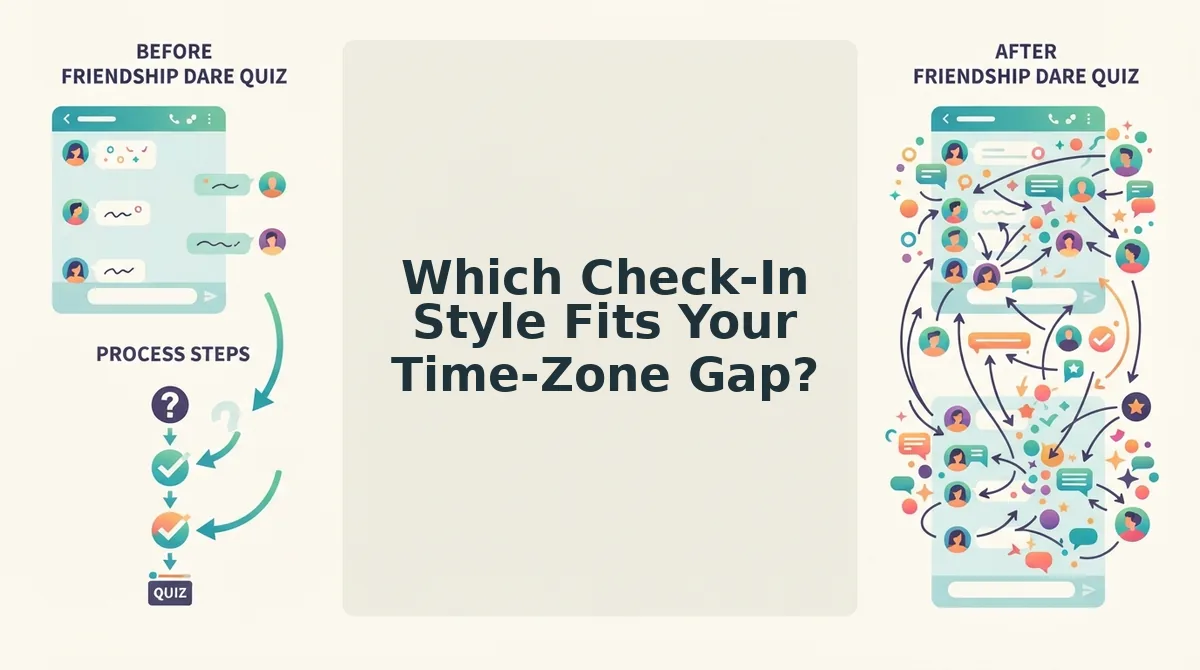
Match the play type to your time-zone gap: a live race works when everyone is awake at the same time, and a drop-and-wait link works when nobody shares a free hour. The cadences below are suggestions, not data, so adjust them to your group's rhythm.
| Time-zone gap | Play type | Suggested cadence |
|---|---|---|
| Same zone | Live race | Suggestion: a fresh quiz whenever the chat gets quiet |
| Best for: college friends now living in the same city but rarely meeting up | ||
| 1-4 hours | Live race or drop-and-wait | Suggestion: one quiz every few weeks |
| Best for: coast-to-coast groups who overlap in the evenings | ||
| 5-8 hours | Drop-and-wait link | Suggestion: one quiz a month |
| Best for: friends split between continents with little shared waking time | ||
| 9+ hours | Drop-and-wait with a quick BFF test | Suggestion: a short quiz whenever someone has news |
| Best for: groups where one friend's morning is everyone else's midnight | ||
To stay in touch across time zones without a shared call slot, switch from synchronous plans to messages friends can answer whenever they wake up. A shareable quiz link does this well because each friend opens it in their own mobile browser, answers on their own schedule, and lands on the same Friendboard as everyone else. Asynchronous play happens because the link waits for each person, not because the quiz is built around time zones. Each new score gives the chat a fresh reason to reply hours later, so the conversation keeps moving even when nobody is online together.
Video calls still beat any quiz for real conversation, so treat the link as the thread between calls, not a replacement for them. Start a quiz in under two minutes, no account needed.
How to Tell Your Check-In Worked Without Making It Too Competitive
Your check-in worked if the chat is talking again, not if someone won. Look for these signals, ranked by how much they say about reconnection.
- Someone asks to make the next quiz. This means the format has become a shared ritual. Hand them the next turn right away.
- Inside jokes resurface. A wrong answer that sparks an old story shows that shared memories are active again. Let the tangent run.
- Friends reply to the rank nudge. A response to a Friendboard update shows people are paying attention. Treat a rank change as a conversation starter, not a verdict.
Keep the rivalry low-stakes so friends who score low don't feel judged:
- Do celebrate funny wrong answers. These answers often get the biggest laughs and give everyone something to talk about.
- Do rotate who creates. Each new creator brings new questions, and a different friend gets the spotlight.
- Don't shame the lowest score. One missed question about breakfast habits isn't a personal failing.
- Don't treat a rank as a friendship score. A friendship test is a game, not a measure of how close you are.
Send the Link to the Chat That Went Quiet
A quiet group chat is rarely a fading friendship. More often, nobody has a low-pressure reason to post first. Picture the former roommate group: one person sends a fresh quiz, scores start showing up from three time zones, and the next Friendboard round gets everyone arguing about who really ate the leftovers.
The flow takes three steps. Enter your name, answer the personal prompts, and share the link. Creating a quiz takes under two minutes, with no account, email, or app download.
The quiz opens the door, but calls and visits keep the friendship strong. Use the banter to plan the next real catch-up.
Ready to restart the conversation? Create a best friend quiz, enter your name, and send the link to the chat that went quiet. The friends who reply first will prove the group is still there.