Mistakes that make friend quiz scores feel unfair in a group
Your group chat goes quiet for a second, then blows up: "That's rigged." "No way you got a 90." "I literally know you better than that." Sound familiar? When friend quiz scores feel unfair in group settings, the fallout isn't about the points, it's about who gets to claim the "best friend" crown, and nobody wants to lose that title to a badly written question.
You're not imagining the tension. A quiz built in 60 seconds with vague prompts and inside jokes will produce wildly inconsistent scores, and the group will blame the quiz, or worse, each other. Here's the good news: the problem is almost always fixable before you hit share.
This guide breaks down the four question mistakes that make scores feel rigged, explains why the same quiz produces different results for equally close friends, and gives you a pre-share fairness audit. You'll also see why one specific question type causes more "that's unfair" accusations than all the others combined, and it's probably not the one you think. When you're ready to test it yourself, create a friend quiz with the fairness rules below and watch your group chat stay friendly.
The 4 Question Mistakes That Make Scores Feel Rigged
A fairness-breaking question is any prompt where the "correct" answer depends on information only the quiz creator holds, rather than on something every participant could reasonably observe or recall. The four mistakes below move from simple to advanced, and each one inflates score variance, the spread between the highest and lowest scores in your group.
Think of a fair friend quiz like a well-designed trivia night at a bar: every team should have a fighting chance based on shared experience, not on guessing what the host was thinking when they wrote the question. When a question breaks that rule, the score stops measuring friendship and starts measuring luck.
Here is the fairness risk table that classifies question types by how likely they are to trigger score disputes:
| Question Type | Example | Fairness Risk | Score Variance |
|---|---|---|---|
| Observable habit | "What do I order at our usual coffee spot?" | Low | Low |
| Opinion | "What's my favorite movie of all time?" | Medium | Medium |
| Memory | "What did I eat on March 3rd?" | High | High |
| Inside joke | "What's the thing we never speak of?" | Very high | Very high |
Mistake 1: Memory questions with no shared anchor. A prompt like "What did I eat on March 3rd?" is only verifiable by the quiz creator. No friend can recall that reliably, so correct answers feel arbitrary and wrong answers feel like punishment for not being a diary.
Mistake 2: Inside jokes as quiz questions. Inside jokes are the highest-risk category because they exclude anyone who wasn't present for the original moment. In a group of five, two people might share the joke while three are left guessing, and the score gap will look personal even when it isn't.
Mistake 3: Opinion questions phrased as facts. "What's my favorite movie?" seems fair, but if you've mentioned three favorites over the years, every answer is defensible. The score then reflects which version of you the friend remembered, not how well they know you.
Mistake 4: Ambiguous prompts with multiple valid interpretations. "What is my go-to order?" could mean coffee, lunch, or late-night snack. When three friends answer three different but technically correct things, the quiz marks two of them wrong, and the group calls foul.
If you want a quiz that measures closeness without the arguments, build it around observable habits and shared experiences. A best friend quiz works best when every question has one answer that any close friend could reasonably know.
Why the Same Quiz Produces Different Scores for the Same Friendship
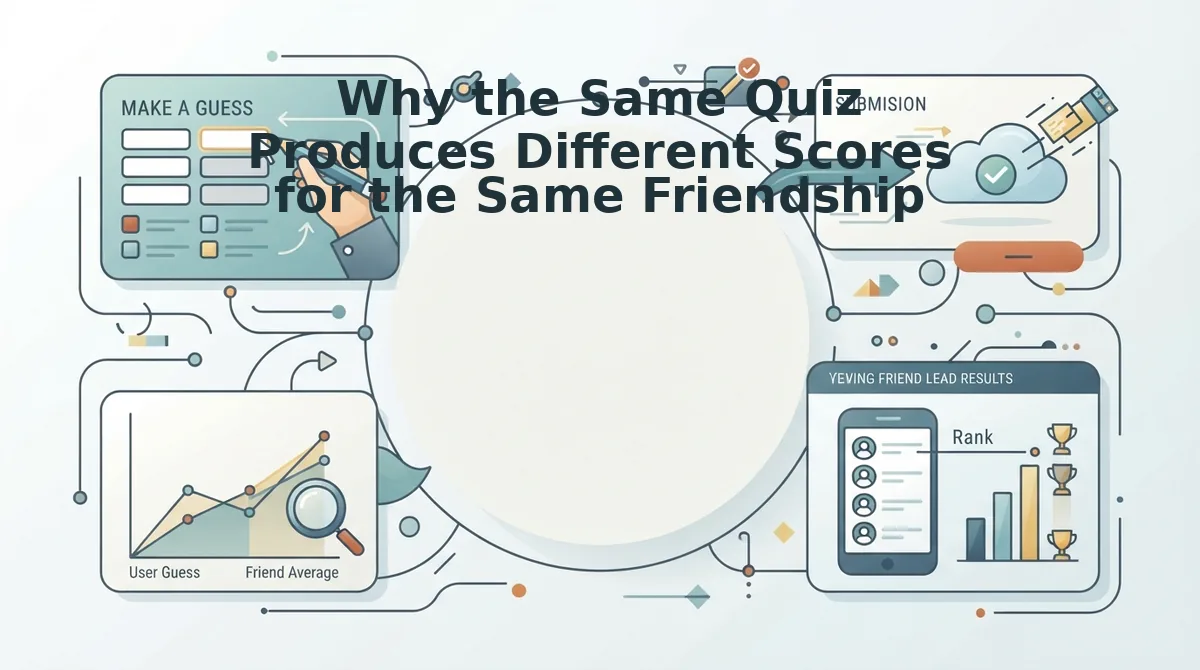
Score variance is the measurable spread between the highest and lowest results on the same quiz, and it is driven by question clarity, not by how much your friends care about you. Two equally close friends can score 20 points apart on the identical quiz because they interpreted the same prompt differently, answered at different speeds, or guessed on different questions.
Think of it like two people reading the same recipe: one assumes "a cup of rice" means cooked, the other assumes dry. Both are reasonable readers, but they produce different dishes. Friend quiz prompts work the same way, the wording, not the friendship, creates the gap.
Here is a worked example from the Friend Quiz flow. You answer a prompt about your daily habits, and the quiz asks your friends: "What is my go-to order?" One friend thinks coffee order and answers "oat milk latte." Another thinks lunch order and answers "chicken burrito." A third thinks late-night snack and answers "spicy ramen." All three know you well. The quiz marks two wrong because you only entered one answer when you built it. The score difference is a question-clarity problem, not a friendship-quality problem.
Answer timing adds another layer. Friends who answer quickly tend to rely on instinct and shared patterns; friends who overthink may talk themselves out of the right answer. Guessing patterns also vary, some people commit to a first instinct, others distribute guesses strategically. None of this reflects how much they know you.
Score variance is not a measure of friendship quality; it is a measure of question clarity. If you want to understand exactly how the numbers add up, the friend quiz accuracy score calculation breaks down the mechanics. The fix is simpler than you think: run the fairness audit before you share.
The Fairness Audit: 5 Checks Before You Share
A fairness audit is a 5-point pre-share checklist that catches question design flaws before your group chat turns into a debate. Run every quiz through these checks in order, and you will eliminate most score disputes before the first friend taps the link.
Prerequisites: A completed draft quiz from the friend quiz creator, your phone, and roughly 3 minutes. No account or app download required.
- Open your draft quiz and read each question aloud as if you were a friend taking it. Ask: can two reasonable friends disagree on the answer? If yes, rewrite the question so the correct answer is observable or verifiable. You should be able to point to a specific moment, habit, or fact that settles the answer.
- Click through each question and label it as observable habit or private memory. Observable habits are things friends have seen you do (your coffee order, your go-to karaoke song). Private memories are things only one person witnessed. Aim for at least 70% observable habits. You should see a clear majority of questions marked observable.
- Select the question list view and count how many questions rely on inside jokes. If more than 2 out of 10 questions reference a joke only two people understand, replace the extras with universal prompts. You should end with no more than 20% inside-joke density.
- Type a sample answer for each question and check whether the scoring logic is transparent. Players should understand why an answer is right or wrong without asking you. If you cannot explain the correct answer in one sentence, simplify the question. You should be able to write a one-line justification for every correct answer.
- Upload or review the final question set and ask: does this reward knowledge or guessing? If a friend who knows you well can score the same as a stranger guessing randomly, add more specific, knowledge-based questions. You should see a clear scoring gap between close friends and casual acquaintances.
After all five checks pass, share the link. A quiz that survives this audit produces scores your group will accept without a rematch demand.
How to Make Scores Feel Fair Without Making the Quiz Boring
A perfectly fair friend quiz is a boring friend quiz. The goal is not to eliminate disagreement entirely but to make score differences feel like friendly rivalry instead of rigged results. Use these four tactics to balance fairness with the banter that keeps groups engaged.
- Mix observable questions with one wildcard inside-joke round. A quiz that is 100% verifiable facts feels like a test, not a game. Reserve the final 2-3 questions for inside jokes and label them as a bonus round so players know those points are subjective. This keeps the quiz fun while signaling which questions are open to playful dispute.
- Use the Friendboard to turn score gaps into an ongoing rivalry. Instead of letting a low score become a one-time argument, point players to the friendboard rankings where score differences become visible, trackable competition. A 2-point gap feels unfair in isolation but becomes a motivating challenge when displayed on a live leaderboard.
- Add one intentionally ambiguous question and own it. Include a single question where the "correct" answer is your personal preference, not an observable fact. Announce it in the quiz description as the tiebreaker question. This frames ambiguity as a deliberate design choice rather than a mistake, and it gives low scorers a legitimate excuse to demand a rematch.
- Share the answer key after the quiz closes. Post a quick explanation of why each answer was correct, especially for questions friends disputed. Transparency after the fact converts "that was rigged" into "okay, that makes sense." It also gives the next round a baseline of trust that keeps participation high.
FAQ: Friend Quiz Score Fairness
A fairness audit is a 5-point pre-share checklist that catches question design flaws before your group chat turns into a debate. Run every quiz through these checks in order, and you will eliminate most score disputes before the first friend taps the link.
What mistakes make friend quiz scores feel unfair in a group?
Overly specific questions, ambiguous answer options, inside-joke density, and time-pressure bias are the four main culprits. Questions that only one friend could answer, answer choices that overlap, quizzes built entirely on private jokes, and timed rounds that punish careful readers all make scores feel rigged rather than earned.
Do friendship test scores actually mean anything?
Friendship test scores measure question clarity and shared context, not friendship depth. A low score usually means the quiz creator wrote ambiguous or overly specific questions, not that the friendship is weak. Treat scores as a game metric, not a relationship evaluation.
How do I make my friend quiz feel fair to everyone in the group?
Run a fairness audit before sharing: check that two friends can reasonably disagree on answers, keep inside jokes under 20% of questions, make scoring transparent, and ensure the quiz rewards knowledge rather than guessing. Then use the results view to see who scored highest and share the answer key to close disputes.
Why does the same quiz produce different scores for the same friendship?
Different friends have different access to your life. A roommate sees daily habits, a childhood friend holds old memories, and a coworker knows your professional quirks. A fair quiz mixes question types so no single relationship type has an unfair advantage.
Should I remove inside jokes from my friend quiz?
Inside jokes are the fun part of friend quizzes, but when they dominate the question set, anyone outside the core duo feels excluded and scores feel arbitrary.
Make the Fairness Audit Your Final Step Before Sharing
Every unfair score traces back to one skipped check. The Fairness Audit closes that loop: run all five checks, fix what fails, and the quiz you share is the quiz your friends deserve.
Here's the payoff the intro promised: fairness isn't a vibe, it's a checklist. When question wording, answer options, and scoring rules all pass the audit, the same friendship produces consistent scores across devices and retakes.
Your next move:
- Run the Fairness Audit on your draft quiz before generating the link.
- Share the link in your group chat and let the Friendboard settle any disputes in real time.
- For groups that want higher-stakes fun, try the friendship dare quiz and raise the bragging-rights ante.
Run the Fairness Audit, then share your quiz link in the group chat and let the Friendboard settle it.
A fair quiz doesn't just test the friendship, it protects it. When everyone trusts the score, the only thing left to argue about is who knows you best.