How to Pick a Friend Quiz That Fits Your Group Chat
Your group chat has 47 unread messages, but none of them are about you. That's the moment you realize the right friend quiz could turn a dying thread into the most active conversation of the week, if you pick the wrong one, it dies on arrival.
You're not alone in wanting to pick a friend quiz for your group chat that actually lands. The problem isn't a lack of quizzes; it's that nobody explains how to match a quiz style to your chat's specific energy. By the end of this guide, you'll know the five quiz styles that work, the three factors that decide which one fits, and a simple decision matrix you can apply in under a minute.
Here's the roadmap: we'll define the three matching factors, break down each quiz style with concrete examples, and finish with a framework for picking the right one without trial and error. Along the way, you'll see why a format with 3.2 million views on a single "Who's Most Likely To" video still flops in the wrong chat, and how to avoid that exact mistake. Friend Quiz lets you build a personalized challenge in minutes, no app download required, so you can test the framework immediately.
What Are the 3 Factors That Decide Which Friend Quiz Works?
A friend quiz only lands when it matches three variables: your chat's energy level, your group size, and how much friction everyone will tolerate. Get these three right, and the quiz becomes the highlight of the week; get one wrong, and it's a screenshot nobody responds to.
Factor 1: Chat energy. This is the baseline activity of your group, how often people reply, joke, and react. A high-energy chat full of banter can sustain a chaotic, open-ended quiz with subjective answers. A low-energy chat needs a structured, quick-answer format that doesn't demand paragraphs of commentary. Think of chat energy like a room's temperature: you wouldn't serve a five-course meal in a kitchen that's already on fire, and you wouldn't serve finger food at a formal dinner.
Factor 2: Group size. A quiz built for two people collapses in a 12-person chat, and a quiz built for a crowd feels empty in a trio. Small groups (2-3 people) thrive on deep, personal trivia where every question references a shared memory. Large groups (8+) need broad, low-stakes questions where anyone can participate without feeling left out.
Factor 3: Friction tolerance. Friction is the total effort required to start, answer, and share a quiz. The Speed Test filter measures three friction points: setup time (how long it takes to create the quiz), answer time (how long each response takes), and share friction (how many taps to send it to the chat). A group that abandons anything requiring a login will only engage with a zero-friction option like a best friend quiz that generates an instant link with no account.
These three factors work together as a filter. A close-knit duo with high energy and low friction tolerance wants a fast, personal trivia quiz. A 10-person chat with medium energy and high friction tolerance can handle a longer, more elaborate format. Match all three before you send the link.
Quiz Style 1: Who Knows Me Best for Close-Knit Duos and Trios
This style works best in small, high-trust groups where every question can reference a specific shared memory or inside joke. It's a best friend quiz format that rewards depth over speed.
Prerequisites: A group of 2-3 people who have known each other for at least a few months, plus 10-15 minutes of uninterrupted time together. The Quiz N' Chill BFF Friendship Test works best done together in real time, not asynchronously, because reactions to wrong answers are half the fun.
- Open the quiz builder and enter the creator's name. Type your name on the homepage to start. You should see the first personal trivia prompt appear immediately, no signup required.
- Answer 8-12 personal questions about your habits, quirks, and preferences. Select the option that's actually true for you, not the one that sounds impressive. Each answer takes about 5 seconds, so the full setup runs under 2 minutes.
- Generate the quiz link and send it directly to your duo or trio chat. Tap the share button and paste the link into your thread. Friends should see the quiz open instantly in their browser, no app install needed.
- Have each friend answer the questions about you. Each person completes the quiz in 3-5 minutes. They should see their score immediately after the final question.
- Compare scores together in real time. Read the results out loud or share screenshots. Expect laughter at the wrong answers and bragging rights for whoever scores highest.
If this format feels too intimate for your chat, the next style flips the dynamic entirely.
Quiz Style 2: Who Is Most Likely To for Active, Banter-Heavy Chats
Who Is Most Likely To quizzes turn every answer into a public vote, which makes them the fastest way to generate playful arguments in a group chat that already moves at high speed.
- Wild card questions spark the loudest reactions. These are absurd, unpredictable prompts like "Who is most likely to text the wrong person and not notice for three days?" They matter because unpredictability is what keeps a banter-heavy chat from scrolling past. Use them as the opening category to hook everyone before the quiz gets personal.
- Throwback questions mine shared history for inside jokes. Prompts like "Who is most likely to bring up that one trip from 2019 again?" work because they reward long-term group memory. Use them in the middle of the quiz to deepen engagement once the initial novelty wears off.
- Future prediction questions create stakes without real consequences. Asking "Who is most likely to be late to their own wedding?" lets friends make bold claims about each other safely. This category matters because it extends the quiz beyond trivia into playful forecasting, which fuels follow-up debates.
- Confession questions lower the barrier to self-deprecating humor. Prompts like "Who is most likely to cry at a commercial?" invite people to laugh at themselves without feeling attacked. Use them to balance sharper wild card questions so the tone stays fun rather than mean.
A TikTok video using this format has drawn 3.2 million views, proving the style's reach, but popularity alone does not guarantee fit. A Who Is Most Likely To quiz only lands in chats where everyone already feels comfortable being roasted in public.
Quiz Style 3: Which Friend Are You for New or Mixed Groups
Which Friend Are You is a personality-mapping quiz that assigns each participant a role or archetype based on their answers, making it ideal for groups where people do not yet know each other's quirks.
Think of this format like a seating chart at a dinner party: instead of testing who knows the host best, it reveals where each guest fits in the group's dynamic. Persona Pop's "Which Friend Are You" video demonstrates the appeal, showing how identity discovery drives participation even among strangers.
Start simple by asking surface-level preference questions anyone can answer without self-consciousness. Move to intermediate prompts that reveal habits, like how someone handles group plans falling through. Finish with advanced questions that ask participants to choose between conflicting social scenarios, which exposes deeper personality traits.
This style works as a friendship test for mixed groups because it builds connection through self-revelation rather than prior knowledge.
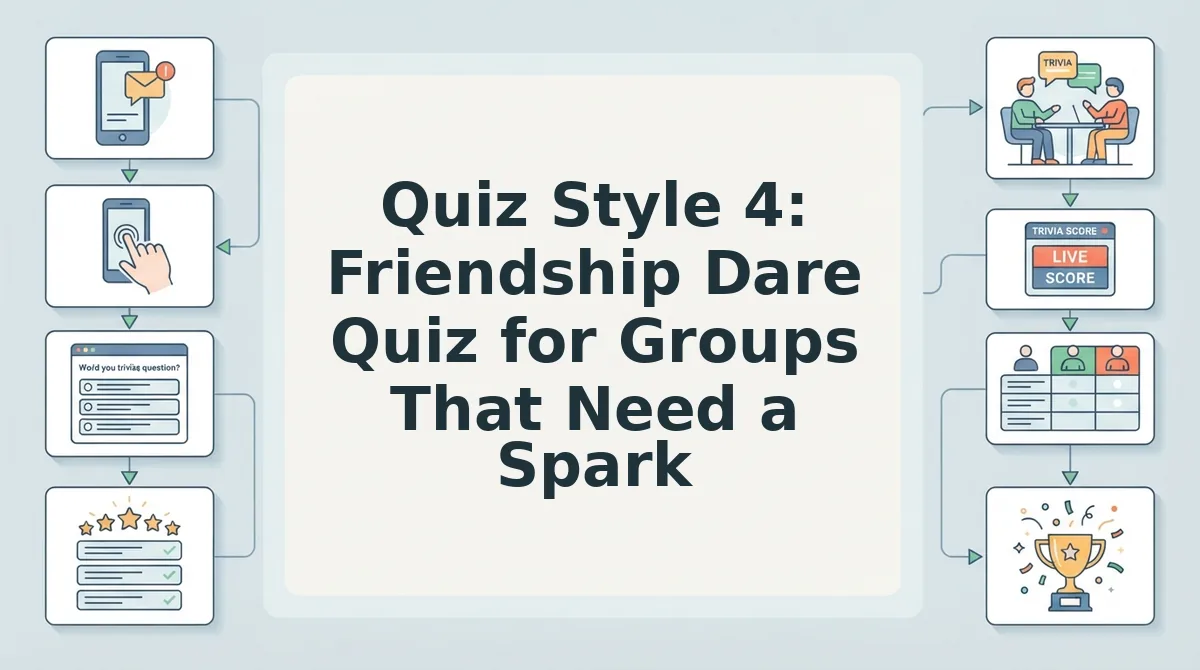
Quiz Style 4: Friendship Dare Quiz for Groups That Need a Spark
A friendship dare quiz pairs each trivia answer with a light challenge, turning passive answering into active participation that revives a dead group chat within minutes.
You need a quiz link ready to share and a group chat with at least three people willing to complete one small dare each. Follow these steps:
- Open the friendship dare quiz builder and select the silly category first. Choose dares like "Send a voice note of your best animal impression." You should see a preview of the dare before it locks in, which keeps the tone light enough for hesitant friends.
- Add one confessional dare to the middle of the quiz. Pick something like "Admit the last thing you googled." This creates a vulnerability spike that pulls lurkers into the thread, and you should see replies increase after this question appears.
- Insert an action dare that requires physical movement. Select "Do ten jumping jacks and send proof" or a similar prompt. The expected outcome is a burst of photo or video replies, which visually signals the chat is alive again.
- End with a photo dare that captures the group's current state. Choose "Post the most recent photo in your camera roll with no context." You should see a final wave of engagement that leaves the chat primed for follow-up conversation.
Dare categories fall into four buckets: silly, confessional, action, and photo. Silly dares lower the participation barrier, confessional dares build intimacy, action dares create visual proof, and photo dares close the loop with shareable content.
Next, see how Friendboard rankings turn that revived energy into an ongoing competition.
Quiz Style 5: Friendboard Rankings for Competitive Squads
Friendboard rankings turn a one-off friend quiz into an ongoing score war, with a real-time leaderboard that updates as each friend submits answers. The friendboard mechanic is a live score leaderboard that refreshes after every response, so latecomers can still climb past early leaders.
Friend Quiz's leaderboard keeps bragging rights visible inside the chat, while Kahoot-style trivia platforms excel at scheduled live events and BuzzFeed quizzes win on sheer volume of ready-made content. The trade-off is format: live-hosted games require everyone online at once, whereas a friendboard works asynchronously.
| Option | Strength | Limitation | Best for |
|---|---|---|---|
| Friend Quiz leaderboard | Async score tracking, no app or login | Requires creator to build the quiz | Squads that want ongoing bragging rights in a group chat |
| Kahoot-style live trivia | High-energy synchronous play | Everyone must join at the same time | Teams scheduling a game night or video call |
| BuzzFeed-style scored quizzes | Huge ready-made library | No persistent leaderboard between friends | Casual groups wanting instant, low-effort fun |
Competitive squads get more replay value from a persistent leaderboard than from a single-round quiz, because rematches and score-chasing keep the chat active for days.
The Chat Energy Matrix: Your 30-Second Decision Guide
The Chat Energy Matrix is a two-axis decision tool that matches a friend quiz style to your group's activity level and size. Plot your chat on dead-to-active energy and small-to-large group size, then pick the quadrant you land in.
Think of it like choosing a board game: a quiet two-player chess match suits a calm duo, while a loud party game fits a rowdy crowd. Dead energy plus a small group calls for a Who Knows Me Best quiz to revive one-on-one curiosity. Dead energy in a large group needs a Which Friend Are You quiz, since low-stakes self-discovery works when nobody is typing.
Active energy in a small group favors Who Is Most Likely To for rapid-fire banter. Active energy in a large group is where Friendboard Rankings shine, because a live leaderboard channels competitive chaos into repeat plays. Friendship Dare quizzes sit in the middle: they inject energy into any size group that has stalled.
Run the matrix in 30 seconds: check the last 10 messages for energy, count active participants, then pick the matching style and send the link.
Frequently Asked Questions About Friend Quizzes for Group Chats
How many questions should a friend quiz have?
Use 5-10 questions for fast-moving group chats where attention spans are short, and 15-20 questions for deeper dives between close friends. Shorter quizzes get more completions, while longer ones reveal more about how well friends truly know each other.
What is the difference between a BFF test and a friendship test?
A BFF test measures how well one specific best friend knows you, while a friendship test works for any friend or acquaintance. BFF tests use personal, inside-joke questions; friendship tests stay broader and more accessible.
Why does my group chat ignore quiz links?
Chats ignore quiz links when the quiz feels like homework, requires an app download, or arrives when the conversation is already dead. Send a short, low-commitment quiz during an active moment and mention one funny question to spark curiosity.
How do I make a friend quiz without an app?
Use a web-based quiz maker like Friend Quiz that generates a shareable link without downloads or account signups. Create the quiz in your browser, copy the link, and paste it directly into WhatsApp, iMessage, or Snapchat.
Can a friend quiz work in a group chat with people who barely know each other?
Yes, if you pick a Which Friend Are You style quiz that focuses on self-discovery rather than personal history. These quizzes let newcomers participate without needing inside knowledge, which lowers the barrier to joining the conversation.
Pick your quiz and send it before the chat goes quiet again.
Pick Your Quiz and Send It Before the Chat Goes Quiet Again
The Chat Energy Matrix already told you which quiz fits. Now act on it. Group chat momentum dies in minutes, not hours, the window between "we should do something" and radio silence is brutally short.
Here's the sequence that works:
- Match the energy. Quiet duo? Who Knows Me Best. Banter-heavy? Who Is Most Likely To. Competitive? Friendboard Rankings.
- Build it in under a minute. No app download, no account login, no friction. Just your name, a few prompts, and the link is live.
- Send it immediately. Drop the link in the chat while the conversation is still warm.
That's the entire playbook. The best friend quiz isn't the most elaborate one, it's the one that actually gets answered. Create a friend quiz now and send it before the chat scrolls past the moment.
The quiz that ships in 30 seconds beats the perfect quiz that never gets sent.