Common Mistakes When Browsing Public Friend Quizzes
We get it. The quiz looks official, the questions feel pointed, and the score arrives with the confidence of a lab result. But here's the promise: by the end of this article, you'll know exactly which traps cause that false alarm, how to spot them before you tap, and how to browse any public quiz without letting a random algorithm rent space in your head.
Here's the roadmap: first, we'll unpack the Public Quiz Trap, a three-part framework covering the Assumption Trap, the Privacy Trap, and the Accuracy Trap. Then you'll get a 10-second pre-click checklist for vetting any quiz link. Finally, we'll compare public quizzes against personal ones so you know what a real friendship test actually looks like. One of these traps is so subtle that most people fall for it before the first question even loads, and it's not the one you think. If you'd rather skip the guesswork entirely, you can create your own friend quiz and control every question from the start.
What Is the Public Quiz Trap and Why Does It Cause Most Browsing Mistakes?
The Public Quiz Trap is a three-part failure pattern, the Assumption Trap, the Privacy Trap, and the Accuracy Trap, that causes people to misinterpret, overshare on, or over-trust generic friend quizzes they find through public links. Most browsing mistakes happen because users treat a mass-produced quiz as if it were personally crafted for them.
Think of a public quiz like a horoscope written for twelve zodiac signs at once. It feels specific because the questions reference universal experiences, "Do they know your coffee order?" or "Have they seen you cry?", but the scoring logic is identical for every person who clicks. The Assumption Trap is when you assume the quiz was made by someone who knows you or your friendship. In reality, public quizzes are often template-based, recycled across platforms, and written to maximize engagement, not accuracy.
The Privacy Trap is the second layer. Public quiz links frequently route through third-party hosting pages that request permissions, collect interaction data, or display ads before revealing results. You may be handing over behavioral signals, how long you hesitate on a question, which answers you change, without realizing it. The Accuracy Trap completes the framework: even if the quiz is harmless and well-intentioned, its scoring model has no calibration to your actual relationship.
Here is the framework in a self-contained summary: The Public Quiz Trap is a three-part model for understanding why browsing public friend quizzes leads to mistakes. The Assumption Trap occurs when users believe a generic quiz was designed with their specific friendship in mind. The Privacy Trap occurs when users overlook data collection, ad tracking, or permission requests embedded in public quiz links. The Accuracy Trap occurs when users treat uncalibrated template scoring as a meaningful measure of relationship quality. Together, these three traps explain nearly every negative experience people report after taking public friend quizzes.
Understanding this framework matters because it converts vague frustration into a checklist. When a quiz result stings, you can ask: Did I assume intent? Did I expose data? Did I trust an uncalibrated score? Most of the time, the answer to at least one is yes.
How to Check a Public Friend Quiz Link Before You Click
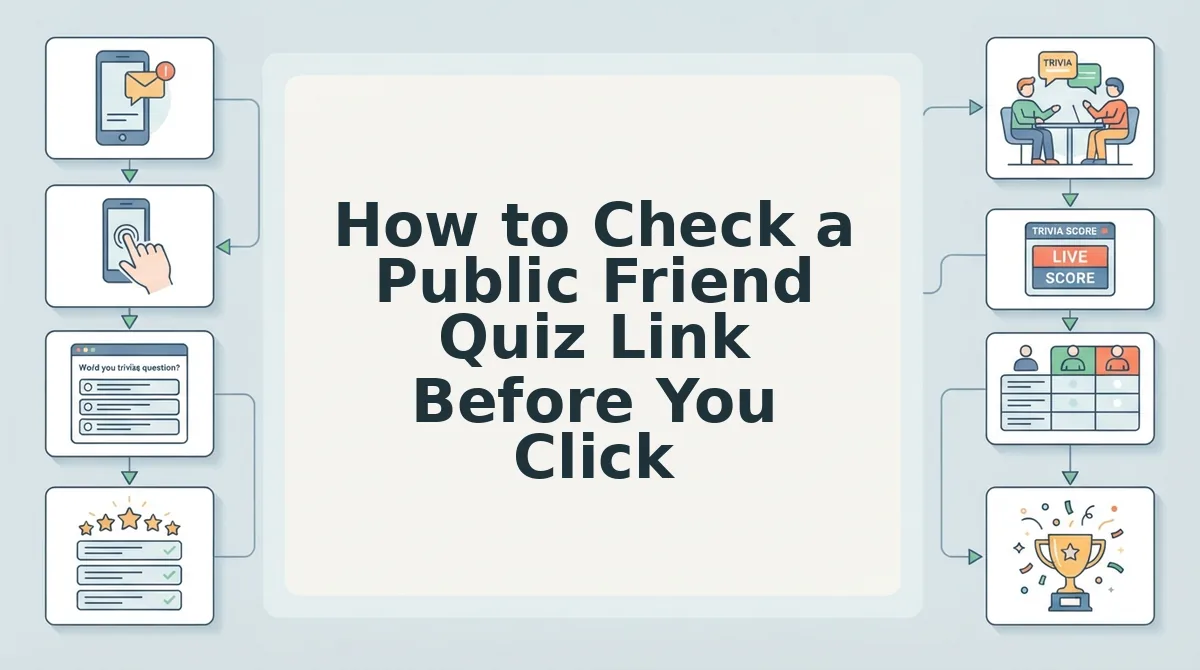
Before you tap that link, run it through this 10-second check. You need no special tools, just your phone's built-in browser features and about ten seconds of attention. Each step below catches one of the three traps from the framework above.
- Check the domain. Look at the URL before tapping. If the domain is a URL shortener (bit.ly, tinyurl, t.co) or an unfamiliar third-party quiz aggregator, treat it as unverified. A legitimate personal quiz usually comes from a recognizable domain or a direct link from someone you know. Expected outcome: You can identify who actually hosts the quiz.
- Verify HTTPS. Tap and hold the link (or hover on desktop) to preview the full URL. Confirm it starts with
https://and nothttp://. The "s" means the connection is encrypted. Expected outcome: You see a padlock icon in your browser bar after the page loads. - Preview the redirect path. On most phones, long-pressing a link shows a preview card with the destination URL. If the preview shows a different domain than the text suggests, or multiple redirects, back out. Redirect chains are a common way public quizzes route you through ad networks before the actual quiz loads. Expected outcome: The preview URL matches the visible link text or is a single, sensible destination.
- Check the sender context. Ask yourself: Did a close friend send this directly to me, or did it arrive in a large group chat, a forwarded message, or a public feed? A quiz forwarded through five people has zero personal relevance to you, no matter how targeted the questions feel. Expected outcome: You can name who created the quiz and why they sent it to you specifically.
If all four checks pass, the quiz is likely safe to open, though the Accuracy Trap still applies to any result it shows. If any check fails, skip it. The drama you avoid is worth more than the score you'd get. That distinction between public and personal quizzes is exactly what we'll unpack next.
Public Friend Quiz vs. Personal Friend Quiz: What's the Difference and Why It Matters
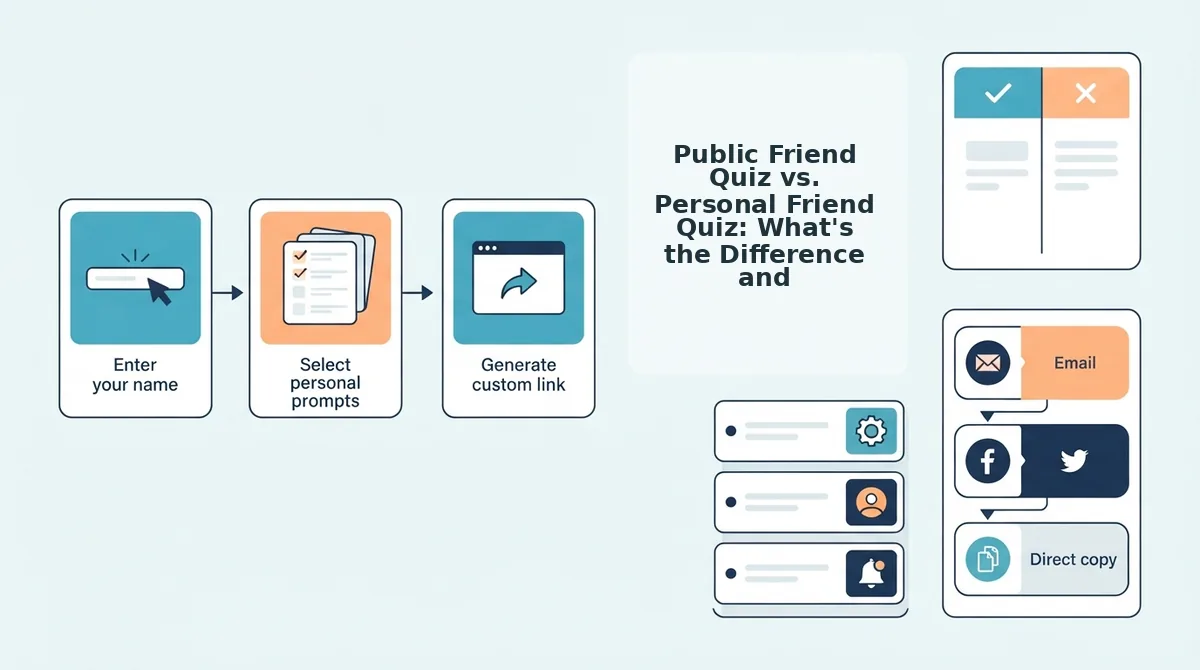
A public friend quiz pulls questions from a generic, one-size-fits-all pool, while a personal friend quiz is built from details only your actual friends would know. The distinction determines whether results reflect real closeness or just pattern-matching against strangers' assumptions.
Public quizzes dominate social feeds because they are instant and frictionless. Their strength is entertainment value: you answer 10 questions, get a percentage, and share it in a group chat within 60 seconds. The trade-off is that the question pool was written for millions of people, not for you.
Personal quizzes invert that trade-off. A personalized best friend quiz uses your own habits, quirks, and inside jokes as the source material, so a high score means something specific. The cost is setup time: someone has to record those details first.
| Comparison Factor | Public Friend Quiz | Personal Friend Quiz |
|---|---|---|
| Question source | Generic pool written for mass audiences | Your recorded habits, preferences, and quirks |
| Result accuracy | Entertainment-grade; measures pattern overlap | Relationship-grade; measures actual knowledge of you |
| Privacy exposure | Often requires name, email, or social login | No account needed; link-based access only |
| Share mechanics | Public leaderboards and viral feeds | Private links sent directly to chosen friends |
| Setup time | Zero; start immediately | 2-3 minutes to record personal answers |
Public quizzes are best for casual entertainment seekers who want instant fun without commitment. Personal quizzes are best for close friend groups who want bragging rights backed by real knowledge, not guesswork.
The contrarian insight most comparison content misses: public quizzes are not broken, they are just built for a different job. If you want a quick laugh with acquaintances, a public quiz delivers. If you want to prove your best friend actually pays attention, a friendship test that actually knows you is the only format that can do that.
Choosing between them is less about quality and more about intent. Browsing a public quiz expecting personalized insight is like reading a horoscope and expecting a medical diagnosis.
7 Mistakes People Make When Browsing Public Friend Quizzes
Most browsing mistakes stem from one root cause: treating a generic entertainment product as a personalized relationship diagnostic. Here are the seven most common errors, ranked by how much they distort your experience.
- Treating results as relationship verdicts. A low score on a public quiz reflects the quiz author's assumptions, not your friend's actual knowledge of you. Use the result as a conversation starter, never as evidence in an argument.
- Using your real name and personal details. Public quizzes often collect and display the information you submit. Enter a nickname or initials, and skip any field that asks for your birthday, location, or email unless the quiz's purpose requires it.
- Clicking links without inspecting the URL first. Fake quiz links are a known phishing vector on social platforms. Hover or long-press the link, check for misspellings or unusual domains, and avoid any quiz that redirects before showing questions.
- Assuming the questions are about you. Public quiz question pools are written for mass audiences, so the "right" answers reflect the quiz creator's guesses about a generic person. Recognize that a mismatch is a design limitation, not a personal failure.
- Answering under social pressure instead of honestly. Group chats create momentum to answer fast and match the crowd. Slowing down and answering what you actually think produces more interesting results and better follow-up conversation.
- Sharing results without reading the fine print. Some public quizzes attach your name or score to public leaderboards or share data with third parties. Check what the result screen displays before you screenshot and post it.
- Expecting the same depth as a personalized quiz. Public quizzes cannot know your inside jokes, your coffee order, or your childhood nickname. If you want results that mean something, create your own friend quiz with details only your real friends would recognize.
Fix these seven habits and public quizzes become what they are meant to be: fast, low-stakes fun that fuels group chat banter without pretending to be anything deeper.
Frequently Asked Questions About Browsing Public Friend Quizzes
Are public friend quizzes safe to browse?
Most legitimate public quizzes are safe, but fake quiz links are a known phishing vector on social platforms. Check the URL before clicking, avoid quizzes that demand your email or phone number before showing results, and never reuse a password on a quiz site.
Do public quiz results actually mean anything?
Public quiz results measure how well your answers match a generic question pool written for mass audiences. They are entertainment-grade, not relationship-grade. A high score means you share common assumptions with the quiz author, not that your friendship is proven.
Should I use my real name on public quizzes?
No. Public quizzes often display submitted names on leaderboards or result screens that get shared widely. Use a nickname or initials, and skip optional fields asking for your birthday, location, or email unless the quiz's stated purpose requires them.
How do I spot a fake quiz link?
Check the URL for misspellings, unusual domains, or redirects before any questions appear. Legitimate quizzes show questions immediately on the same page. Any quiz that asks for login credentials, payment details, or excessive personal data before revealing results is a red flag.
Now that you know what to avoid, the next step is turning that awareness into a smarter browsing habit.
Browse Smarter, Not Harder: Your Next Step After Fixing These Mistakes
The three traps and seven mistakes all trace back to one root cause: browsing public quizzes puts you in someone else's game. You're answering questions designed for strangers, filtered through links you can't fully verify, and walking away with a score that means nothing about your actual friendships.
Here's the shift that changes everything:
- Browse smarter, apply the link-checking habits from this guide before clicking anything shared in a group chat.
- Create your own, create your own friend quiz in under two minutes and control every question.
- Share with friends, send your quiz link to the people who actually know you, then compare results in real time.
Stop browsing. Start creating. The payoff isn't just a safer link, it's a quiz that reflects your real habits, your real quirks, and your real friendships. When you build the quiz yourself, every answer becomes a conversation starter instead of a data point.
Public quizzes measure how well you match a stranger's template; a quiz you create measures how well your friends actually know you.