Buddy Meter vs Friend Quiz dare questions for bold groups
You searched "buddy meter vs friend quiz dare questions" because someone in your group chat wants a dare round and you need to know which link to send. The verdict up front: only one of the two actually has dares. Friend Quiz runs a dedicated Friendship Dare Quiz plus a dare-idea library split into soft, chat, creative and bolder-but-safe prompts. Buddy Meter's documented flow is region, name, ten about-you questions, a share link, and friends guessing a score out of 10 â with question banks built on preferences and habits such as comfort food and biggest pet peeve.
Picture how that second format plays out: a creator locks ten habit answers and drops the link into a WhatsApp group, so friends spend the round guessing rather than doing anything. That is a good game. It just isn't a dare.
What follows is a format comparison, not a feature brag sheet â what each product actually asks of your friends, and which of three decisions really settles the choice for a mobile group. One detail is worth holding until later: a dare prompt has no answer key, and that quietly breaks the scoring model most people assume both tools share.
Which of the two actually has dare questions?
A dare question is a prompt that asks a friend to do something rather than recall something about you. On that definition, Friend Quiz publishes dare content and Buddy Meter's documented flow does not.
The Buddy Meter vs Friend Quiz dare question split is a difference of format, not a missing button: Buddy Meter tests recall of facts about you, while Friend Quiz offers both a recall quiz and a dare format where friends act instead of answer. Buddy Meter's own described sequence â region, name, ten about-you questions, link, then friends guessing a score out of 10 â has no dare mechanic anywhere in it. Friend Quiz separates its prompts into four groups: soft, chat, creative, and bolder-but-safe, so a group can stay inside a comfort level it picks deliberately.
The distinction competitors blur is that a dare library is not the same thing as a dare mechanic. A library is content you read and adapt; a mechanic is a step inside the product flow that hands friends a prompt and expects a response. Buddy Meter has neither documented. Friend Quiz has both, which is why the Friendship Dare Quiz can run with no signup for the creator or the friends answering.
Think of it like a pub quiz versus a party game: the quiz has an answer sheet and a scorer, the party game has a referee and a forfeit. Both are fun on a Friday night; only one produces a score. It is also worth noting how thin the comparison field is â no third-party page comparing these two products on dare format surfaced in research, which makes this an under-served query rather than a crowded one.

The three questions that decide it
Question-Type Match is a way of picking a quiz maker by asking what kind of answer it expects, and on its three axes these tools are not close substitutes.
| Axis | Buddy Meter | Friend Quiz |
|---|---|---|
| What gets tested | Recall â comfort food, biggest pet peeve, habits and preferences | Recall in the standard quiz; willingness to act in the dare format |
| Who holds the answer key | The creator, who locks ten answers before sharing | The creator for quiz rounds; nobody for a dare prompt |
| What the loser owes | A score out of 10, reported on a leaderboard | A score, or a dare completed in the group chat |
Buddy Meter deserves credit on the middle row: one locked answer per question and one point per match makes the result feel authoritative, and its documented WhatsApp share button plus Snapchat and Instagram status steps remove real friction. Friend Quiz scores ten questions the same way, one locked answer each, no partial credit â its own guidance notes that open answers invite disputes.
The third row is where the demand-supply gap shows. Top-ranking videos in this niche are truth-or-dare and best-friend-challenge formats with view counts in the low thousands, while the tool pages ranking alongside them are about-you trivia. People want the dare round; the tools mostly sell the scoreboard.
Three groups, three answers. A group that argues over scores should stay with locked-answer recall, because a dare has no answer key and nothing to verify. A group that goes quiet after question three needs commitment prompts, not more trivia. A group that wants a dare round only should skip the quiz entirely and start from the dare library.
Best for the scoreboard crew: Buddy Meter, for a clean 0-to-10 result and a share flow already documented step by step. Best for the dare-first group: Friend Quiz, which runs a dare format and needs no signup from anyone. More head-to-heads live in our quiz comparisons.
Buddy Meter's flow is still worth walking through in detail, because it shows exactly where a dare round would have to slot in.
What Buddy Meter actually does
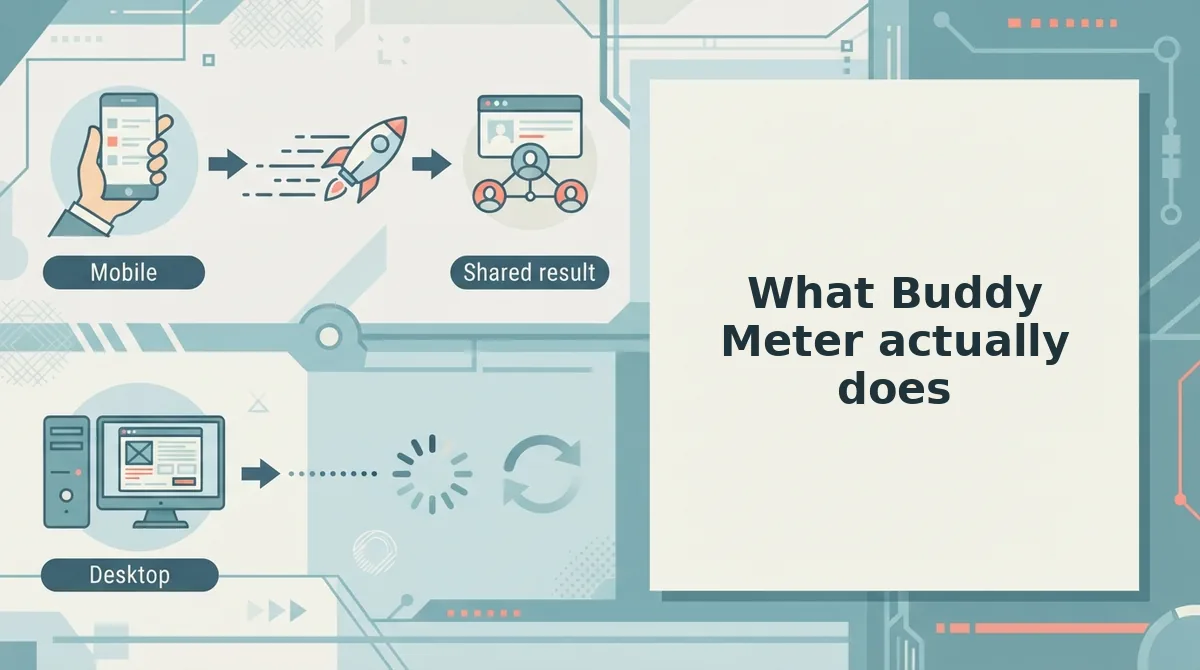
Buddy Meter runs a ten-question recall quiz: you pick a region, type your name, answer ten about-you prompts, share one link, and friends guess your score out of 10. Its documented flow contains no dare prompt type, no dare category, and no commitment mechanic â the output is guesses plus a leaderboard, not a dare anyone has to perform.
Before you start: you need a phone or desktop browser and a group chat to paste a link into. No account, email address, or app install is required at any step, for you or for the friends who play.
- Open the Buddy Meter quiz page in your browser. You should land on the region selector with the start control visible â about 15 seconds.
- Select your region from that selector. Once a region is set, the name field becomes active and accepts input.
- Type your name into the name field, spelled the way your group chat spells it. That string is the label friends will see â roughly 10 seconds.
- Answer the ten about-you prompts one at a time, choosing from the options on screen ("What is my comfort food?", "What is my biggest pet peeve?"). You should see all ten completed in two to three minutes.
- Share the generated link using the WhatsApp share button, or follow the documented Snapchat and Instagram status steps. Success looks like the link opening in a friend's browser with no signup prompt.
- Check the leaderboard once friends submit. Each entry reports that friend's score out of 10, ranked against the rest. Expect a single number, not per-question feedback.
The documented-claims ledger
Each row traces to one of three pages: the quiz page (2026-10-30), the how-well-do-friends-know-you page (2026-11-08), and the best BFF questions page (2026-08-25). Where the third column reads "Not documented," no page supports the claim.
| Claim | Source and date | Status |
|---|---|---|
| Flow: region, name, ten about-you questions, shareable link | Quiz page, 2026-10-30 | Documented |
| WhatsApp share button plus Snapchat and Instagram status steps | Quiz page, 2026-10-30 | Documented |
| Leaderboard reporting a score out of 10 | How-well-do-friends-know-you page, 2026-11-08 | Documented |
| No signup required to play | Quiz page, 2026-10-30 | Documented |
| Prompt style: preferences and habits | Best BFF questions page, 2026-08-25 | Documented |
| Dare prompt type | None of the three pages | Not documented |
| Dare categories or comfort tiers | None of the three pages | Not documented |
| A dare the friend must perform | None of the three pages | Not documented |
Does Buddy Meter have dare questions? Nothing in its own documentation supports it. Its pages describe a ten-question recall format built from preference and habit prompts, one shareable link, and a leaderboard scoring friends out of 10. A reader hunting for a dare prompt type, a dare category, or a dare the friend must actually carry out will not find one described. That gap is the comparison in miniature: a group that wants dares is choosing between a recall quiz and a format that ships dare prompts â not between two dare products. If recall is what you want, a BFF test covers the same ground with one locked answer per question.
What the Friend Quiz dare format actually is
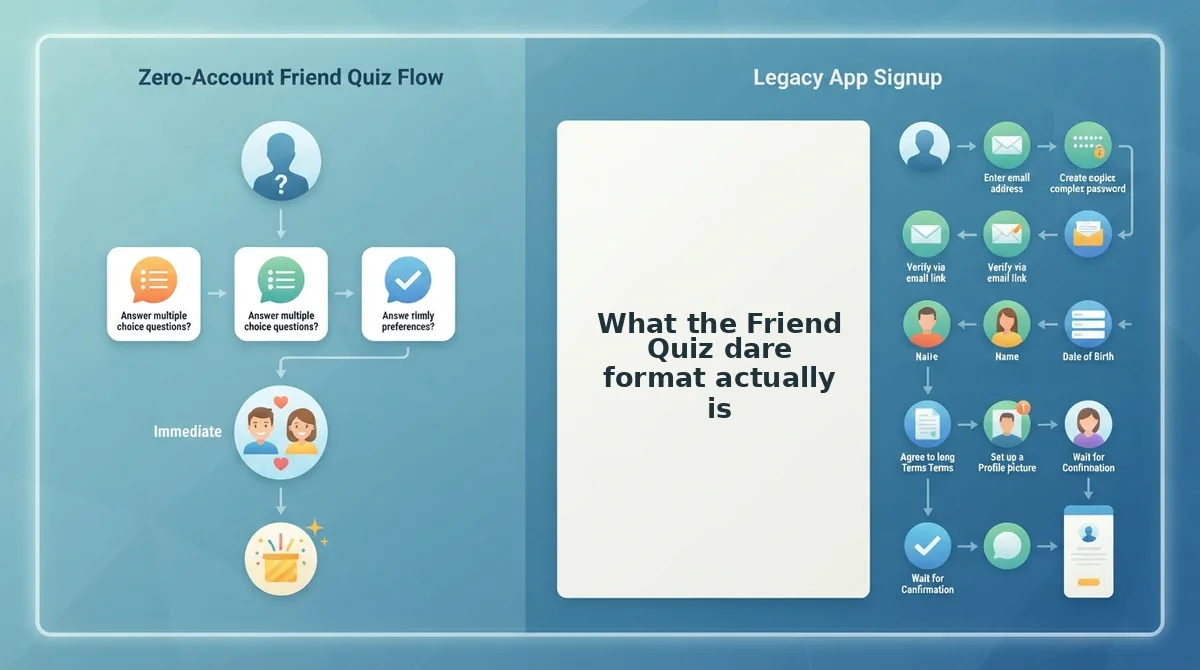
Friend Quiz splits dares into two things: a readable library sorted into four comfort tiers, and a dedicated Friendship Dare Quiz that runs alongside it. The dare layer sits outside the scored round, so it warms a group up instead of ranking it.
The four tiers each carry a stated comfort level, which is what lets a group pick a starting point rather than scrolling until something feels safe:
- Soft â low-stakes prompts for a group where one person barely knows the rest; nothing requires performing on camera.
- Chat â text-only dares that land in the group chat, where the banter was headed anyway.
- Creative â for the friend who would rather make something, like a voice note or a caption, than answer a question.
- Bolder-but-safe â the top tier, and the one most groups actually use together, because of the house rule below.
That house rule is no humiliation and no risky stunts. It is the reason the bolder tier survives a mixed group: the escalation is social, not physical, so nobody leaves the chat embarrassed or hurt.
Keep the scoring distinction straight. Friendboard ranking applies to the quiz round â ten questions, one locked answer each, one point per match. A dare round is the warm-up before that scored link goes out, not the event the ranking measures.
The library also exists to be read before the product is used. Someone who is not ready to build a quiz can read safe dare ideas, find a tier that fits the group, and come back when the chat is ready. That ordering is the whole design.
So the teased question resolves cleanly: only one of the two ships dares, and it ships them as content first and a round second. Start by picking your tier, send the warm-up, then build a best friend quiz to put a number on the bragging rights. Your group chat is one link away from settling it.