Friendship test quirk answers that keep the quiz from being too easy
A quiz drops in the group chat, the Friendboard fills up within the hour, and everyone ties at the top. Nobody wins, nobody gets roasted, and the banter dies before it starts.
Perfect scores are boring, and the usual cause is a quiz built from obvious favorites. The fix is in your friendship test quirk answers, meaning the habits you pick and the wrong options you put beside them.
This guide shows you how to build a quiz that sparks surprise guesses and produces a clear winner. You'll rank quirks on the Guessability Ladder, write decoys that sound true, and check your Friendboard. You'll also see why the wrong answers matter more than the right ones.
You only need your name and a few personal quirks. Enter your name, pick your prompts, and share the link. Friends answer in their mobile browser with no account or app required.
To keep a friendship test from being too easy, choose quirks that only close friends would know. Pair each one with a wrong answer that sounds believable. That combination spreads out the Friendboard and gives you a real winner.
How Do I Pick Quirk Answers So My Friendship Test Isn't Too Easy?
Pick quirks that only your close friends could guess, and rank them by how many people could know them. Pair each one with wrong answers that sound true. Specific habits are harder than generic favorites, and believable decoys stop lucky guesses, so the Friendboard spreads out instead of ending in a tie.
A quirk is a specific habit or ritual that belongs to you, such as how you eat cereal or the song you skip every time it plays. A generic like, such as your favorite color, does not count.
A decoy answer is a wrong option built to tempt the reader. A good one sounds like something you would actually do.
The Friendboard is the live score ranking that shows who knows you best as friends finish your quiz.
Simple: Start With Habits, Not Favorites
List routines you repeat without thinking, like the snack you hide or the way you load the dishwasher. If a stranger scrolling your profile could answer it, it's too easy.
Intermediate: Rank Quirks by Who Could Know Them
Think of a weak security question like "What city were you born in?" It fails because too many people know the answer. A good quiz question works the same way in reverse. It should be hard for acquaintances and answerable for your inner circle.
Advanced: Pair Every Quirk With a Tempting Decoy
A specific quirk next to three silly wrong options is still easy. Surround the real answer with decoys that fit your personality, so readers have to recall the memory instead of ruling out the obvious fakes.
Use this contrast to sort your list:
- Habit (how you eat cereal) vs. favorite food (pizza)
- Weird ritual (the song you always skip) vs. favorite color (blue)
- Oddly specific dislike (the one texture you refuse to touch) vs. generic dislike (Mondays)
Once your list leans toward the left side, create your friendship test and share the link straight into your group chat. No sign-up or download is needed.
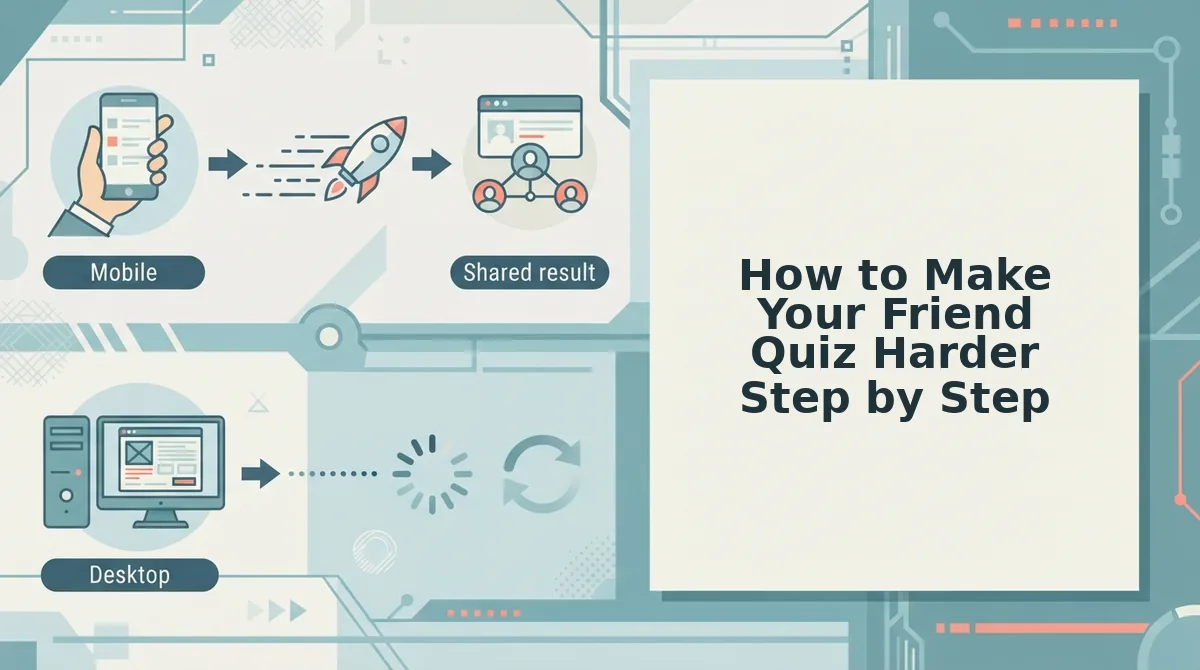
How to Make Your Friend Quiz Harder Step by Step
To make your friend quiz harder, rank each quirk by who could guess it, swap easy prompts for close-circle ones, and write believable decoys. Then cut anything nobody could know. Expect the whole process to take about 10 minutes before you share.
Before you start: you need your name, a phone or laptop with a browser, and a rough list of your habits. You don't need an account or an app.
Everyone scores 100 on a friend quiz for two reasons that work together. The first is obvious quirks. Questions like your favorite food or color are things anyone who follows you already knows. The second is weak decoys. When the wrong options are absurd or plainly don't fit you, friends can eliminate them without knowing the real answer. Process of elimination does the work that memory should do. The fix is to raise the difficulty of the question and the believability of the wrong answers at the same time. Hard questions with silly options are still easy, and easy questions with clever options are still guessable.
- Rank every quirk on the Guessability Ladder (about 3 minutes). Label each item on your list with one of four rungs. When you're done, every quirk should have a label.
Rung Who could guess it Example quirk type Public Anyone who follows you Favorite food, favorite color Circle Close friends Morning routine, go-to snack Deep Cut One or two people A childhood ritual you still keep Unguessable Nobody, so cut it A secret thought you've never shared - Swap Public prompts for Circle and Deep Cut prompts (about 3 minutes). Replace most Public items so your mix leans toward Circle and Deep Cut. For example, swap "What's my favorite food?" for "What do I always order when we eat out late?" Success looks like a list with only one or two Public warm-up questions left.
- Write Plausible Decoys (about 3 minutes). Every wrong option should come from one of two sources. It can be true of someone else in the chat, or true of you in another context, like your weekend habit instead of your weekday habit. You should be able to imagine a friend hesitating over each option.
Pro tip: Build each decoy from a real habit of another friend in the group chat. The wrong answer will feel familiar, so even close friends will second-guess themselves.
- Cut anything Unguessable (about 1 minute). Delete any quirk nobody could know, because it only produces random guessing. Your final list should be hard but fair.
When your list is ready, build your best friend quiz. Type your name, pick the prompts that match your Circle and Deep Cut quirks, and drop the instant link into WhatsApp or iMessage.
Next, see whether your changes worked by reading the scores.
How to Check Your Quiz Worked on the Friendboard
Your quiz worked if the Friendboard shows a clean Score Spread with one clear first place. A tie at the top means the quiz is too easy, while a board of zeros or near-zeros means it is too hard. Success means friends finish at different scores, not that nobody scores.
| Friendboard reading | What it means | Likely cause | Fix |
|---|---|---|---|
| Tie at the top | Too easy | Decoys are obviously wrong, or most quirks sit on the surface rung | Rewrite decoys so they sound true and add more Circle quirks |
| Clean spread, clear first place | It worked | A balanced mix of Ladder rungs with believable decoys | Keep the mix for your next quiz |
| All zeros or near-empty board | Too hard | Too many Deep Cut quirks nobody could know | Swap some Deep Cuts for Circle quirks |
Worked example: A creator checks the board after the first few friends answer and sees three of them tied at the top. For the next quiz, the creator replaces the coffee-order decoys with drinks the creator actually orders sometimes, so only close friends can pick the right one.
Can a friendship test be too hard? Yes. Unguessable answers flatten the Friendboard just as obvious ones do. When every quirk is a private Deep Cut, even your closest friend guesses at random, so scores cluster near zero and nobody earns bragging rights. A good test rewards attention, not luck. Aim for questions that someone who really pays attention to you could answer, and that a casual acquaintance would get wrong. If your best friend scores no better than a classmate, you cut too deep, and you should bring back Circle-level quirks.
The format matters too. A BFF test works best for one close friend who should ace it. A friendship dare quiz works best for group chats that want higher stakes. Choose your format, share the link, and watch the board fill.
Friendship Test Quirk Answers FAQ
These answers cover the questions creators ask most after their first quiz goes out.
Why does everyone get 100 on my friend quiz?
Everyone scores 100 because your decoys are too easy to rule out. If the wrong options sound nothing like you, friends spot the right answer by elimination. Rewrite each decoy so it sounds believable, ideally something you almost do.
How do I keep quirk answers fun and not embarrassing?
Skip any quirk that would embarrass you or another friend if someone screenshotted it. Quiz links travel through group chats, so choose harmless habits and preferences that you would gladly share in public.
How many quirk questions should a friendship test have?
Use a mix across the Ladder rungs rather than a fixed number. No data points to a single ideal count. Lean toward Circle and Deep Cut questions, and keep a few easy ones so new friends still score.
Should I use inside jokes as answers?
Yes, but use them sparingly. Inside jokes count as Deep Cut prompts. They reward your oldest friends, but they shut out newer ones who were not there, which can flatten the bottom of the Friendboard.
Pick Your Quirks and Drop the Link
A hard friendship test is not one that stumps everyone. It is one that sorts your friends, so the spread on the board shows who really pays attention.
- Rank your quirks on the Ladder before you write anything.
- Weight the mix toward Circle and Deep Cut quirks, and keep a few easy ones.
- Write decoys that sound true so friends cannot win by elimination.
- Read the Score Spread and adjust your next quiz based on what it shows.
Your next step is simple: make a friend quiz by entering your name, answering the prompts, and sharing the link. You need no account and no app download. Then let the Friendboard settle who knows you best.