Friendship Loyalty Test Format Options for Close Peer Circles
Your WhatsApp group chat has stalled, and recycled memes are no longer generating replies. You know standard trivia about favorite colors fails to capture genuine social backing, so choosing the right friendship loyalty test format is essential for sparking real interaction.
You will discover how structured social dilemma questions cut through superficial recall to measure authentic circle alignment without creating unnecessary group tension. This guide maps out setup options for close peer circles, though its scope centers strictly on casual group banter rather than psychological relationship counseling.
Can a simple digital challenge really separate dependable confidants from casual lurkers? Later, we reveal why specific daily habit prompts often outperform direct trust inquiries when measuring peer engagement.
Consider how a rapid group activation operates:
- Situation: An iMessage thread goes dormant after weekend plans fall through.
- Action: The organizer creates an interactive friendship test by entering their name, setting daily habit prompts, and pasting the web link into the thread.
- Outcome: Circle members complete the challenge on mobile browsers without downloading an app or creating profiles, logging instant scores on a shared board.
Building an instant, zero-login challenge lets you measure peer attention while keeping participation completely seamless. Examining specific question mechanics reveals what sets loyalty prompts apart from standard trivia.
What Distinguishes a Loyalty Test Format from Standard Trivia?
A loyalty test format evaluates situational fidelity and social defense under pressure rather than measuring rote biographical memory. Most social quizzes treat friendship as an encyclopedia of static trivia, but genuine loyalty formats assess how peers respond to ethical friction, reputation defense, and confidentiality.
A loyalty test is an interactive challenge format designed to assess interpersonal commitment through hypothetical moral dilemmas and social scenarios rather than recallable trivia.
Situational fidelity represents the active willingness to prioritize a peer's emotional safety over social convenience, whereas rote biographical memory merely reflects passive data retention. In group chat dynamics, knowing someone's birthday or coffee preference indicates historical exposure, but it does not predict whether that person will defend a reputation when absent or keep sensitive disclosures secure. A loyalty test isolates interpersonal commitment by replacing fact-checking prompts with behavioral reaction scenarios. By framing questions around real-world alliances and confidentiality, the format measures proactive social alignment instead of superficial familiarity.
Think of standard trivia like an inventory checklist verifying that goods arrived on time, whereas a loyalty challenge functions as a structural stress test measuring load capacity in high wind.
The Devotion vs Recall Framework categorizes peer assessment into three distinct operational tiers:
- Level 1: Biographical Recall (Static Trivia). Evaluates retrospective data points such as pet names, favorite foods, and personal routines.
- Level 2: Boundary Recognition (Situational Awareness). Evaluates how well a peer navigates your pet peeves, sensitive topics, and emotional limits.
- Level 3: Situational Fidelity (Active Devotion). Evaluates defensive allegiance, such as taking your side in group tension or maintaining confidentiality under social pressure.
Progressing from recall to loyalty transforms a casual quiz into an active group diagnostic. When questions present high-stakes behavioral choices, friends must weigh mutual respect against peer pressure, revealing who offers active solidarity versus passive observation.
Most peer circles rely on a standard best friend quiz to spark lighthearted chat banter, but layering fidelity questions exposes where relational boundaries actually lie. Creators can test these dynamics on Friend Quiz by sequencing both personal quirks and allegiance prompts into a custom challenge link in under two minutes without requiring account logins.
Deploying these prompts effectively depends on how different social networks handle link previews and user interaction.
How Digital Loyalty Test Formats Compare Across Messaging Platforms
Which loyalty test format delivers authentic peer validation without breaking group chat momentum? Digital friendship loyalty test formats compare across three primary mechanisms: manual copy-paste chat chains, ephemeral social story stickers, and web-based interactive links, each presenting distinct trade-offs between setup friction, answer privacy, and response drop-off. While direct messaging threads protect intimacy, social stories maximize visibility at the expense of genuine scoring accuracy.
A loyalty test format is a structured social challenge designed to evaluate interpersonal trust, responsiveness, and peer alignment through digital prompts. On mobile video channels, the Kabir k viral loyalty test dynamics demonstrate that viewers gravitate toward unscripted, high-stakes peer confrontations. In actual friend circles, however, testing devotion rarely requires staged video drama.
Instead, peer groups rely on three everyday testing vehicles across messaging ecosystems.
| Format | Setup Friction | Recipient Effort | Answer Privacy | Best Persona |
|---|---|---|---|---|
| Copy-Paste Text Chains | Low (Manual drafting) | High (Manual typing) | High (Direct chat only) | Best for tight two-person bonds sharing intimate history |
| Social Story Stickers | Low (Pre-made templates) | Low (Tap to react) | Low (Public or follower-facing) | Best for social butterflies seeking broad peer engagement |
| Web-Based Instant Links | Very Low (Browser-based setup) | Lowest (Single-tap answers) | Controlled (Score-based friendboards) | Best for fast-paced group chats driven by friendly competition |
Why do so many shared challenges stall halfway through a circle?
Friction kills participation. Native text chains on WhatsApp or iMessage keep conversations intimate, but asking friends to manually type out answers to ten hypothetical questions causes steep response drop-off. Meanwhile, Instagram and Snapchat story stickers yield fast taps, yet broadcast personal relationship dynamics to entire follower lists rather than close friends.
Choose your format based on group size and intent:
- Choose text chains if you are testing a single best friend on sensitive topics that require deep, nuanced explanations.
- Choose social stickers if your objective is casual entertainment across your extended social network.
- Choose interactive web links if you want immediate participation across a group chat without demanding app installations.
Our recommendation for active group chats is an interactive friendship dare quiz hosted on an instant mobile web link. Browser-based links eliminate the barrier of account creation, allow immediate answer tapping, and prevent the drop-off typical of long text threads.
Structuring those specific scenarios requires an intentional framework that tests loyalty without alienating your circle.
Copy and Paste Scenarios Built on the 3-Tier Dilemma Engine
The 3-Tier Dilemma Engine is a structured testing framework that evaluates friendship loyalty through escalating stakes of personal priority, public social defense, and absolute confidentiality. Moving beyond superficial trivia questions, this system forces peers to choose between competing social obligations to uncover genuine commitment levels.
Direct behavioral trade-offs reveal peer alignment faster than generic preference trivia because high-friction choices force clear prioritization. Would your circle protect your privacy, burn personal time, or speak out when you are not in the room?
- The Unfiltered Vault Scenario: This prompt tests Tier 3 Confidentiality by asking what a friend does when an ex-partner probes for sensitive personal records. It matters because true loyalty demands guarding private data even under persistent external pressure. To use it, present the scenario as a multiple-choice question where the benchmark response is an immediate refusal and rapid alert to you.
- The 3 AM Crisis Decision: This prompt tests Tier 1 Priority by assessing whether a peer answers an unexpected distress call during a demanding work night. It matters because urgent availability signals active mutual support during critical emergencies. To use it, frame the situation around sacrificing sleep to provide immediate transport or crisis assistance without hesitation.
- The Third-Party Gossip Defense: This prompt tests Tier 2 Social Defense by measuring how a contact reacts when an acquaintance mocks your character in your absence. It matters because peer loyalty requires active public intervention rather than comfortable neutrality. To use it, configure options ranging from passive listening to vocal confrontation, establishing direct boundary-setting as the correct answer.
- The Irreversible Calendar Sacrifice: This prompt tests Tier 1 Priority by evaluating whether a friend cancels non-refundable plans to attend your landmark milestone. It matters because deliberate time allocation demonstrates peer ranking far better than verbal affirmations. To use it, structure a prompt requiring peers to pick between non-refundable event tickets and attending your urgent celebration.
- The Uncomfortable Truth Challenge: This prompt tests Tier 3 Confidentiality and interpersonal trust by determining whether a peer risks an argument to prevent you from making a destructive mistake. It matters because true allies prioritize long-term protection over short-term social ease. To use it, force a choice between polite flattery and direct confrontation regarding a critical misstep.
- The Public Reputation Shield: This prompt tests Tier 2 Social Defense by checking if a friend absorbs social awkwardness to dispute rumors spreading through a mutual circle. It matters because risking one's own standing separates fair-weather contacts from devoted allies. To use it, require the participant to commit to formally debunking misinformation on the spot rather than changing the topic.
- The Competing Allegiance Audit: This prompt tests Tier 2 Social Defense during cross-group conflict by measuring whether a peer mediates or upholds your mutual alliance. It matters because peer groups inevitably encounter rivalries where indecision damages trust. To use it, frame an explicit social dispute that requires choosing your alliance over passive fence-sitting.
In a real-world test, a creator sets up these situational habit and loyalty prompts on Friend Quiz in under two minutes by simply entering their name and selecting their core preferences. The creator shares the generated link directly into an active iMessage group chat. Group members tap the URL, make their selections instantly on mobile web without account registrations or app downloads, and the real-time friendboard reveals who held the line.
You can turn these high-stakes loyalty prompts into an interactive challenge on Friend Quiz without forcing your friends through app downloads or registration barriers. Executing these prompts effectively requires a smooth release strategy inside your messaging channels.
How to Run a Live Loyalty Challenge in Your Group Chat Step by Step
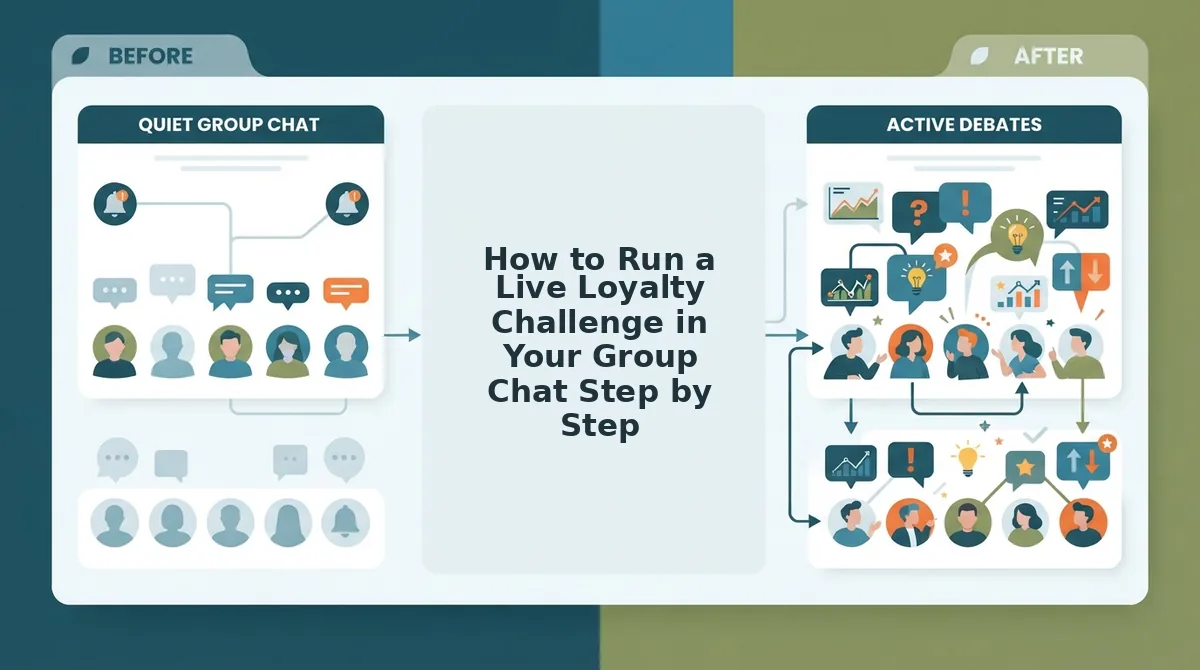
To run a live loyalty challenge in a group chat, create a web challenge link, broadcast it to your chat thread, let members submit unassisted answers, and evaluate the final score rankings on a shared leaderboard. Completing the entire setup takes under two minutes because participants play immediately without downloading an app or registering an account.
Before beginning, ensure you have an active mobile web browser and a group thread on WhatsApp, iMessage, or Snapchat. A Friendboard is a real-time digital leaderboard that automatically logs and scores each player as they finish a challenge.
Deploying interactive peer testing challenges requires a four-step execution cycle:
- Configure your personal prompts: Open the Friend Quiz homepage, type your display name into the designated field, and select your answers across the sequential personal habit and loyalty scenarios. You should see an instant confirmation screen displaying your custom challenge link. Time: 90 seconds.
- Distribute the single challenge URL: Tap the copy link button and paste the URL directly into your group chat alongside a brief rule notice, such as giving everyone ten minutes to respond. You should see the messaging app populate the live link preview card in the chat window. Time: 15 seconds.
- Collect blind responses: Allow friends to open the link on their mobile devices and make their selections sequentially without seeing prior submissions. You should see participant entries register automatically in the background without any manual data entry. Time: 3 to 5 minutes.
- Review live Friendboard standings: Open your administrative view to check the score tallies, identify who scored highest, and take a screenshot of the final leaderboard to paste back into the group chat. You should see the completed list sorted from highest accuracy to lowest. Time: 30 seconds.
What happens when the scores drop?
Sharing your live friendship quiz results immediately triggers group chat banter. When a self-proclaimed best friend scores 35% by guessing the wrong emergency contact while a quiet mutual friend scores 90%, the chat naturally shifts into humorous call-outs, screenshot receipts, and playful demands for rematches.
Managing this competitive energy requires establishing clear boundaries so the teasing remains lighthearted.
How to Keep Friendship Loyalty Tests Fun Without Crossing into Toxicity
A friendship loyalty test stays fun only when it operates as an open, opt-in activity where every participant understands the prompts and views the outcomes. The definitive line between healthy group entertainment and toxic behavior rests on mutual transparency, public scoring, and the complete elimination of covert entrapment.
The Guardrail Boundary Rule is an operating standard that distinguishes transparent, consensual peer trivia challenges from covert loyalty traps designed to interrogate relationships. While internet culture often frames loyalty testing as a dramatic trial of devotion, secret relationship trials invariably backfire by introducing manufactured suspicion into peer groups.
Think of a healthy friendship challenge like a tabletop board game where every player sits at the same table, views the pieces, and rolls the dice in plain sight. A toxic loyalty test operates like planting hidden microphones across the room to record whether someone slips up.
Healthy friendship testing is a shared social activity where peers willingly answer trivia about personal habits to spark conversation and lighthearted rivalry. Under the Guardrail Boundary Rule, players engage with open mechanics where everyone accesses the same prompts simultaneously, scores appear publicly on shared friendboards, and outcomes celebrate shared history. In contrast, manipulative relationship testing weaponizes secret criteria or deceptive setups to extract behavioral proof. Safe challenges prioritize transparency, immediate results, and group chat entertainment over surveillance, ensuring peer circles build rapport rather than resentment.
Observable group dynamics reveal distinct structural boundaries between healthy social banter and harmful relationship surveillance:
- Healthy peer banter: Public group chat links, standardized multiple-choice prompts, voluntary participation, instant friendboard rankings, and zero social penalties for incorrect guesses.
- Manipulative relationship testing: Asymmetrical information, covert scorekeeping, emotional ultimatums, and weaponizing missed answers during interpersonal conflict.
Maintaining visible, equal ground transforms the challenge into a catalyst for connection rather than suspicion. Navigating these ethical boundaries often raises practical questions regarding format fairness, data privacy, and specific game mechanics.
Frequently Asked Questions About Friendship Loyalty Test Formats
Can digital challenges gauge interpersonal trust without creating friction? Friendship loyalty test formats evaluate peer devotion through scenario scoring, browser links, and real-time scoreboards.
What is a friendship loyalty test format?
A friendship loyalty test format is a structured situational challenge that measures peer reliability, discretion, and mutual support. Unlike standard trivia testing facts like favorite foods, loyalty formats introduce hypothetical dilemmas that highlight how friends back each other up during moments of social pressure.
How do I create a loyalty test without app installs?
You can create a loyalty challenge through web-based quiz tools in any mobile browser. Type your display name, configure personal scenario prompts, and drop the generated URL into messaging chats like WhatsApp or iMessage so peers can participate immediately without profile creation or verification hurdles.
What makes a mobile loyalty test format effective?
Effective mobile loyalty formats rely on frictionless mechanics that maximize group chat engagement across iOS and Android devices:
- Zero-account creation requiring only a fast display name
- Instant browser execution without app downloads or updates
- Real-time scoreboards displaying peer rankings immediately after completion
Why do some friendship loyalty tests cause chat conflict?
Loyalty tests spark conflict when creators use low scores to enforce social hierarchies or broadcast private grievances. Challenges stay constructive when prompts focus on playful hypothetical dilemmas rather than rigid scoring criteria, forced compliance, or guilt-inducing ultimatums that question personal integrity.
How do you know if a loyalty test is unhealthy?
A loyalty test becomes unhealthy when poor results lead to social exclusion, passive-aggressive confrontation, or real-life penalties. Healthy tests encourage banter and shared laughter, whereas toxic challenges pressure participants to share private secrets or prove devotion under emotional duress.
Choosing the right scenario structure sets the baseline before discovering where your friends stand.
Put Your Peer Circle Allegiance to the Test
Putting your peer circle allegiance to the test requires swapping predictable biographical facts for situational dilemma prompts that measure active solidarity under social pressure.
Picture dropping a dynamic challenge link into your quietest group chat on a Friday afternoon and watching notifications detonate as everyone battles for first place. That rapid engagement resolves what simple trivia tests fail to capture: true social allegiance is demonstrated by how friends advocate for you during awkward choices, not whether they memorized your favorite fast food.
- Recall tracks data, devotion measures action: Remembering favorite bands reflects passive memory, but loyalty scenarios test who has your back when reputations are on the line.
- Binary choices spotlight peer alignment: Forcing peers to navigate conflicting loyalties reveals whether they shield your secrets or fold under pressure.
- Playful competition preserves group harmony: Framing dilemma tests around competitive banter lets close circles test boundaries without breeding toxic hostility.
Take immediate action by entering your name on Friend Quiz, selecting your challenge prompts in under two minutes, and dropping your custom URL straight into WhatsApp, iMessage, or Snapchat without forcing anyone to install an app. A casual friend can easily recall your surface habits, but genuine loyalty proves itself the moment an interactive dilemma asks them to take a stand.