Friendboard vs Global Leaderboard Engagement

Drop a generic trivia link into a silent WhatsApp group, and friends will ignore it when their score lands them at rank 45,000 against millions of strangers. Analyzing friendboard vs global leaderboard engagement reveals that players abandon massive public scoreboards because competing against anonymous accounts creates an unattainable status cliff. Shared spaces reignite instantly when the leaderboard narrows the stakes entirely to personal relationships.
You already know the frustration of watching group chat banter flatline while casual players ignore apps that require tedious account logins. This guide breaks down why private social ranks outperform public ladders in driving recurring clicks, and outlines how to trigger natural peer rivalry across mobile messaging threads. Later, we reveal the specific mechanics that cause public ranks to collapse active participation.
Consider this standard loop:
- The situation: A messaging thread goes quiet for days with zero incoming activity.
- The action: A creator builds a custom challenge using a zero-friction friend quiz maker and drops the generated challenge link into the chat without requiring any app installs.
- The outcome: Friends submit answers about the creator's personal habits, generating instant scores on a shared Friendboard that triggers direct responses and active debate.
This dynamic operates specifically within close personal groups, rather than open competitive gaming ecosystems. To understand why closed circles trigger this reaction, examine the direct metrics behind localized scoreboards.
Evaluation Criteria: How Localized and Global Ranks Compare
Localized ranks measure intimacy within private circles, while global leaderboards prioritize mass competitive volume across broad public populations. Bigger scoreboards do not produce bigger engagement because massive scale dilutes emotional stakes and delays active feedback loops.
A Friendboard is a zero-friction, private ranking display generated for an individual creator and their direct social contacts. Unlike public boards, private scoreboards prioritize personal context over sheer participant volume, creating an immediate reach versus relevance tradeoff in digital gamification mechanics.
| Evaluation Metric | Localized Friendboards | Global Leaderboards |
|---|---|---|
| Audience Reach | Bounded strictly to direct contacts and shared group chat links. | Mass, open-network reach spanning hundreds of thousands of strangers. |
| Social Relevance | Extremely high; every score attaches to an identifiable peer. | Low; scores are populated by anonymous handles and disconnected usernames. |
| Response Velocity | Near-instant submission speeds powered by active group chat notifications. | Slower engagement cycles dependent on periodic public resets and discoverability feeds. |
| Access Friction | Zero logins, no account creation, and immediate browser playback. | Frequently requires profile authentication, account setups, or app installations. |
Global architectures offer undeniable advantages for universal discovery. Public platforms excel at aggregating demographic data, running massive public tournaments, and showing players where their skills sit across an entire digital ecosystem.
Does high visibility actually compel someone to complete a challenge?
Decision Framework: Choosing the Right Ranking Architecture
- Choose Localized Friendboards if your primary goal is igniting immediate social banter, settling personal rivalries, or driving completion rates through peer accountability.
- Choose Global Leaderboards if you are managing multi-tiered esports brackets, long-term public gaming ladders, or competitive ecosystems where users seek status against strangers.
Best for Group Chat Instigators: Localized Friendboards, such as those generated through a Friendship Dare, because they turn trivial social questions into immediate, zero-friction banter without sign-up barriers.
Best for Public Competitors: Global leaderboards, because dedicated gamers benefit from verifiable rank sorting across massive, worldwide player bases.
Our Recommendation: We favor localized scoring over global displays whenever retention relies on relationships. When personal stakes vanish into a wall of ten thousand anonymous usernames, competitive motivation evaporates.
Examining the mechanics of worldwide score distribution reveals why broad distribution networks struggle to maintain continuous peer participation.
The Global Leaderboard Option: High Reach with Diminishing Returns
A global leaderboard aggregates all participant outcomes across an entire platform into a unified public ranking system to incentivize competition at scale. While this architecture maximizes broad visibility, it reliably causes participant drop-off when the point thresholds for top ranks become inaccessible to normal users.
A global leaderboard is an open ranking database that calculates and displays the standings of every participant platform-wide. These systems ingest raw score events across the entire user base, run background sorting queries, and publish a persistent rank ladder that resets on designated seasonal or continuous intervals. Because every user shares the identical ladder, casual participants instantly compete against power users who optimize for the absolute upper limit of the scoring system.
Think of a global leaderboard like running a local 5K road race where your finish time is placed directly against Olympic marathon runners on an international roster. When everyday participants realize their maximum effort yields a placement at rank fifty thousand, the incentive to complete another run disappears entirely.
Why would any casual user keep playing when rank number one holds an unreachable score built by power users?
The operational mechanics of these open systems break down under two distinct pressures:
- The unattainable status gap: The psychological drop-off caused by the unattainable status gap occurs the moment a casual participant concludes that no amount of typical play can bridge the mathematical distance to the top tier.
- Algorithmic notification reliance: To offset this loss of natural motivation, platforms must rely on continuous algorithmic push notifications, pinging disengaged users with synthetic updates just to artificially maintain daily activity.
A score ceiling dominated by extreme edge cases alienates regular participants while exclusively serving the narrow fraction of competitive players at the absolute peak. Overcoming this disconnection requires shifting the competitive context away from strangers and directly into close social relationships.
The Friendboard Option: Leveraging Relative Social Rank and Peer Banter
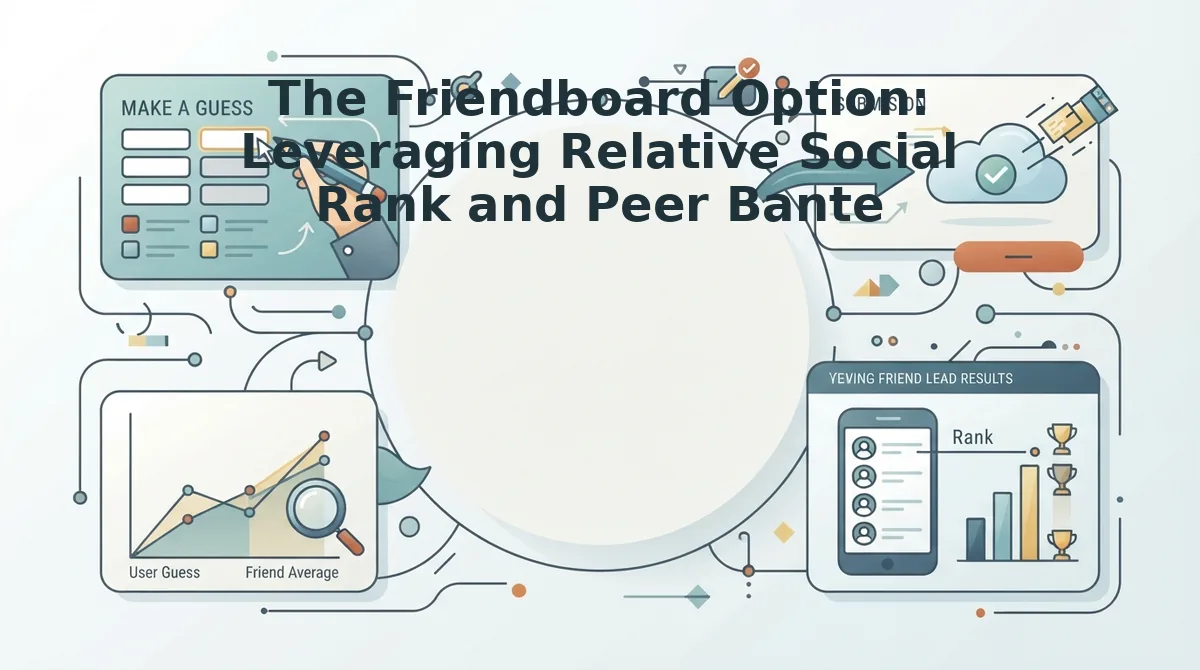
A Friendboard leverages closed-network score tracking to drive immediate social banter by ranking participants against their actual friends rather than anonymous global players. Relative social rank outscores absolute global prestige for everyday retention because people care far more about beating their inner circle than outscoring strangers on the internet.
A Friendboard is a private, real-time leaderboard that displays trivia scores and rankings exclusively among participants who share a creator's custom link. Think of a Friendboard like a refrigerator door tally in a shared apartment rather than a worldwide marathon board. When you see your name rise above a roommate's, the stakes feel personal, immediate, and impossible to ignore.
Micro-circles of 5 to 15 participants produce optimal peer pressure without visual clutter. Within this narrow window, every shift in rank creates visible consequences for the group dynamic.
Consider this workflow inside a daily group chat:
- The situation: A quiz creator shares a fresh challenge link into an ongoing group thread to settle a debate over who knows their personal habits best.
- The action: A close friend completes the custom trivia challenge without an app download or account login, immediately claiming the second-place slot on the live scoreboard.
- The outcome: Moving from rank 4 to rank 2 among your four closest friends triggers an immediate reply in iMessage, instantly igniting peer rivalry and prompting the remaining members to play.
When competition stays localized, social velocity accelerates. Creating a customized bff quiz lets you launch an instant challenge, settle friendly rivalries, and track bragging rights on a live scoreboard without forcing anyone through an app store download. By keeping the player pool tight and relevant, closed leaderboards convert passive scrolling into active group conversation.
Evaluating how these localized circles perform across broader performance metrics reveals distinct operational advantages.
Core Metrics Compared: Retention, Friction, and Social Velocity
Closed, peer-level Friendboards significantly outperform open global leaderboards in click-through rates, challenge completion, and viral loop coefficients because they eliminate onboarding barriers and rely on personal accountability rather than abstract global standing.
Social velocity measures how rapidly an interactive challenge spreads across direct peer-to-peer networks through organic player invitations. While global leaderboards excel at capturing aggregate multi-region play counts, zero-friction browser links turn every quiz taker into an immediate distribution hub inside messaging apps.
The friction profile determines whether participants actually finish the challenge or drop off before viewing results.
| Performance Dimension | Walled-Garden Friend Rosters (App-Based) | Zero-Login Friendboards (Browser-Based) | Open Global Leaderboards (Platform-Wide) |
|---|---|---|---|
| Onboarding Friction | High (app download, account registration, permissions) | Zero (instant web access, name-only entry) | Medium (guest mode or centralized account) |
| Link-to-Start Completion | Sub-30% due to cross-app redirection loss | High (single-screen entry into trivia sequence) | Moderate (public queues and lobby wait times) |
| Viral Loop Coefficient (K-Factor) | Low (requires reciprocal app installs) | High (direct share link pasted back into group chats) | Low (individual play with no closed loop) |
| Chat Reactivation Velocity | Low (requires external system push notifications) | High (direct screenshot and link banter in threads) | Negligible (global rank lacks personal context) |
Consider your core channel dynamic when choosing an architecture.
Choose an app-based global leaderboard if you run an established gaming ecosystem where persistent profiles, cloud cross-saves, and cross-title rankings matter more than quick shareability across group chats. Choose a zero-login Friendboard if your primary acquisition channels are iMessage, WhatsApp, and Snapchat threads where conversion speed is your top operational priority.
Best for competitive platforms: Global open leaderboards, which provide macro-level benchmarks for solitary grinders seeking absolute world rank.
Best for group chat instigators: Lightweight Friendboards, which settle immediate rivalries on real-time live player rankings without gatekeeping participants behind sign-up forms.
Our recommendation centers on frictionless social loops: if social banter drives your activation strategy, mandatory account creation destroys sharing momentum before the second player can take the first prompt. Group dynamics thrive on immediate visibility, not identity verification.
Yet stripping away persistent player accounts and identity checks introduces its own structural compromises.
Where Friendboards Fall Short: Real Architectural Limitations
Friendboards fall short because their engagement depends entirely on manual peer distribution, meaning the ranking mechanism dies instantly without active social groups driving continuous submissions. A friendboard is a closed-loop leaderboard that tracks scores strictly within an individual's private social circle rather than aggregating a global player base. When peer distribution stops, a friendboard has zero organic fallback activity.
What happens when the group chat goes silent? The scoreboard freezes completely.
- Distribution dependency requires active human sharing across private messaging channels to generate any initial traffic. Without a creator pasting a link into a lively chat thread, zero participants enter the funnel. To mitigate this drop-off, pin your challenge link directly to the group chat description rather than letting it get buried in conversation history.
- Small sample size sensitivity creates fragile competition loops where a single inactive participant stalls the rivalry loop entirely. In an intimate circle of five people, one unresponsive friend cuts engagement volume by a massive margin and halts rank movement. Counteract this bottleneck by dropping direct mention nudges inside active group threads to prompt the missing responses.
- Absence of global benchmark data leaves participants isolated without any baseline to compare their results against the wider world. Players can easily identify who won the inner circle, but they never discover how their score ranks against thousands of outside participants. Supplement this limitation by sharing finished score cards across public social feeds to test scores against extended peer networks.
- Terminal lifespan dynamics cause peer-to-peer leaderboards to exhaust their replay value the moment every circle member completes their attempt. Unlike global systems that constantly update with new contenders, closed boards hit a hard ceiling once everyone submits their answers. Refresh stale dynamics by rotating who creates the initial challenge prompt across alternating group members.
- Asymmetric relationship tension introduces social anxiety when visible score disparities expose who knows the creator best. Low rankings on a transparent board can trigger uncomfortable private drama rather than lighthearted competitive banter. Prevent negative friction by framing every challenge explicitly around absurd habits, personal quirks, and lighthearted trivia.
Navigating these constraints requires an execution strategy tailored directly to the communication rhythms of your everyday channels.
How to Deploy a Zero-Friction Friendboard in Your Group Chat
To deploy a zero-friction Friendboard, open the mobile web application, enter your name, answer personal trivia prompts about your habits, and copy the generated challenge link directly into your group chat. The setup requires no app installation or account registration, enabling your social circle to compete on a real-time leaderboard within minutes.
A Friendboard is a browser-based, live scoring board that ranks social contacts based on how accurately they answer custom personal trivia challenges. Eliminating mandatory account creation removes drop-off barriers before participants submit their guesses.
Prerequisites: A mobile web browser and an active group chat on platforms like WhatsApp, iMessage, or Snapchat.
- Open the quiz creator on the site homepage (estimated time: 5 seconds). Type your display name into the designated field. Expected outcome: The personal trivia selection screen loads instantly without asking for an email address or password.
- Select your personal preferences and quirks by clicking through the trivia prompt sequence (estimated time: 45 seconds). Customize answers covering your daily routines, likes, and dislikes. Expected outcome: The platform compiles your inputs into a unique, hosted best friend quiz challenge.
- Click the copy link button on the confirmation screen (estimated time: 5 seconds). Expected outcome: A direct URL copies to your clipboard alongside an automated invitation preview ready for messaging apps.
- Paste the challenge link directly into your target group chat (estimated time: 10 seconds). Expected outcome: Friends click the link, submit their guesses in their own mobile browsers, and register instant scores.
- Inspect your live Friendboard by opening the quiz link in your browser (estimated time: 5 seconds). Expected outcome: You view real-time rankings and point totals updating automatically as friends finish their attempts, without logging into an administrative dashboard.
Picture this scenario: an afternoon group chat sits idle with zero messages for hours. A creator types their name on the site homepage, cycles through trivia prompts about their quirks in 45 seconds, and pastes the resulting web challenge into the chat. Within 90 seconds, multiple friends open the browser link, submit their answers without signing up, and ignite an immediate score debate as the real-time leaderboard reshuffles their ranks.
Reviewing the underlying ranking mechanics addresses common questions regarding local and global competition structures.

Frequently Asked Questions About Leaderboard Dynamics
Leaderboard dynamics dictate whether participants stay engaged or drop out after their initial attempt. What happens to casual players when competitive boards get overwhelmed by power users? They disconnect entirely when top scores become unattainable, which is why social context transforms basic ranking systems.
What is the ideal group size for a peer leaderboard?
The optimal micro-circle threshold is 5 to 15 participants for peer scoreboards. Groups within this range maintain immediate social accountability and visible rank mobility. Exceeding 15 people dilutes personal rivalry, while falling below five reduces the competitive pressure necessary to trigger organic group chat banter.
Why do global leaderboards reduce casual player engagement?
Global leaderboards reduce casual player engagement by introducing extreme score gaps caused by power users and automated bots. When ordinary users realize the top percentile requires unattainable scores, rank achievement feels impossible. This dynamic destroys motivation and prompts casual participants to abandon the experience entirely.
How do hybrid leaderboard models balance competition?
Hybrid leaderboard models balance competition by pairing macro global tiers with localized friend sub-divisions. While the global tier satisfies elite players seeking world rankings, localized brackets keep everyday social circles competitive. This structure lets casual participants fight for bragging rights among peers without competing against platform-wide outliers.
Why does relative rank matter more than absolute score?
Relative rank matters more because social standing among known peers drives stronger psychological engagement than raw point totals. Outscoring a close friend creates instant conversational currency and personal rivalry. An isolated score number lacks meaning without the direct context of who you beat.
Understanding these engagement mechanics reveals the definitive balance between global prestige and peer-to-peer competition.
Final Verdict on Social Circles and Group Rivalry
Micro-social rivalries consistently outperform macro-scale rankings because immediate peer recognition beats abstract global prestige across casual mobile audiences. When given the choice, no one truly cares about being player #48,201 on an anonymous server when they can claim the undisputed crown inside their own group chat.
Here is the reality of modern engagement:
- Global scores generate passive observation; localized scores generate immediate retaliation.
- The psychological payoff of a shared inside joke outlasts any fleeting milestone on a universal dashboard.
To settle your circle's bragging rights right now, type your name on the homepage, select your personal trivia answers, and drop your generated challenge link directly into your favorite group chat. In seconds, you will transform passive scroll time into active, real-time banter on a live Friendboard without forcing anyone to download an app or create an account.
Social engagement thrives on intimate friction, proving that dominance within your trusted inner circle will always deliver higher psychological value than anonymity on a global stage.